Eaton Air Conditioner Disconnects

Well, I can say there are more than one 60 amp pullout on a water heater. I'll do some VD and thermal scans tomorrow., after I've slept well.
I been installing 60 amp pullouts for water heaters for almost 40 years. Seldom had any problems with those. I almost always used Midwest version, don't know if it is any better than the Eaton ones that were the topic of the thread or not.
 
Well they certainly don't have sufficient room for 4 AWG conductors which would be necessary if your minimum ampacity is over 55 amps @ 60C and really are not all that practical to use even with 6 AWG conductors in many cases.
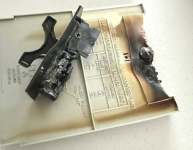
IDK I have seen a melted one that I think was marked for even 3 AWG like this one;
 

Attachments

  • disco-m.png
    disco-m.png
    679.3 KB · Views: 9
Just replaced a bad pullout disconnect, it was being used for a heated press not HVAC, and came here to see if its a common problem I guess it is. It was pretty old probably 60C terminations, I replaced it like for like before i saw this thread, I guess I need to go back and put in a knife switch. Kinda weird 30 amps is not 30 amps unless..
 
If it can't handle 60 amps continuous, it shouldn't be listed for 60 amps. Period. If they want those cheap pieces of junk for HVAC condensers only, they should be listed in tonnage, not amperage. I don't use them for other than HVAC loads, but I don't blame someone else for doing it. It says 30 or 60 amp right on the box.

30 and 50 amp receptacles are the same. Don't make it and say it can handle the load when it can't. I've replaced a pile of 250v 30a receptacles feeding turbo chef convection ovens. They should handle it, but can't, so they now get replaced with hubbell spec grade. The manufacturers and the UL are lying about what the device can do.

 
Who would think that when you buy a disconnect that it can actually carry the marked current rating. :mad:
Maybe the same incompetent testing agencies that approved 250 volt 50 amp receptacles that burnt up within a year or so and even caused fires.I never used that flimsy designed disconnect . Think about ten years ago usually very reliable Square D had a recall on outdoor 30 &/or 60 amp two pole disconnects.
 
Maybe the same incompetent testing agencies that approved 250 volt 50 amp receptacles that burnt up within a year or so and even caused fires.I never used that flimsy designed disconnect . Think about ten years ago usually very reliable Square D had a recall on outdoor 30 &/or 60 amp two pole disconnects.
If they had a recall it was because they knew they had a problem with a particular run of products and they either had a replacement or other field solution for the problem component or depending maybe even a complete replacement product.
 
Kinda weird 30 amps is not 30 amps unless..
I remember decades ago when companies, like Square D, made at least 4 different style non-fused 30A 2pole 240V disconnects for use outdoors.
Different items for different applications.

It still comes down to the UL testing standards.
 
It still comes down to the UL testing standards.
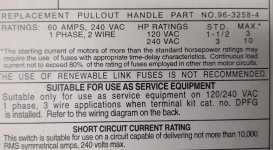
OK, but both UL 1429 "Pullout Switches" (which sends you to UL 98 for "hinged pullout switches") and UL 98 "Enclosed and Dead-Front Switches" require a heating test where the switch is tested at its full rated current until temperatures stabilize. For non-fused switches, the temperature rise of all current carrying parts, including terminals, is limited to 50C.

There is also an overload test in each standard requiring the switch to make and break 150% of its rated current at least 50 times.

So I'm not seeing why any listed pullout switch, properly installed and used, should fail for any application where the current is less than its rating, even if continuous. My guess would be that failures occur when the pullout element is not fully inserted into the switch, causing excess heating.

Cheers, Wayne
 
Methinks that poor contact pressure and area have a lot to do with it, pull-outs or receptacles.
 
Maybe I've been using better pullouts. 88 and 96 mV drop. Water heater.
That is saying continuous load current not to exceed 80% of the chosen fuse in other than motor circuits thats standard to all knife switches also right?
So a 30A disconnect should be able to carry 24 amps continuously.
The cheap all plastic 30A non-fuesd one I replaced the sticker was long gone, it did say 60C not vs 75/60C but that should not matter.
 
Allegedly, there have been fires involving these pullout units on resistive heating loads.
Has anyone experienced this ??
Yes I've seen these melt.
Installer error or not: terrible cheap disconnects really. And way too flimsy to really protect against curious fingers and hands who may pull them out.

You should know though I'm in the camp that feels the disconnects for EVs create more problems than they solve.
Unlike HVAC, EV chargers are serviced approximately never (give or take 20 years).
 
Top