Enforcing NEC at a University?

Status
Not open for further replies.
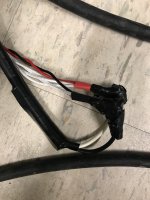
Sort of, a licensed electriction installed the receptacles 208v-3 phase. The students took it from there, this work was done inside of a lab in a University building, so the question is where do inspections end? I really don't know how to treat this.
If it is utilization equipment, it's not an inspection issue.
 
The code does not require all equipment to be listed.

I don't know what you mean by unguarded terminal blocks. Most terminal blocks these days are more or less finger safe and are inherently guarded because of that. It's probably true they should be in a box rather than bolted to the wall but that's a different issue.

As far as spliced wires laying on the floor, I suppose that's a trip hazard, but it doesn't seem to me to be any worse than unspliced wires laying on the floor. Presumably at some point the wires laying on the floor and get moved so they're not on the floor anymore.

If there are actual real issues of safety, perhaps you should approach the professor of this class in a very respectful manner and point them out. It seems to me you just want to complain about some unlicensed guy doing electrical work.

 
Unsafe conditions include:
*spliced wires laying on the floor-no enclosure
*open unguarded terminal blocks-line voltage
*unlisted/labled equipment
Sounds like "typical" school installation work that I'm aware of.

Sort of, a licensed electriction installed the receptacles 208v-3 phase. The students took it from there, this work was done inside of a lab in a University building, so the question is where do inspections end? I really don't know how to treat this.
If it's like NY, who is your AHJ that you are referring to. In NY the AHJ for schools and colleges is the Dept. of Ed.
 
I work in the building codes department, not an AHJ
I'd say if your department is asking you to police this, what I have done in the past is create a dated/written chain of documentation and responsibility. The electrician whom installed the 208 recept in the lab is responsible up to that receptacle. The head of that lab is responsible for whats in their lab.
I'd be much more concerned with installations that are intended to stay in place many years.
 
Most corporations or businesses have an electrical staff and someone with a license. When I worked at a community college and we wired a small cottage on campus that got auctioned off every year I just used my license. Not sure what they would do otherwise.
 
The code does not require all equipment to be listed.

I don't know what you mean by unguarded terminal blocks. Most terminal blocks these days are more or less finger safe and are inherently guarded because of that. It's probably true they should be in a box rather than bolted to the wall but that's a different issue.

As far as spliced wires laying on the floor, I suppose that's a trip hazard, but it doesn't seem to me to be any worse than unspliced wires laying on the floor. Presumably at some point the wires laying on the floor and get moved so they're not on the floor anymore.

If there are actual real issues of safety, perhaps you should approach the professor of this class in a very respectful manner and point them out. It seems to me you just want to complain about some unlicensed guy doing electrical work.
Since this issue is clear as mud, this is the best advice all things considered.

"If there are actual real issues of safety, perhaps you should approach the professor of this class in a very respectful manner and point them out."
 
I'd say if your department is asking you to police this, what I have done in the past is create a dated/written chain of documentation and responsibility. The electrician whom installed the 208 recept in the lab is responsible up to that receptacle. The head of that lab is responsible for whats in their lab.
I'd be much more concerned with installations that are intended to stay in place many years.
Tortuga, thank you, good advice.
 
What state are you in? In my state universities can pull whats a called 'master permits' and get an annual electrical inspection. They usually have a electrician or two on staff.
Same in my area. What is allowed for universities depends on the state electrical rules. On WA, only the federal gov is exempt from permits, inspections.
 
There was a university experiment here (over a decade ago) that went on for several years that involved heating up a remote hill side with 240V quartz heaters, the electrical contractor installed a huge pad mount transformer and some outdoor distribution all over the hill.
It was like a 1200 Amp MDP or something that fed 12 100A outdoor panels.
They used some very odd hi amperage solid state dimmers to control the quartz heaters, it was a huge install and I am pretty sure the dimmers for lack of a better word were custom PCB's and designed / installed by grad students.
What I remember about the dimmers is the same leg of several 240V circuits was all landed on one lug, essentially paralleling one side of the 240V circuits.
Also all the communications cable / monitoring was installed by grad students.
it was one of the strangest things I have ever seen to this day.
 
Status
Not open for further replies.
Top