

Extreme Temperature Data

So if you use one of the ASHRAE numbers, which is it?

The mean annual low temp (which would have a 50% annual historical chance of exceedance if the data is symmetrical about the mean), or the 5, 10, 20, or 50 year return period lows (with 20%, 10%, 5%, and 2% annual historical chance of exceedance, respectively)?

Cheers, Wayne
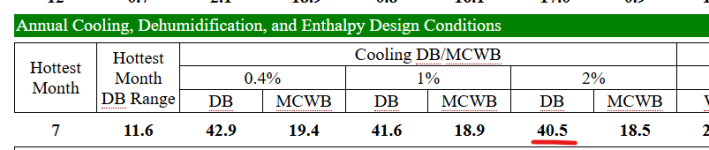
For the high temp I used the 2% DB temperature from the cooling data. If you want to be more conservative the 1% or 0.4% are good too. 1769005204489.png

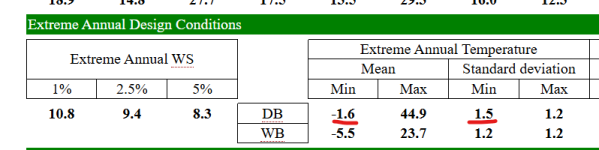
For the low temperature I used the Extreme Annual Temperature, Mean, Min DB minus one standard deviation. To be more conservative just subtract more standard deviations and that will reduce the chance that the site experiences a lower temp. But going past 2 SDs is really getting too conservative for me though.
1769005284491.png
 
As we can see in the replies here there are a lot of ways to slice up the ASHRAE data and there are other data sources than ASHRAE we have not even talked about. Plus temperature history does not guarantee future temperature performance. Someone could be ultra conservative and choose the lowest temperature in the data and next year the site might experience a new low temperature because that's how nature works. Choosing a reasonable temperature that is defendable by pointing toward industry standards is about all we can do. On our side is that most strings have a lot of overhead left for Voc to increase since the granularity of Voc when stringing modules together is poor.
 
P.S. My comments on the return period values and how to compute them are not correct. I dug up a second-hand reference to a formula from the ASHRAE document on how to compute them, which is to take the mean extreme annual low M, and subtract F times the standard deviation, where F is given by:

F = -sqrt(6)/pi * (0.5772 + ln(ln(1/(1-n)))
Typo in the above formula, it should be F = -sqrt(6)/pi * (0.5772 + ln(ln(n/(n-1)))) for an n year return period (1/n chance of exceedance each year)

For the high temp I used the 2% DB temperature from the cooling data.
OK, so based on the historical data, that gets exceeded about 175 hours each year, or about 7.3 days worth of the time.

For the low temperature I used the Extreme Annual Temperature, Mean, Min DB minus one standard deviation.
Then based on the corrected formula above, for historical data that's a 6.9 year return period value, meaning the chance of exceedance each year is 14.4%. ASHRAE already computes the 5, 10, 20, and 50 year return period values, just slightly to the right of what you last excerpted.

Of course, with global warming, the historical data likely underestimates how often the high temperature is exceeded and may overestimate how often the low temperature is exceeded (although that is less clear to me).

Cheers, Wayne
 
Last edited:
Of course, with global warming, the historical data likely underestimates how often the high temperature is exceeded and may overestimate how often the low temperature is exceeded (although that is less clear to me).
Global warming can also be contributory to new record short term low temperatures. We were warned a month or so ago about the current polar vortex incursion into the US by the observation of higher than normal temperatures in the stratosphere over the northern polar regions. Heat supplies energy that moves air masses around, and some of those air masses are cold.
 
Top