Floating Neutral

Merry Christmas
Status
Not open for further replies.
sparkygriffin said:
Now were getting somewhere. If you agree that one ground rod isn't going to be enough than his house was not meeting the NEC.
Nope, I 'm not saying one rod was not enough it may very well have been.

As far as being code compliant, the first rod may have had a resistance of 1000 ohms and adding a second rod would probably not have lowered the GE resistance much if anything at all but, we would still be code compliant.

The 25 ohm requirement is only for one rod, if that can not be met you add the second rod and your done even if the total resistance is 100,000 ohms.


sparkygriffin said:
So would you than agree that if it did he may not have expeireneced the problems he had?
No, odds are the second rod would not of changed anything.


sparkygriffin said:
That was my point go back and check. I always said he had to have a good grounding system, just like the PO.CO. said.
Let's assume there was a GES resistance of 25 ohms between the sevice rods and the pole base ground, (the earth being the conductor between the two) any unbalanced neutral current of over 4.8 amps would be a lost cause and we would be letting smoke out of many of the items inside the house.

sparkygriffin said:
And thank you for the warm welcome.
You're welcome.

Roger
 
sdv said:
And, what also concerns me is that the meter box is locked by the utility, and they do not perform periodic inspections. The utility's neutral conductor came loose at the meter box. Not sure how?perhaps they stressed the cable at the pole.

Once again - and you need to make sure on this - you may own the meter base, and the conductors with in it. Locked or not...

Now a question - how did it come loose inside it? They often corrode in there - but not come loose by themselves. (Uless never tightened in the fist place) Even if a truck hit a line over head out front - it would most likely do much more damage to everything else rather than pull a conductor inside a meter base. Weather head or at the pole is a different story and those conductors are clearly POCO....
 
I don't know how to highlight sentences like you or I would. I understand the two and done ground rods I'm not disputing that. All I'm saying is if he had a good grounding system on his house. A well casing , footer, water or 1000 ground rods if it was better than the utiltitys ground he would not have noticed it. I really don't care how far away or how close the transformer is or pole or whatever your saying about the 4 amps of current. That is irrelevant to what I'm saying, if his house has a better ground than the utilitity he doesn't see this problem.
 
Sparkygriffin, the grounding system to the earth by itself would not have anything to do with saving the houses equipment. Electricity (current) does not seek earth, it seeks it's source and for sake of conversation, we will say that the source is the transformer on the pole.

No matter how good the houses ground system is, if the transformers ground does not have a measurable resistance back to the houses ground, there will be damage.

The earth would only be a conductor, it would not be the end of the circuit.

The 4.8 amps comes into play in Ohms law.

If we have a grounding system that meets the 25 ohm number (between the House and the Pole Ground wire) we could use ohms law to calculate how good of a conductor we have in E / R = I or 120 / 25 = 4.8 amps, this would be all the conductor (earth) could handle before failure.

Roger
 
I have no idea where you are getting that you measure resistance from the house to the pole. You measure resistance between the ground rods you drive and if you need to you keep on driving rods than you do. I'm sorry but I completly disagree with what your saying. I think you need to check out what I'm saying for yourself.
 
roger said:
No matter how good the houses ground system is, if the transformers ground does not have a measurable resistance back to the houses ground, there will be damage.

What exactly does that mean?

"does not have a measurable resistance" = infinity?

"does not have a measurable resistance" = zero?
 
sparkygriffin said:
I have no idea where you are getting that you measure resistance from the house to the pole. You measure resistance between the ground rods you drive and if you need to you keep on driving rods than you do. I'm sorry but I completly disagree with what your saying. I think you need to check out what I'm saying for yourself.

Sparkygriffin, I don't know what else to say. If I am interpretting your position on this correctly, you are under the impression that the earth itself will complete a circuit, IOW's you seem to be saying that you could make any 120 volt circuit work by connecting the hot wire to a load and you would only need to stick the other wire into the ground for it to work.

BTW, why would you want to continue driving rods? :grin:

Roger
 
crossman said:
What exactly does that mean?

"does not have a measurable resistance" = infinity?

"does not have a measurable resistance" = zero?
Yeah, I kind of thought about that after I posted it, I should have said something along the lines of, "Depending on the resistance between the Poles Ground wire and the Houses GES we would be able to tell how much unballanced neutral load current could be carried between them before there would be damage".

Roger
 
sparkygriffin said:
IA well casing , footer, water or 1000 ground rods if it was better than the utiltitys ground he would not have noticed it. I really don't care how far away or how close the transformer is or pole or whatever your saying about the 4 amps of current. That is irrelevant to what I'm saying, if his house has a better ground than the utilitity he doesn't see this problem.

I also want to welcome you to the forums. Please understand that we call each other wrong all the time, and that it is all meant to be civil and friendly discussion. I've been wrong more times than I remember (but I could count them if I went back and searched the archives :)

Flat out: you don't understand the physics of the situation.

In an open neutral situation, the neutral potential in the panel will float to any voltage between the supply legs, depending upon the characteristics of the connected loads. This is because the neutral potential is maintained by the _conductor_ connecting the panel neutral to the transformer neutral. Lose that conductor, you no longer have a 120/240V service, you have a straight 240V service that is divided by the connected loads.

The connection to Earth soil can in no reasonably way replace the _conductor_ that connects the panel neutral bus to the transformer neutral terminal.

Only if the connection to Earth soil had an unexpectedly low resistance, and the transformer had a similar low resistance connection to 'Earth' could the soil possibly serve as such a alternate neutral. But the resistance of this 'soil conductor' would need to be less than a couple of ohms to provide any sort of protection from the results of a floating neutral. Such a low grounding electrode impedance is unheard of in a residence.

If you have seen situations where the grounding electrode connection has provided significant protection from an open service neutral, you will certainly find that the 'grounding electrode' is actually some sort of underground metal structure that has another _metallic_ connection back to the transformer, and _not_ a 'soil' connection.

-Jon
 
Looking at the big picture and assuming:

A) a 120/240 1 phase 3-wire service
B) an unbalanced load between "A" phase to neutral and "B" phase to neutral
C) we are only concerning ourselves with stabalizing the 120/240 volt system itself

Hypothesis #1: The lower the impedance between the transformer X0 terminal and the panel neutral bar, the more stabalized the phase voltages will be as seen at the loads. What I mean is that "A" to neutral will be 120v and "B" to neutral will be 120v.

Hypothesis #2: The higher the impedance between the transformer X0 terminal and the panel neutral bar, the greater the difference between the phase voltages as seen at the loads. What I mean is that a given phase to neutral will be substantially higher than the other phase to neutral at the load.

Assuming 1 and 2 to be correct:

Corollary #1: Even without any type of grounding electrodes, a nice big copper or aluminum neutral wire with low resistance between X0 and the neutral bar will stabalize the voltages as in Hypothesis #1.

Corollary #2: Even without a nice big copper or aluminum conductor between X0 and the neutral bar, any other low resistance conductor between the 2 points will stabalize the voltages as in Hypothesis #1. This could be solid metal paths through a metallic community water system/other home services, or it could be some extravagant grounding electrode system for both the home and the poco xfmr with multiple and or special electrodes, and using the earth as a portion of the path.

Notice I said "some extravagant grounding electrode system". Most likely, the typical home GES ain't gonna cut it and your TV is likely to go "poof" if the service neutral is lost.

Edit: I din't see your post Winnie, we are basically saying the same thing.
 
Last edited:
All I'm saying is if he had a good grounding system on his house. A well casing , footer, water or 1000 ground rods if it was better than the utiltitys ground he would not have noticed it. I really don't care how far away or how close the transformer is or pole or whatever your saying about the 4 amps of current. That is irrelevant to what I'm saying, if his house has a better ground than the utilitity he doesn't see this problem.


I read all the replies, and STILL have to add sparkygriffin YOU ARE WAY OFF BASE ON THIS. Read Soares for starters.
 
Nesc

Nesc

FYI. The NESC does not allow an electric utility to use earth as the sole return path for current. If the neutral connection came loose, that path is lost. No ground path will ever provide a replacement.
 
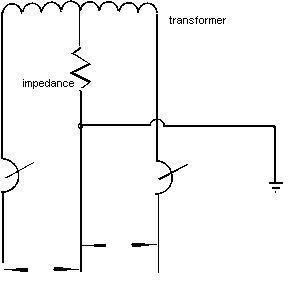
It took me a while to get this post accomplished... crossman, I don't understand your second hypothesis. Why would one phase be subtantially higher than the other with respect to the neutral bar.


service.jpg


The connected lods acting as voltage dividers would do that according to their impedances, but I dont see the high impedance (bad / no connection ) of the neutral doing it.
 
Neutral Paths

Neutral Paths

Multiple parallel paths for current is not necessarily bad. We are required to bond the neutral to water pipes, ground rods, UFERs, etc. Each provides an alternate path. However, grounds are for touch potential safety to avoid electrocutions, not to insure overcurrent protective devices operate correctly. The ground path can be relatively high resistance and still provide safety. However, the neutral return path, when faced with 10's of amps and a poor connection, will cause the voltage on the phases to swing all over the place, rough on appliances.
 
Sparkygriffin,

First welcome to the forum, you are surrounded by very experienced professionals from sparky’s to scientist, all of which have participated in this thread.

Second as a Moderator no one has censored or deleted your replies. If that were the case you would see an empty box stating a deletions with the Mod’s name, and you would have received a PM from that Mod.

Third, it does not sound like you understand the basic principles of current flow, ohms law, and voltage divider circuits. I suggest you do some basic research and may understand what we are trying to impress on you. The grounded circuit conductor (neutral) from the transformer is less than 1-ohm. If lost the return path goes several magnitudes higher, leaving the service connection point a very simple voltage divider circuit.
 
Last edited:
e57 said:
I had a long detailed response and it vanished in spell check... :mad:

Who owns the equipment the neutral was lost in - you or them?

Most metering and conductors to and from them are customer owned and maintained. Even though their meter is on/in it.


Sorry, late in on this one. e57's statement is sad, but true here, we own and install right through to the drip loop. I'd like to know just exactly how the neutral was lost in the can????
 
sparkygriffin said:
if his house has a better ground than the utilitity he doesn't see this problem.

No matter how good the ground and soil conditions are - it would NEVER be adequate to support the load of even the simplest of circuits. There are shells of resistance in magnitudes greater than required from each rod - at the house, and at the pole. It would not matter if it is rod, a UFER (CEE), huge copper plates... What is needed is a low resistance metallic path - as mentioned this can sometime inadvertently occur with metallic water lines - but it is not intentionally the case. FYI my local POCO often does not include a rod at pole mounted transformers, as the are usually right next to several homes with one... Each with a bonded neutral conductor... Even though the rods may be 1' apart due to the close proximity of homes here - it still does nothing to create a viable path for current to flow back to the transformer.
gndshells.jpg


More on the topic...
http://www.ijme.us/issues/spring2006/p33.htm
 
Last edited:
realolman said:
It took me a while to get this post accomplished... crossman, I don't understand your second hypothesis. Why would one phase be subtantially higher than the other with respect to the neutral bar.


service.jpg


The connected lods acting as voltage dividers would do that according to their impedances, but I dont see the high impedance (bad / no connection ) of the neutral doing it.

Hello, realoman, thank you for the reply.

I want to make sure you understood that I said that the load on the 2 phases was different, for example, A to N is 40 ohms and B to N is 100 ohms.

Considering that ^^^^, the more impedance you place in series with the neutral conductor, the more the voltage difference as compared on each phase. Upon first look, it may appear that the neutral impedance has nothing to do with it. But it does. There are some series/parallel circuits in there that you have to account for.

Set up some examples by using the phase impedances I described above, 40 ohm load on A to N, and 100 ohm load on B to N. Then do an ohm's law calculation with zero ohms in series with neutral, do a second calculation with 25 ohms in series with neutral, and a third calcualtion with an open neutral.

For the first two calculations, you can use superposition and the rules for series/parallel circuits. For the third calculation, it is a simple 240 volt series circuit.

Compute the voltage on each load in each scenario. You'll see how it works. I'll give you a shot at the calcs first. If needed, I can help you out, just let me know. I may have time tomorrow night.
 
e57 said:
No matter how good the ground and soil conditions are - it would NEVER be adequate to support the load of even the simplest of circuits.

On a practical basis, I will agree, but never say "never".

If you give me the following 4 things:

1) unlimited money
2) access to the service equipment neutral bar
3) access to the POCO X0
4) no constraints of property lines or right-of-ways

then I can build you a grounding electrode system that at some point is not relying on a metallic path yet it will have less than 1 ohm of resistance from X0 to neutral bar and will carry plenty of current.
 
crossman... you did say unbalanced load... I completely missed that... the only part that I seemed to see was the part about the impedance of the neutral causing a higher voltage from one phase to the neutral than the other

...sorry.
 
Last edited:
Status
Not open for further replies.
Top