
Ground Fault through Y-Yg Transformer

Merry Christmas

bwat

EE
Location
NC
Occupation
EE
Hoping someone can confirm my suspicions before I go back and sketch out (and relearn) my sequence components for this.

This is a real issue I'm having at client's site. We didn't design this. We were brought in to figure out what's happening.


SP = 480V Service Panel, main bonding jumper is installed
TR = 408V to 208V transformer, wye-wye
DP = 208V Distribution Panel, 'system bonding jumper' is installed

Current setup goes:

(480V utility service)-----(SP)-----(TR)-----(DP)----(208V loads)


What it looks like they did is land the neutral on both the H0 and X0 sides of the transformer (going to their respective panels, SP and DP). I don't believe they should have landed the one on H0 because now it's not a separately derived system. I see it as essentially a Yg-Yg transformer since there's a N-G bond at both panels, although there isn't one at the transformer, on either side, as far as I can tell.

That might not be a big deal to have it not be an SDS, and preferred in some cases, but what I think is happening is that the main 480V breaker in SP is "seeing" all of the single phase 208V loads or imbalances as a ground fault and they're getting occasional trips in that main CB in SP on ground fault.

The GF setting is at 500A, and that's what's tripping, so I initially thought it was real/significant issue they were having. But maybe it's a design issue. Tripping seems to mostly occur when utility service is lost and then restored.


Can someone please confirm (or correct) my theory here that imbalances at 208V could be seen as GF at the 480V main because of the grounding/bonding scenario used with the transformer?


Quick edit: I named the title what I did because I think they should remove the connection to H0 and make it Y-Yg transformer which would then create an SDS for the 208V side.
 
My 2 cents. For what it's worth.

The choice of a Wye-Wye is unusual for a normal 480 to 208 step down transformer. This would typically be accomplished with a Delta to Wye. A Wye-Wye is seen in the POCO world, but is (imo) unusual elsewhere. Was there some specific reason a Wye-Wye was chosen?

Similar to your situation, when a 208 to 480 step up is done with a reversed step down transformer, the problem you mention is commonplace. Namely a connection on the primary of the Wye X0 to the Source neutral. This should always be left floating.

There will always be small imbalances between the neutral to line voltages of the POCO mains. As different loads come and go, especially single phase ones, the voltages on L1, L2 and L3 (to neutral) will always be slightly different. Similarly, as these 3 slightly different voltages energize the primary side of your transformer (along with tiny differences in the 3 primary winding impedances) they will create a transformer X0 that might not be exactly at the same potential as the POCO X0.

I like to think of X0 like the X=0, Y=0 origin on a piece of graph paper when you draw a nice symmetrical 3 phase set of Wye vectors. The POCO X0 and the magnetically created primary X0 in the transformer will never line up exactly. They will normally be close, but the "real world" will cause them to be offset and never perfectly aligned.

If they are connected, the POCO source will be the bully here, and fight hard to draw both X0 points together. That fight is done by flowing current on the neutral. Tiny imbalances between POCO and transformer X0 will cause small currents. Larger imbalances will cause big currents to flow as they look to align both X0s together. And remember, this neutral current flow is typically on a wire w/o any overcurrent protection.


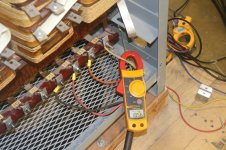
The image below was from a post back in 2021 about an X0 connection on a Wye-Wye.


In that thread, I posted this pic I took when (for fun) I connected a small 30 kVA transformer's Wye windings to my shop's 208 VAC primary. And hooked up the neutral. You can see 18.5A of current flowing on the neutral, with no load on the secondary, this imbalance is all just from the idle magnetizing current and some small difference in X0 potentials.

1765208925307.jpeg

iirc, the voltage imbalance I measured with the X0 floating was ~0.5 volts.

In your case, and this is just a WAG, I could imagine that when the POCO service is lost and then restored, those first few seconds of line voltages could see some really serious voltage imbalances on the Mains L1/L2/L3 feeding your transformer primary. And those big non-symetrical line voltages will cause a big mis-alignment between the POCO X0 and the transformer X0. And since they are tied together, big currents will have to flow to pull them together.

Long story short, I would float that primary X0.

Again, just my 2 cents.
 
Last edited:
Is there a current transformer on the neutral conductor feeding the transformer, and that is used by the main CB? And if so, does this CT have the correct orientation?

Also, does this wye-wye have a tertiary delta winding?
 
Is there a current transformer on the neutral conductor feeding the transformer, and that is used by the main CB? And if so, does this CT have the correct orientation?

Also, does this wye-wye have a tertiary delta winding?
It's a Schneider/SQD QED-2 switchboard, so I would be surprised if the neutral CT orientation was incorrect, but yes, looking at the old shop drawings there is a CT for the neutral for GF sensing in the gear.

Transformer does not have tertiary winding.
 
My 2 cents. For what it's worth.

The choice of a Wye-Wye is unusual for a normal 480 to 208 step down transformer. This would typically be accomplished with a Delta to Wye. A Wye-Wye is seen in the POCO world, but is (imo) unusual elsewhere. Was there some specific reason a Wye-Wye was chosen?

Similar to your situation, when a 208 to 480 step up is done with a reversed step down transformer, the problem you mention is commonplace. Namely a connection on the primary of the Wye X0 to the Source neutral. This should always be left floating.

There will always be small imbalances between the neutral to line voltages of the POCO mains. As different loads come and go, especially single phase ones, the voltages on L1, L2 and L3 (to neutral) will always be slightly different. Similarly, as these 3 slightly different voltages energize the primary side of your transformer (along with tiny differences in the 3 primary winding impedances) they will create a transformer X0 that might not be exactly at the same potential as the POCO X0.

I like to think of X0 like the X=0, Y=0 origin on a piece of graph paper when you draw a nice symmetrical 3 phase set of Wye vectors. The POCO X0 and the magnetically created primary X0 in the transformer will never line up exactly. They will normally be close, but the "real world" will cause them to be offset and never perfectly aligned.

If they are connected, the POCO source will be the bully here, and fight hard to draw both X0 points together. That fight is done by flowing current on the neutral. Tiny imbalances between POCO and transformer X0 will cause small currents. Larger imbalances will cause big currents to flow as they look to align both X0s together. And remember, this neutral current flow is typically on a wire w/o any overcurrent protection.


The image below was from a post back in 2021 about an X0 connection on a Wye-Wye.


In that thread, I posted this pic I took when (for fun) I connected a small 30 kVA transformer's Wye windings to my shop's 208 VAC primary. And hooked up the neutral. You can see 18.5A of current flowing on the neutral, with no load on the secondary, this imbalance is all just from the idle magnetizing current and some small difference in X0 potentials.

View attachment 2580962

iirc, the voltage imbalance I measured with the X0 floating was ~0.5 volts.

In your case, and this is just a WAG, I could imagine that when the POCO service is lost and then restored, those first few seconds of line voltages could see some really serious voltage imbalances on the Mains L1/L2/L3 feeding your transformer primary. And those big non-symetrical line voltages will cause a big mis-alignment between the POCO X0 and the transformer X0. And since they are tied together, big currents will have to flow to pull them together.

Long story short, I would float that primary X0.

Again, just my 2 cents.
Thank you for the good info! Confirms my suspicions that I should probably float the H0 (what you referred to as primary X0).

However, wouldn't our present scenario just generate current on the neutral (and maybe create other problems), but not necessarily be detected as a ground fault up stream?

I was thinking that in order for the GF trips to happen, you have to get current back on the EGC (or some other return path not on neutral or phases) and this is happening because of the additional N-G bond on the 208V side while also connecting H0.
 

In that thread, I posted this pic I took when (for fun) I connected a small 30 kVA transformer's Wye windings to my shop's 208 VAC primary. And hooked up the neutral. You can see 18.5A of current flowing on the neutral, with no load on the secondary, this imbalance is all just from the idle magnetizing current and some small difference in X0 potentials.

View attachment 2580962

iirc, the voltage imbalance I measured with the X0 floating was ~0.5 volts.

In your case, and this is just a WAG, I could imagine that when the POCO service is lost and then restored, those first few seconds of line voltages could see some really serious voltage imbalances on the Mains L1/L2/L3 feeding your transformer primary. And those big non-symetrical line voltages will cause a big mis-alignment between the POCO X0 and the transformer X0. And since they are tied together, big currents will have to flow to pull them together.

Long story short, I would float that primary X0.

Again, just my 2 cents.

Just to be clear: the behavior of a wye primary : delta secondary transformer will be quite different than a wye:wye.

In the system you tested in your shop, I would guess that the transformer was a delta:wye that you connected in reverse. The transformer did exactly what you described; the transformer tried to 'balance' the neutral and fought with the utility definition of that neutral, and you got a bunch of circulating current between on the neutral connection. But you _also_ would have had current circulating on the delta.

With a wye:wye transformer you must have a neutral connection, or you must have some other path to permit unbalanced secondary currents to flow. If you don't do this then the L-N voltage on the secondary will be very unstable. The reason is that any unbalanced L-N current on the secondary side will be reflected as L-N current on the corresponding primary coil, and you have to have a path for that primary unbalanced current to flow. (The path could be provided by a tertiary delta, or could even be a magnetic circuit on a 5 leg core, but it has to be something and that is usually a neutral connection.)

I believe the problem with the OP's installation is that the primary neutral is also regrounded at the primary connection point, not that the primary neutral is connected to H0.

-Jonathan
 
Confirms my suspicions that I should probably float the H0 (what you referred to as primary X0).
Yes, sorry for typing too fast. The Wye midpoint on your Primary would be H0.

I was thinking that in order for the GF trips to happen, you have to get current back on the EGC (or some other return path not on neutral or phases) and this is happening because of the additional N-G bond on the 208V side while also connecting H0.
I could certainly see that happening. Normally, with H0 floating, the primary and secondary are magnetically coupled... but electrically isolated. However, with the H0 connected to the Mains neutral, there is, as you point out, a connection between H0 and X0 now via the N-G bond on both the primary and secondary sides.

So maybe during a POCO power restoration, and with some big primary voltage imbalances causing some big neutral currents to flow (however briefly), those currents may now have 2 paths back to the source?

Are you sure the N-G bonds are at the panels, and not inside the transformer? If there was a N-G bond there on the primary H0, it would surely be a second path back for neutral currents that the CT would not see.
 
It could be helpful if a Rogowski coil probe could be put around all conductors feeding the wye primary winding to make sure that the observed current is negligible.

Another thing is that wye-wye transformers can regenerate voltage on an open input phase from a blown fuse, etc. This issue may not be apparent until heavier loading causes the voltage to sag on the open phase. While an open phase should not cause zero sequence current to flow, perhaps it could help induce false breaker tripping when the transformer is energized. This is speculation on my part.
 
Just to be clear: the behavior of a wye primary : delta secondary transformer will be quite different than a wye:wye.

In the system you tested in your shop, I would guess that the transformer was a delta:wye that you connected in reverse. The transformer did exactly what you described; the transformer tried to 'balance' the neutral and fought with the utility definition of that neutral, and you got a bunch of circulating current between on the neutral connection. But you _also_ would have had current circulating on the delta.

With a wye:wye transformer you must have a neutral connection, or you must have some other path to permit unbalanced secondary currents to flow. If you don't do this then the L-N voltage on the secondary will be very unstable. The reason is that any unbalanced L-N current on the secondary side will be reflected as L-N current on the corresponding primary coil, and you have to have a path for that primary unbalanced current to flow. (The path could be provided by a tertiary delta, or could even be a magnetic circuit on a 5 leg core, but it has to be something and that is usually a neutral connection.)

I believe the problem with the OP's installation is that the primary neutral is also regrounded at the primary connection point, not that the primary neutral is connected to H0.

-Jonathan
So your thinking is that the H0 connection should stay, but we should make sure the neutral (on both 480V and 208V sides) should not have any other N-G bonds other than the MBJ at the main 480V panel upstream from the transformer?
 
So your thinking is that the H0 connection should stay, but we should make sure the neutral (on both 480V and 208V sides) should not have any other N-G bonds other than the MBJ at the main 480V panel upstream from the transformer?

That is my thinking, but I want to be clear that in the field of large transformers for distribution to buildings I am not a professional.
 
Is there a NEC complaint way to do a wye-wye transformer, on a service voltage > 150V to ground and 1000V or less 1000 amps or more, its just one MGN / TN-C system? I suppose if H0 and X0 are not bonded?
photos please.
 
That is my thinking, but I want to be clear that in the field of large transformers for distribution to buildings I am not a professional.
I just sketched some things out on this. I think we would HAVE TO have at least one N-G bond on the secondary (even though it's a wye-wye) or else you have no way for fault current to flow if there's a phase to ground fault on the secondary. And adding in this N-G bond somewhere in the secondary circuit doesn't look like it would cause a problem on the GF sensing on the primary.

So I might be recanting and saying that everything is right as it currently stands:

(MBJ at 480V panel) ---- (Wye-Wye Transformer with no N-G bonds seen, but H0 and X0 connected respectively to their sides)---- (SBJ at 208V panel)

So it's technically a Yg-Yg, but the "g" is happening at the MBJ and SBJs in the remote panels.


Wouldn't that function perfectly normal and not cause any GF issues at 480V panel, and be NEC compliant?
 
If you have a 480V wye grounded wye source, feeding a 480/277V wye: 208/120V wye transformer, with a _neutral_ from the source to the transformer H0, and then H0 and X0 connected together, _not_ connected to the GEC or EGC, and then the X0 neutral continuing to loads, then I think that the _physics_ will work correctly, but I think you bump into some serious code issues.

If you draw everything out you have the necessary neutral for the wye:wye. You have a fault current path on the 208V side of thing, and you have a path to earth for the 208V system. You don't have multiple connections between neutral and 'ground' on any of the systems.

That 480V neutral needs to serve as the 208V system bonding jumper and the GEC for the 208V system and the neutral for the 480V transformer. I don't know if it is possible for one conductor to follow all three relevant rule sets. For example if the 480V feed is in metallic, conduit you can't have the various bonding bushings required for GECs and also have the isolation required for a neutral.
 
Yes see 250.30

What is H0 bonded to? Under the NEC 250.24 (B) I would imagine H0 would have no connection not even to X0.
I knew I worded that poorly. H0 goes back to the 480V panel neutral. X0 goes to the 208V panel neutral

They are not floating, since the panel neutrals have a N-G bond (MBJ on one, SBJ on the other)

They are not connected together (H0 to X0) at the transformer as far as I can tell

Winnie - hopefully this clarification is helpful for your post as well.
 
If you have a 480V wye grounded wye source, feeding a 480/277V wye: 208/120V wye transformer, with a _neutral_ from the source to the transformer H0, and then H0 and X0 connected together, _not_ connected to the GEC or EGC, and then the X0 neutral continuing to loads, then I think that the _physics_ will work correctly, but I think you bump into some serious code issues. ...

That arrangement has some similarity to an autotranformer in having a continuous neutral path from the input to output, and does not provide isolation. However, it does not have a shared winding between the input and output circuits, and so it's not an autotransformer. A L-N ground fault on the 240V side will appear with 1/2 of the secondary's zero sequence current on the 480V side in the OP's case.
But for the reasons you mentioned and others, it does not appear to meet NEC requirements.
 
I knew I worded that poorly. H0 goes back to the 480V panel neutral. X0 goes to the 208V panel neutral

They are not floating, since the panel neutrals have a N-G bond (MBJ on one, SBJ on the other)

They are not connected together (H0 to X0) at the transformer as far as I can tell

Winnie - hopefully this clarification is helpful for your post as well.

In that case, then the arrangement sounds correct to me. Again: I do electric motor research, I know how electrical systems work, but your transformer is outside of my professional training and experience.
 
If the H0 is connected to the 480 V neutral and the X0 is connected to the 208 V neutral, then electrically it is effectively a grounded wye - grounded wye transformer since both neutrals are (remotely) bonded to ground. I think any neutral or ground current in the 208 V system will show as neutral current (at H0 bushing) in the 480 V system. The zero sequence current has to pass through the transformer. This works electrically, but not sure about NEC or your 480 V ground protection. What does the transformer nameplate show. It's possible that the H0 is internally grounded. An ungrounded primary wye would cause an issue for any L-N loads on the secondary side. At least that's my first impression.
 
Some updates.

There does not appear to be any internal connection at the transformer between H0 and ground. That was one of my first thoughts as well. If there's another N-G bond there, that would definitely throw off the GFP.

There is a delta tertiary winding on this transformer. @synchro : you asked this and I apologize that I originally said no.
 
That tertiary delta changes things.

It provides a path to define the L-N voltage as neutral, on both the primary and secondary side.

Now we again have to question if the primary neutral is appropriate. As others have shown, this primary neutral will 'fight' the supply neutral and can lead to significant circulating currents.

However sometimes the utility will require this as part of 'effective grounding'. IMHO you are correct to question the neutral connection to H0, and should dig further.
 
Top