Help with getting the right voltage output from a transformer.

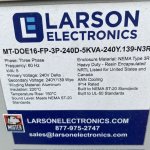
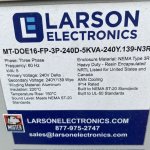
The nameplate clearly shows it is not the Delta-Wye you wanted.
It has two labels. The one in the picture below says delta - wye, the other one doesn’t. Guys asked me to get the readings with two meters to determine which one was correct. Are saying for sure, it’s wye - wye, there for the first label is wrong? I will call the manufacturer.
 

Attachments

  • IMG_0738.jpeg
    IMG_0738.jpeg
    149.2 KB · Views: 1
So the unit that is working has unbalanced voltage going to it, but the unit that doesn't work has balanced voltages?

That seems to imply the voltage isn't the problem, or at least not the problem keeping the VFD from running at full speed.

I wonder if the VFD just has some parameters set wrong? Also wondering if the HVAC controls just aren't calling for full output? For example, maybe the temp. differential just isn't enough, or maybe the thermostat or a sensor isn't reading correctly?
Both have the unbalanced delta supply.
As far as I know, the thermostat is calling for heat properly. The fan ramps up and then drops down. The heating company has changed all of the parts involved, so they say. They have been out more than 10 times. Later trips were the top service guys. These two things I do know. What exactly they did, I’m not sure.
 
img_0743 in post #44 for a wye:wye transformer.

img_0760 in post #46 is for a delta:wye transformer.
0743 is the second label one the problem transformer.
0760 is the only label on the transformer on the other (working) transformer.
The picture below is the 1st label on the problem transformer. It says delta-wye
 

Attachments

  • IMG_0738.jpeg
    IMG_0738.jpeg
    149.2 KB · Views: 4
Edited to ask, I don’t quite get the excessive l-n voltage because there is no neutral. The XO of the transformer is connected to the metal case.
Thanks
Mike

I am making a bunch of guesses here.

I should have said 'L-G' voltage, not 'L-N' voltage. The neutral of the transformer gets connected to ground, and the VFD gets power from the line circuit conductors only.

But the L-G voltage impacts VFD operation. And your wye:wye transformer won't give stable L-G voltage. The solution is to use a delta:wye transformer.

I don't think you need to do any more diagnostics. I think you need to figure out how to get the transformer replaced with the correct one.
 
The label does not match the nameplate. Every piece of information on the nameplate applies to a Y-Y.

Did they send you something different than what you ordered?
 
It has two labels. The one in the picture below says delta - wye, the other one doesn’t. Guys asked me to get the readings with two meters to determine which one was correct. Are saying for sure, it’s wye - wye, there for the first label is wrong? I will call the manufacturer.

The voltage readings don't tell me enough to confirm one way or the other.

The discordant labels ( one says delta:wye, the other wye:wye on the same transformer, and you have 2 different transformers that look different with the same part number) is enough to warrant a call to the manufacturer.
 
I am making a bunch of guesses here.

I should have said 'L-G' voltage, not 'L-N' voltage. The neutral of the transformer gets connected to ground, and the VFD gets power from the line circuit conductors only.

But the L-G voltage impacts VFD operation. And your wye:wye transformer won't give stable L-G voltage. The solution is to use a delta:wye transformer.

I don't think you need to do any more diagnostics. I think you need to figure out how to get the transformer replaced with the correct one.
Thank you. It’s 19 degrees here and if I don’t have to climb on the icy roof I’m happy. lol
 
The voltage readings don't tell me enough to confirm one way or the other.

The discordant labels ( one says delta:wye, the other wye:wye on the same transformer, and you have 2 different transformers that look different with the same part number) is enough to warrant a call to the manufacturer.
I called then and emailed them when it was delivered. Those had to do with the fact it couldn’t sit on a pad, like the first. The denied it, said it did and it was the same part number and the same as the other one. In spite of the pictures I sent. In the end I made a stand to mount the transformer.
Thanks agian
Mike
 
This is the info for the first unit, which seems to be working

averaging meter
Input 129, 117, 129
236, 237, 245,
Output 114, 114, 189
250, 250, 226

This is the problem unit:
Averaging meter
Input, 125,125,217, 250,250,226
Output, 140,140,140, 253,253,228

It seems like you may have reversed the Input and Output designations on the averaging meter measurements of the first unit that is working.
That's because of the identical 250, 250, 226 L-L measurements between the two units.
 
Still, the delta or wye secondary is not going to cause a lack of output from the VFD. All the VFD does is rectify the AC to DC, then recreate AC for the motor. Think about it; a VFD changes the voltage and frequency together to keep the motor operating at the correct torque. So if you are running a motor at 30% speed, the VFD is putting out 30% voltage too. It is ALWAYS capable of making the output voltage match whatever you tell it to, as long as that is LOWER than the input voltage, because the VFD cannot create voltage that is not there (some can, but that’s special). I have made a 480V input VFD put out 208V to the motor, it’s just programming (don’t do this though for other reasons). So even if the line was 240V, that is not going to affect whether or not the VFD can put out 208V. It can.

What the delta vs wye input affects is the LIFE of the VFD. All VFDs are designed for a solidly grounded wye input, with a consistent L-G voltage reference that is 58% of the L-L voltage. In a delta source, the L-G reference is floating, so it can be the full L-L level. The components in the front end of the drive are protected by MOVs, which are selected EXPECTING the 58% value, so when exposed to higher voltages, they fail faster and they fail catastrophically, usually spewing conductive metal oxides all over inside of the VFD, causing cascading failures. So yes, it’s not good to use a delta supply to a VFD, but it does not make the VFD perform differently until there is a complete failure. So back to what was said earlier by steve66, this is programming problem or a motor problem or a load problem or an internal VFD hardware failure of some sort. This is not a transformer problem and the more time wasted on this is keeping someone from finding the real issue.
 
It seems like you may have reversed the Input and Output designations on the averaging meter measurements of the first unit that is working.
That's because of the identical 250, 250, 226 L-L measurements between the two units.
I hope not. I took each reading 3 times. I wanted to make sure I gave everything I could do you could help me.
 
Still, the delta or wye secondary is not going to cause a lack of output from the VFD. All the VFD does is rectify the AC to DC, then recreate AC for the motor. Think about it; a VFD changes the voltage and frequency together to keep the motor operating at the correct torque. So if you are running a motor at 30% speed, the VFD is putting out 30% voltage too. It is ALWAYS capable of making the output voltage match whatever you tell it to, as long as that is LOWER than the input voltage, because the VFD cannot create voltage that is not there (some can, but that’s special). I have made a 480V input VFD put out 208V to the motor, it’s just programming (don’t do this though for other reasons). So even if the line was 240V, that is not going to affect whether or not the VFD can put out 208V. It can.

What the delta vs wye input affects is the LIFE of the VFD. All VFDs are designed for a solidly grounded wye input, with a consistent L-G voltage reference that is 58% of the L-L voltage. In a delta source, the L-G reference is floating, so it can be the full L-L level. The components in the front end of the drive are protected by MOVs, which are selected EXPECTING the 58% value, so when exposed to higher voltages, they fail faster and they fail catastrophically, usually spewing conductive metal oxides all over inside of the VFD, causing cascading failures. So yes, it’s not good to use a delta supply to a VFD, but it does not make the VFD perform differently until there is a complete failure. So back to what was said earlier by steve66, this is programming problem or a motor problem or a load problem or an internal VFD hardware failure of some sort. This is not a transformer problem and the more time wasted on this is keeping someone from finding the real issue.
What do I do then? The changed the VFD and supposedly everything involved.
Thanks
Mike
 
What the delta vs wye input affects is the LIFE of the VFD. All VFDs are designed for a solidly grounded wye input, with a consistent L-G voltage reference that is 58% of the L-L voltage. In a delta source, the L-G reference is floating, so it can be the full L-L level. The components in the front end of the drive are protected by MOVs, which are selected EXPECTING the 58% value, so when exposed to higher voltages, they fail faster and they fail catastrophically, usually spewing conductive metal oxides all over inside of the VFD, causing cascading failures. So yes, it’s not good to use a delta supply to a VFD, but it does not make the VFD perform differently until there is a complete failure. So back to what was said earlier by steve66, this is programming problem or a motor problem or a load problem or an internal VFD hardware failure of some sort. This is not a transformer problem and the more time wasted on this is keeping someone from finding the real issue.

In general I agree with the above, and @Jraef has far more field experience with VFDs than I do.

However:

1) We have 2 identical systems that had 2 identical problems. When the correct delta:wye transformer was added to one system the problems were fixed. When the incorrect wye:wye transformer was added to the other system the problems remained.

2) The HVAC supplier and manufacturer have already replaced the drive and have identified the unbalanced power as the issue.

I'd simply ass-u-med that some component of the drive was by design shutting things down as a safety feature when the unbalanced power was noted, rather than letting the hardware fail. But thinking about the point above, I now suspect that some drive associated logic is getting tripped up by some aspect of unbalanced power. For example maybe there is some earth leakage detection, or maybe some grounded sensor that shows greater leakage and is tripping some control logic, or something similar. If you knew the core problem then the fix would be much smaller than adding the transformer.

However you don't know what the core problem is, and the HVAC manufacturer isn't providing any helpful information. Their solution also involves a transformer, to step down to 208V. Since the system was intended to operate on 208V or 240V, this tells me that they also don't have a clue.

IMHO this puts adding the transformer somewhat into the category of a voodoo fix, something that you do on the basis of mythology. But in this case it is a voodoo fix that has been demonstrated to be effective. The OP has already bought and paid for the transformers, but now has to convince the transformer supplier that they goofed on one of them.

I agree that balanced wye power is not the essential minimum fix for the problem with the blower, but at this point it is probably the cheapest demonstrated fix. And also if, because supply balance isn't the core issue, if balanced wye power doesn't fix the problem, it is the cheapest way to put the problem back in the HVAC manufacturer's court.

 
Top