
Hi-leg Delta xfmr reference?

Status
Not open for further replies.

crossman

Senior Member
Location
Southeast Texas
I have been enjoying the 4-wire delta thread. I have a question, but didn't want to lead the topic astray, so I started a new thread.

In the first diagram, there isn't really a reference, except for time itself. I say that because there is no single place in the diagram that we are keeping involved in all voltage measurements. We can take an o-scope with 4 isolated channels and compare the sine waves for "out of phase" conditions compared to the other voltage graphs. We are just measuring voltages around the delta and being consistent with the polarity of each o-scope channel.

I can understand the RMS vectors which would arise from this. They would simply be arrows drawn on the windings with, say, the heads at the black leads and the tails at the red leads. Simple enough, and the two vectors at the bottom of the drawing that involve the midpoint "neutral" would be drawn the same direction = in phase.
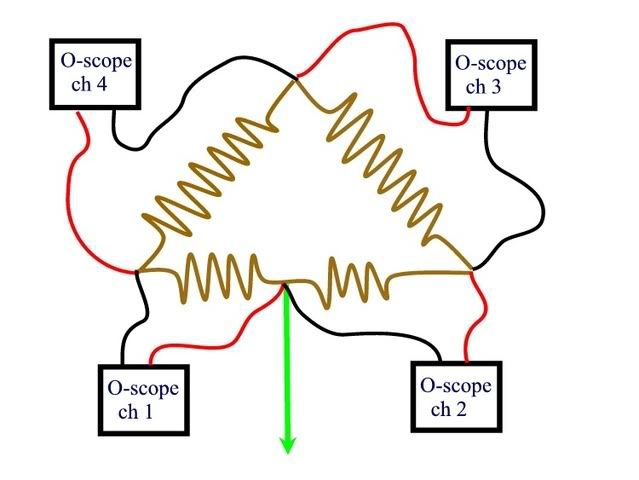
deltanoref.jpg


But in the next diagram, if we make all measurements in reference to the neutral, then there are actually only three places we can get voltage readings, not four as in the diagram above. What would the vectors look like if we always kept the black lead of each o-scope channel on the neutral? We would only have 3 o-scope graphs. It seems that there could only be 3 vectors. What would the vectors look like?
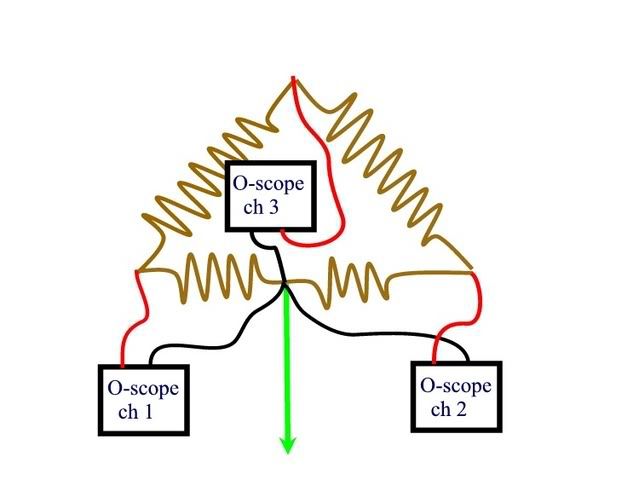
deltaref.jpg
 
crossman said:
I have been enjoying the 4-wire delta thread. I have a question, but didn't want to lead the topic astray, so I started a new thread.

In the first diagram, there isn't really a reference, except for time itself. I say that because there is no single place in the diagram that we are keeping involved in all voltage measurements. We can take an o-scope with 4 isolated channels and compare the sine waves for "out of phase" conditions compared to the other voltage graphs. We are just measuring voltages around the delta and being consistent with the polarity of each o-scope channel.

I can understand the RMS vectors which would arise from this. They would simply be arrows drawn on the windings with, say, the heads at the black leads and the tails at the red leads. Simple enough, and the two vectors at the bottom of the drawing that involve the midpoint "neutral" would be drawn the same direction = in phase.

deltanoref.jpg


But in the next diagram, if we make all measurements in reference to the neutral, then there are actually only three places we can get voltage readings, not four as in the diagram above. What would the vectors look like if we always kept the black lead of each o-scope channel on the neutral? We would only have 3 o-scope graphs. It seems that there could only be 3 vectors. What would the vectors look like?
deltaref.jpg

The phasors would be,

120Vrms @ 180
120Vrms @ 0
208Vrms @ 90 (high leg)

My opening statement in "4-wire delta, phasors, and Kirchoff"
 
Straight up:

Straight up:

crossman said:
Thanks Rattus. And the 208 volt phasor at 90 degrees would point away from the midpoint "neutral"?

It would point straight up, irrespective of the orientation of the circuit diagram.
 
Is the following correct?

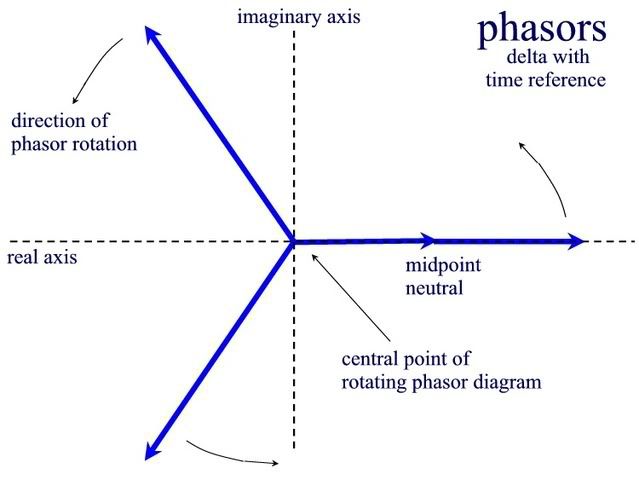
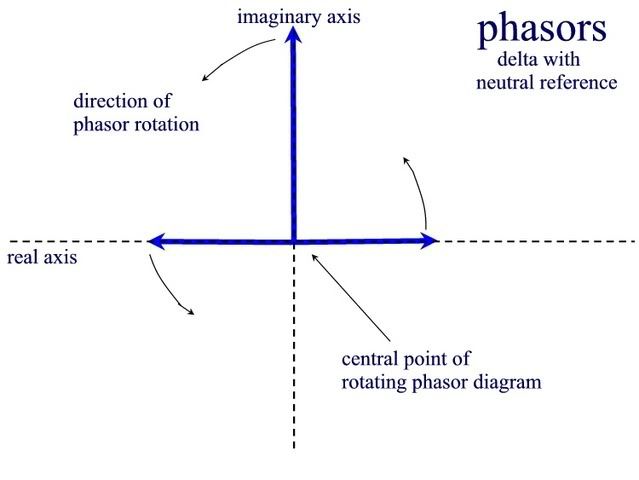
If we were to draw the phasor digrams of the two different ways to measure voltage in a hi-leg delta, they would look like the following:

I believe I am correct that each phasor will have its tail placed on (0, 0j) because that is the center of rotation of each phasor.

First, the delta with no point on the xfmr as the reference in respect to the voltages:

deltaphasortime.jpg


And now the phasor diagram using the midpoint neutral as the reference to all voltage measurements:

deltaphasorneutral.jpg
 
Crossman,

Your first diagram fits the wye connection, not a delta.

Think static phasors, not rotating.

The arrows indicate the direction of angle measurement--CCW from the positive reference axis.

Now, it is correct, but not recommended, to draw each arrow in the opposite direction if we change the phase angle by 180 degrees
 
Now I am confused. So as for arrows with heads and tails and concerning AC voltage, I could have three different ways to show them?

1) Phasors which rotate at the rate w (where w is the angular frequency) and project magnitudes onto the real axis and imaginary axis which I havefound in the physics texts

2) RMS vectors which are found in the basic AC theory texts

3) Static phasors

I thought I had developed a decent understnading of 1 and 2 above, but now you threw me a curve ball. Back to the books for me.

Are 2 and 3 the same thing? Instead of saying RMS vector I should say RMS phasor? Or are they different?
 
static phasor

static phasor

static phasor: I guess this means a phasor at a given point in time.

The phasor is just the complex amplitude of a sinusoid. A phasor is NOT a vector because a vector is stationary while a phasor rotates with time. The phasor quantity was originally called a vector but the term phasor was coined by engineers to avoid confusing the two.

Because we usually deal with the RMS values instead of the max values of the waveform, the phasor is usually represented using the effective value phasor notation. If you recall, the RMS value is the equivalent DC quantity, which when applied to a linear time invariant resistor, renders the same average power. For the sinusoid, we get V_effective = V_rms = V_max / sqrt(2).

The phasor V_rms@phi represents the time function v(t) = sqrt(2)*V_rms*COS(wt+phi). But remember the phasor rotates in time. The full representation includes the time variable function e^jwt along with the phasor so that the time function is:
v(t) = V_max*(e^jphi)*e^jwt

We normally don't show the e^jwt component when using phasors and we usually use the RMS value instead of the maximum value.
 
phasor is a transform

phasor is a transform

In case it was not clear, the phasor is a complex number, not a time function. It is a transform of the time function but has a component that goes along with it, namely e^jwt that shows how the phasor rotates in time.
 
rotating vector

rotating vector

mivey said:
A phasor is NOT a vector

I have heard the term "rotating vector". While some say vectors don't rotate (and, I guess, technically they don't) I have no problem with that as I think it illustrates what we mean by phasor. Some professors might fuss at you for saying it (as happened to me when I used the term in class one day) but who cares? We are talking about the same phenomenon, not writing a book.
 
mivey said:
static phasor: I guess this means a phasor at a given point in time.

The phasor is just the complex amplitude of a sinusoid. A phasor is NOT a vector because a vector is stationary while a phasor rotates with time. The phasor quantity was originally called a vector but the term phasor was coined by engineers to avoid confusing the two.

Because we usually deal with the RMS values instead of the max values of the waveform, the phasor is usually represented using the effective value phasor notation. If you recall, the RMS value is the equivalent DC quantity, which when applied to a linear time invariant resistor, renders the same average power. For the sinusoid, we get V_effective = V_rms = V_max / sqrt(2).

The phasor V_rms@phi represents the time function v(t) = sqrt(2)*V_rms*COS(wt+phi). But remember the phasor rotates in time. The full representation includes the time variable function e^jwt along with the phasor so that the time function is:
v(t) = V_max*(e^jphi)*e^jwt

We normally don't show the e^jwt component when using phasors and we usually use the RMS value instead of the maximum value.
mivey -
I'm impressed. Excellent discussion. I followed and agreed right down to, "The full representation includes the time variable function e^jwt ...". Where I went, "huh" - dug back through the brain cobwebs, - oh yeah, Euler. It's always nice to learn

carl
 
mixing circuit & phasor diagrams

mixing circuit & phasor diagrams

rattus said:
Crossman,

Your first diagram fits the wye connection, not a delta.

The first phasor diagram could represent delta or wye terminal voltages. Phasors originating from the same origin is one representation method. This is usually the preferred method because it does not mix the circuit and phasor diagram, which can cause confusion.

Putting the phasors in a triangular shape to represent the delta is blending the phasor diagram and circuit diagram. This is a perfectly valid and useful method because it illustrates graphically how the phasors sum to zero.

The inside of the delta triangle is a wye. You could super-impose a wye on the delta and the voltages at the terminals would still be represented by the first phasor diagram (but you could find the neutral point). Think about the delta-wye and wye-delta impedance transformations where that given Z_resistance=resistance, Z_capacitance=-j/wC, and Z_inductance=jwL
Z_delta = 3*Z_wye or if you are talking just capacitance (farads): C_wye = 3*C_delta [edit: for balanced loads]

Any way, this is similar to what would happen if you established a neutral point for the delta as per the ANSI/IEEE Standard 100:
"the neutral point of a system is that point which has the same potential as the point of junction of a group of equal non-reactive resistances if connected at their free ends to the appropriate main terminals or lines of the system.". In this case, the superimposed wye is made up of 3 LTI resistors.
 
Last edited:
The first phasor diagram could represent delta or wye terminal voltages. Phasors originating from the same origin is one representation method. This is usually the preferred method because it does not mix the circuit and phasor diagram, which can cause confusion.

Putting the phasors in a triangular shape to represent the delta is blending the phasor diagram and circuit diagram. This is a perfectly valid and useful method because it illustrates graphically how the phasors sum to zero.
You're doing great. This exactly meets my understanding.

As for a phasor being a "rotating vectors" - that was the term used in 1971, by some university professors. As I recall, the physical explanation was a rotating magnetic field in an alternator. Its DC, essentially constant mangitude and rotating. Stop the rotor and the mag field is a vector.

As for the professors not liking that term now - Likely different teaching methods after 36 years.

carl
 
old school

old school

coulter said:
that was the term used in 1971, by some university professors.

I attended a class by a retired professor and he was still using the term "rotating vector" plus used vector and phasor interchangeably. Oddly enough, I still understood what he was talking about.
 
I didn't say that right. I should have said, "When they used the term phasor, it was explained as a rotating vector."

And you're right, context sensitive terms are usually easy to translate.

carl
 
Phasors, phasors, phasors:

Phasors, phasors, phasors:

crossman said:
Now I am confused. So as for arrows with heads and tails and concerning AC voltage, I could have three different ways to show them?

1) Phasors which rotate at the rate w (where w is the angular frequency) and project magnitudes onto the real axis and imaginary axis which I havefound in the physics texts

2) RMS vectors which are found in the basic AC theory texts

3) Static phasors

I thought I had developed a decent understnading of 1 and 2 above, but now you threw me a curve ball. Back to the books for me.

Are 2 and 3 the same thing? Instead of saying RMS vector I should say RMS phasor? Or are they different?

Crossman,

There are static (fixed) phasors which are complex numbers with constant values. They provide the RMS magnitude (always positive) and the phase angle, e.g., 120V @ 120 degrees. They do not rotate.

There are rotating phasors of the form,

Vp[cos(wt) + jsin(wt)]

As the magnitude arrow rotates, the real and imaginary componets of the function are traced out on the x & y axes.

Technicall, "vector" is an obsolete term unless we are describing electromagnetic fields or a similar phenomenon.

We are using static phasors in this steady state analysis.
 
coulter said:
I didn't say that right. I should have said, "When they used the term phasor, it was explained as a rotating vector."

And you're right, context sensitive terms are usually easy to translate.

carl

Carl, in which earlier post did you discuss these terms?
 
nostalgia

nostalgia

coulter said:
mivey -
I'm impressed. Excellent discussion. I followed and agreed right down to, "The full representation includes the time variable function e^jwt ...". Where I went, "huh" - dug back through the brain cobwebs, - oh yeah, Euler. It's always nice to learn

carl

As long as we are remembering stuff and talking about the rotation of phasors:
as for the euler stuff:
e^j# = cos# +jsin# and e^-j# = cos# - jsin#
a+jb = r*e^j# with a conjugate of a-jb = r*e^-j#

We talk about balanced 3-phase systems when we really don't have them. We can get close enough that it doesn't matter from an analytical standpoint. The beauty of the balanced system is that we can analyze it like a single phase circuit.

But wait! There's more! 90% of the fault types on the 3 phase systems are unbalanced so, what to do? Well thanks to Charles Fortesue's ingeneous, and the follow-up work of Wagner & Evans, we can use phasors to get back to the simple, single-phase-type world we love. We can take the unbalanced system and convert it into 3 balanced systems. Now we are back to the simple world we like, only we now have 3 simple worlds.

The first world has a set of balanced phasors with an a-b-c (positive) rotation. The next world has a set of balanced phasors with an a-c-b (negative) rotation. The last world has 3 phasors of equal magnitude, all in the same direction. These three worlds all are rotating CCW. These are our positive sequence, negative sequence, and zero sequence components of the unbalanced system.

We can use these three simple worlds to analyze the complicated unbalanced world caused by unsymmetrical faults as well as unbalanced loads, open conductors, etc.

Now we can talk about why a ground and neutral are different. Zero sequence current flow only produces zero sequence voltage drops.

In other words, the neutral and ground are NOT the same. While the voltage from neutral to ground is zero when no zero sequence voltage is present, When zero sequence current flows, the will be a voltage from neutral to ground.

Hmmm, maybe good fodder for the "delta system neutral point" thread.
 
Freeze frame

Freeze frame

rattus said:
They do not rotate.

I see what you are saying (I think). We are not following these phasors through time. We are looking at the phasors at a point in time. A photograph of a rotating phasor is what you are calling a static phasor.

Is that it?
 
Status
Not open for further replies.
Top