georgestolz said:
Tallgirl, I don't get what you're saying at all.
Let's say that the conductors for all three circuits (2 kit, 1 spa) are all running the same way in close contact in romex. Let's say that the spa is inducing voltage onto the load side of the kitchen GFI's somehow. Could you describe a circuit path that results in a tripped GFI?
I think this article explains it better than I can --
http://www.codecheck.com/gfci_principal.htm
Here's a blurb from the article --
Lightning storm trips GFCIs protecting remote outdoor outlets:
"I have several outdoor 110V outlets, protected by GFCI breakers. These circuits nearly always trip when there are nearby lightening strikes. I am satisfied that there is no short circuit caused by water as :
A lightning storm without rain will still trip the GFCI.
Water from the sprinklers does not cause a problem.
I can immediately reset the GFCI when it is still raining and it comes back on.
The electrical cables buried underground run for about 600 feet.
Is GFCI tripping caused by electrical storms normal ? Are my GFCI breakers too sensitive ? Is there any way to modify the circuits to avoid this?"
This doesn't surprise me. Long runs of cable will be sensitive to the EM fields created by nearby lightning strikes. Those cables probably have 3 parallel wires: H, N, G. The lightning will induce currents in all three which would normally not be a problem as long as H and N are equal. However, I can see this not being the case since there will be switches in the Hot but not the Neutral so currents could easily unbalance.
These are not power surges as such and surge suppressors will probably not help.
Since it happens with all of your GFCIs, it is not a case of a defective unit. Perhaps there are less sensitive types but then this would reduce the protection they are designed to provide.
Inductive amp meters work by sensing the field produced by the current in the wire, so we know there are magnetic fields surrounding the wiring.
Induced currents vary in strength according to Faraday's Law: e = - dI/dt. Since the maximum value of dI/dt (first derivative of current change) varies only by load (because the frequency is fixed ...), the maximum value of dI/dt increases for greater loads. Starting current for motors is the greatest load they present, which is why I asked if the breakers can be reset with the motors running.
Also, I'm not convinced that induced voltages disappear completely under load, tho in this case the OP says there is no load. Induction is a problem in a variety of areas, including my favorite, which is network wiring, as well as more mundane things --
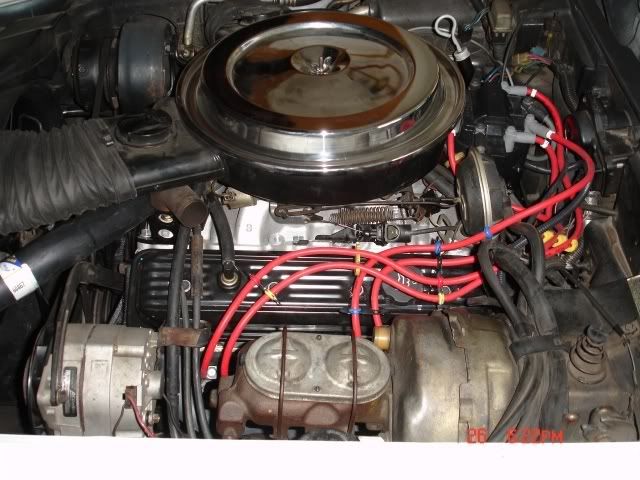
In this instance, enough voltage can be induced to cause a backfire when one of the cylinders is on the intake stroke and the plug wire to it has a current induced from a cylinder at the start of combustion. Firing spark plugs is non-trivial.
I think this is what Allen meant when he wrote that induced voltages are an iffy subject. They might not always make sense, but the problems happen anyway.
At any rate, I think the horse has been beaten to death and the OP should tell us what he learned days ago