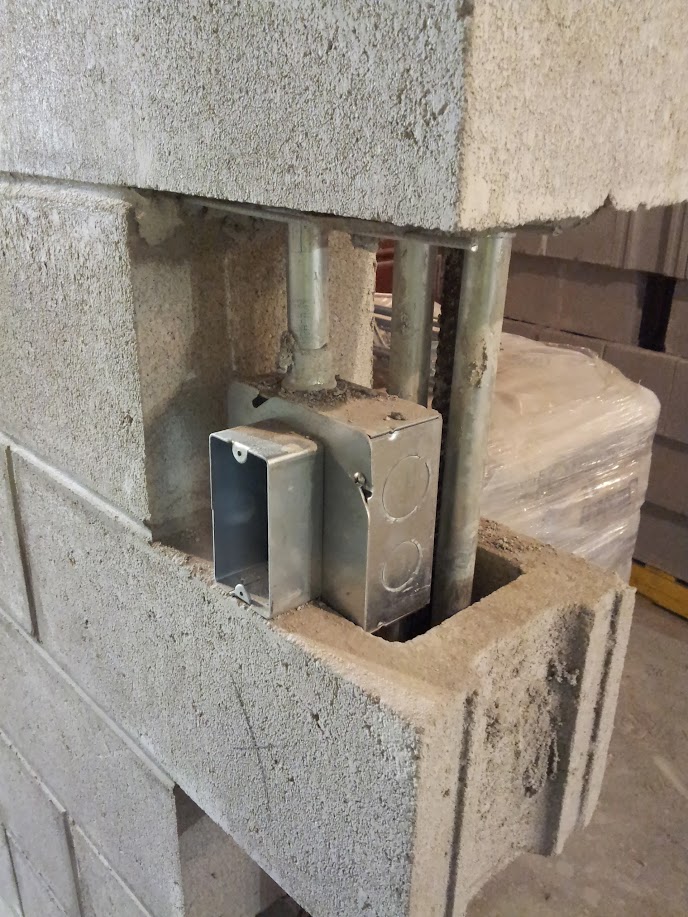
Mudrings and Boxes

Status
Not open for further replies.

JFletcher

Senior Member
Location
Williamsburg, VA
Is there any problem (code violation(s)) with setting a 1900 box back from the face of the stud and using a deeper ring to bring it flush with the drywall? Two reasons I want to do this: 1) More fill and 2) I have a load of 2" rings that will probably never get used otherwise.
 
In nyc its a violation to have more then 1/4" of space between the finish surface and the edge of a mud ring

Sent from my SM-N920P using Tapatalk
 
Is there any problem (code violation(s)) with setting a 1900 box back from the face of the stud and using a deeper ring to bring it flush with the drywall? Two reasons I want to do this: 1) More fill and 2) I have a load of 2" rings that will probably never get used otherwise.

The only problem that I see is that the mud ring won't be up against the back side of the drywall which means that the box must be very secure otherwise the mud ring will pull through the hole.
 
thanks guys. nickelec, are you saying the main body of the mudring (where the slots/holes are for the screws to the box) cannot be more than 1/4" back from the drywall, that the face (where the device mounts) cannot be more than 1/4" back, or that there cant be more than 1/4" gap around the edge of the ring? If it's the lattertwo, that's in the NEC. and if the wall type is combustible material like wood, there is no gap allowed.

I was thinking there might be a listing issue with the mudring main body not against the wall surface, especially if it a fire rated wall.
 
thanks guys. nickelec, are you saying the main body of the mudring (where the slots/holes are for the screws to the box) cannot be more than 1/4" back from the drywall, that the face (where the device mounts) cannot be more than 1/4" back, or that there cant be more than 1/4" gap around the edge of the ring?

That should be 1/8".

312.4 Repairing Noncombustible Surfaces.
Noncombustible surfaces that are broken or incomplete shall be re-
paired so there will be no gaps or open spaces greater than
3mm(1⁄8 in.) at the edge of the cabinet or cutout box
employing a flush-type cover
 
thanks guys. nickelec, are you saying the main body of the mudring (where the slots/holes are for the screws to the box) cannot be more than 1/4" back from the drywall, that the face (where the device mounts) cannot be more than 1/4" back, or that there cant be more than 1/4" gap around the edge of the ring? If it's the lattertwo, that's in the NEC. and if the wall type is combustible material like wood, there is no gap allowed.

I was thinking there might be a listing issue with the mudring main body not against the wall surface, especially if it a fire rated wall.

That should be 1/8".

312.4 Repairing Noncombustible Surfaces.
Noncombustible surfaces that are broken or incomplete shall be re-
paired so there will be no gaps or open spaces greater than
3mm(1⁄8 in.) at the edge of the cabinet or cutout box
employing a flush-type cover
As noted, gap is 1/8" for non-combustible surfaces.

Setback is 1/4" maximum in noncombustible surfaces, 0" in combustible.

314.20 In Wall or Ceiling. In walls or ceilings with a
surface of concrete, tile, gypsum, plaster, or other noncombustible
material, boxes employing a flush-type cover or
faceplate shall be installed so that the front edge of the box,
plaster ring, extension ring, or listed extender will not be
set back of the finished surface more than 6 mm (1⁄4 in.).
In walls and ceilings constructed of wood or other combustible
surface material, boxes, plaster rings, extension
rings, or listed extenders shall be flush with the finished
surface or project therefrom.
 
Ignorant Brit again.........
Mud ring?

A sheet metal ring mounted between the front of the box and the finish surface.

Originally to allow setting plaster (mud) to make the finished wall while the box was behind the lath that supported the plaster.

Different depth rings available for different construction details.
Not quite the same as an extension ring but used interchangeably by many people.
 
A sheet metal ring mounted between the front of the box and the finish surface.

Originally to allow setting plaster (mud) to make the finished wall while the box was behind the lath that supported the plaster.

Different depth rings available for different construction details.
Not quite the same as an extension ring but used interchangeably by many people.
Clear as mud.............:)
 
Another application:

NaGIJ1awwUIrBrVYH2wHtmxrlDOqbdm0RnK-EWdc76CpYrlVONuxRG8sQPFeyvznWwHlPdaV4MfzOtmi7FSwCbEjru73gETxKjdfPWohmef9IXYx3cZwkANt2ed-xyUyUFV44k4mjDdQruxcrRvbL1a0RlS1I_LSxy4eAUK7tM33yClw5JllYsJOLXNnrIjFpRYjpdcLwtDGXwgdFXCTD56imPnJiAnPhzjfBIZmX2i3EFAeeDPCRbWNJxVVpNbmDuu46TbQ5_KbE6C2QaLmAnldWN0sSzCoOoaVzyWzWl4SiSFmaxS53wCZ8xHApexNwm-AiUuw_48umt_E2UM9fjH00CNm5FbBMC6CfQyxzb_KceTmGZbrgMRfPczgczHuOdupXGyq4_pFJhKcDJgftwFn5g1zpYWxpP-mEuudR-4ZjUzM3yB4AWZXoO8qDHXNJ_x_U-kJH74mQeAUh2KbA9FSfYT_GS3KdjQIT6fPtqFmc4pPzyWaHfa7DhdQf90M9l1oGix65nj9s7_eexfbRFANthylk7b8wfKdWh4ZZS9_eNZxS-gYneryscV2XrvFduyxQ56-KZCGivMya4kDiWz09SynbpGOoav2IvAMBw5L2Lkc=w689-h917-no
 
Thanks. But still none the wiser. Sorry.
The point is to allow the box to be bigger than the hole in the finish material. So if you have a metal box that's 4" x 4" (x some depth), and you only want a (roughly) 2" x 4" hole in your finish material, you use a "mudring". It's just a piece of metal that fits over the 4" x 4" opening, has a reduced size 2" x 4" opening, and has a projecting collar deep enough to extend through the finish material to the finished surface.

Cheers, Wayne
 
The point is to allow the box to be bigger than the hole in the finish material. So if you have a metal box that's 4" x 4" (x some depth), and you only want a (roughly) 2" x 4" hole in your finish material, you use a "mudring". It's just a piece of metal that fits over the 4" x 4" opening, has a reduced size 2" x 4" opening, and has a projecting collar deep enough to extend through the finish material to the finished surface.

Cheers, Wayne
Thanks Wayne. I see now.
 
Status
Not open for further replies.
Top