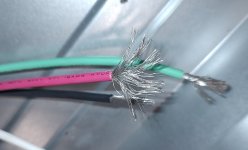
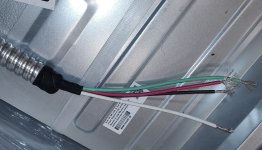
NEC 110.14 and highly stranded wire on oven

The ovens (and practically every appliance I looked into) use AWM wire. AWM wire is available in various strandings. Some are Class B or C. Some have higher strands. A good place to see them is in units that may be returned to the store. I saw an oven at Home Depot one time sitting on the floor. The customer had returned it, and they had put it there for a discounted sale. Otherwise, unfortunately, they do not let you look at this detail in the appliance before you buy it. Calling the manufacturer is completely useless, as they do not understand what you are talking about. And their installation manuals do not address this detail at all.
Crimp ferrules onto the wires if they're finely stranded, and use a Wago Lever-Lok or Polaris-style connector as you see fit. Ferrules solve this problem, making the end of the wire, no matter its strand count - a semi-solid conductor. It'll still smoosh (technical term) under the set screw in a Polaris connector, but the strands won't be cut by tightening the set screw. You'll need the new-ish Lever-Loks made for 10awg wire if you want to insert ferruled 12ga. The ferrules do bulk up the end of the wire a bit.

All that said, a properly made up wire nut termination has been field proven millions of times over, listing nonsense not withstanding. For up to 10awg, I'd use a good quality wirenut and not loose any sleep over it. That termination will likely outlive us all.


SceneryDriver
 
"Connect solid, stranded and fine-stranded conductors"

There are even some push-in connectors without levers, from Ideal I think, that specifically state you can push in fine stranded conductors, and I have done it, and it works fine, most of the time. Occasionally the fine strands will accordion but not usually.
 
From https://www.wago.com/us/lp-221 on WAGO 221 Series LEVER-NUTS

"Connect solid, stranded and fine-stranded conductors"

Cheers, Wayne
Very interesting. I contacted Wago tech support and specifically asked them this question. This is what I got: "
Hello,

Our products are UL approved for B and C strands. You can use a Ferrule on the flexible wire and it would be considered a solid wire.


Kind regards,

Kellie Galvan


Technical Support


WAGO CORPORATION
N120 W19129 Freistadt Rd
Germantown WI 53022
www.wago.com/us/
 
I would have no problem wire nutting that to solid #12.

-Hal
Thank you, Hal. Your point is taken. Almost all of these connections are done with regular wire nuts - whether because the electrician is not aware of 110.14, or because they are aware of it and believe the NEC requirement to be nonsensical. But this leaves a big Code application issue. We can not just ingone the NEC. If we start ignoring clauses here and there because they seem impractical, soon we don't have a Code.
 
I agree with Larry

this only a NEC wording issue.
Its not practical to UL list every type of stranded wire a wirenut can be combined with, and it does appear to be a common practice, many lighting fixtures now only come come with metric wire of a unknown stranding.
my fix would be add an exception
something like
Proposed Exception to 110.14(C):
This is a good approach. The Code-making panel may have been responding to a problem with larger conductors, but wrote the article too broadly.
 
Are Lever-nuts? I thought they were.

Mark
The Wago literature is very confusing. They say their product can be used on flex wires, but they do not specify what they mean by flex wire - what kind of stranding. I contacted their tech support and asked the question and got this answer:
Hello,

Our products are UL approved for B and C strands. You can use a Ferrule on the flexible wire and it would be considered a solid wire.


Kind regards,

Kellie Galvan


Technical Support


WAGO CORPORATION
N120 W19129 Freistadt Rd
Germantown WI 53022
www.wago.com/us/
 
ist only been in the NEC since 2011, the proposals that created this limitation stemmed from issues unique to solar photovoltaic systems and other types of splicing wire connectors, not standard wirenuts splicing a 14 AWG solid to a 18AWG Class K stranding fixture wire.
This tells a lot about the problem. The CMP, responding to a unique problem, issued a generalized mandate. Which CMP is in charge of 110.14?
 
Every oven for for residental use has flexible metal conduit with finely stranded wire? Since when? I have see a few with this but most are set up for cord and plug use. Can use a 3 wire cord for older 3 wire outlets or a 4 wire cord for newer outlets.
Wall Ovens... not ranges. Ranges are coreded, 3 or 4 prong gotta install the cord for the house. Wall ovens are hardwired.
 
This tells a lot about the problem. The CMP, responding to a unique problem, issued a generalized mandate. Which CMP is in charge of 110.14?
I think that would be a pretty easy Public Input (PI) AKA code change proposal to the 2029 NEC add a exception to 110.14
Exception: Splicing wire connectors of the twist-on and lever-type identified for use with stranded copper conductors not larger than 10 AWG shall be permitted to splice copper conductors more finely stranded than Class B and Class C, provided the conductors are within the connector’s marked conductor size range.
 
Top