
Overstuffed J-Box?

Status
Not open for further replies.

IslanderVT

Member
Location
Northern VT
Occupation
Engineer
This is a J-Box we did to transition from a 4/0 SER indoor run to 4/0 URD outdoor run. Its for a 24kW solar array....they're not service entrance conductors.

We put in an 8x8x4 J-Box, but after wiring it got pretty tight.

Did we overdo it? Is this J-Box too full?

The romex shown is a branch circuit for outlets in the garage that passes through. The two empty LB's are for communication wiring which isn't run yet.

Thanks!
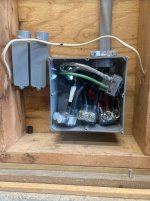
Very Full J-Box.JPG
 
Might be close, I didn't look up the box dimensions table. But it something like 6X the size of the conduit or cable entry. Looks like you missed a connector in the back of the box.
 
Might be close, I didn't look up the box dimensions table. But it something like 6X the size of the conduit or cable entry. Looks like you missed a connector in the back of the box.
Agree on the 6x dimension. 2 inch entry would need minimum of a 12 inch length to opposite wall.

Also that metal cable clamp needs to be bonded somehow.
 
Agree on the 6x dimension. 2 inch entry would need minimum of a 12 inch length to opposite wall.

Also that metal cable clamp needs to be bonded somehow.
Not a fan of PVC boxes unless all NM fittings are used, hopefully those LB's are going to remain accessible in the future.
 
Thanks for the feedback.

Yes this wall will be sheetrocked, but have an access panel for the J-Box and LB's.

Thanks for the tip on bonding the clamp...we missed that.
 
Might be close, I didn't look up the box dimensions table. But it something like 6X the size of the conduit or cable entry. Looks like you missed a connector in the back of the box.
There is no way that is compliant with 314.28(A)(2). If I measure the connector in the picture and apply the 6 x rule, the box is about 1/2 the code required size.
 
Just FYI, when sizing a this J box you have to comply with 312.6(A) for the distance from the back entrance to the front cover. It is 4" for 4/0 so you are in compliance there, not for 314.28 though, as mentioned.
 
So if that's 4/0-4/0-4/0-2/0 SER with XHHW insulation, and the conductors are compact aluminum, then per 2017 NEC Chapter 9 Table 5A, the insulated 4/0s have an area of 3 * 176.3 mm2 and the bare 2/0 has a diameter of 9.55 mm, or an area of pi/4 * 9.552 = 71.6 mm2. That makes the total area of the conductors 600.5 mm2, so the minimum conduit area would be 600.5/40% = 1501 mm2.

Looking at Chapter 9 Table 5, every 1-1/2" conduit has an area of less than 1501 mm2 (although PVC Type A is close at 1500 mm2). So 2" is the minimum size equivalent conduit, and the 6x rule requires a 12" box dimension.

Cheers, Wayne
 
There is no way that is compliant with 314.28(A)(2). If I measure the connector in the picture and apply the 6 x rule, the box is about 1/2 the code required size.
Never said it was compliant. That's why I said "close" and said I didn't look up the requirements. Plus, I didn't know the connector size.
 
There is no way that is compliant with 314.28(A)(2). If I measure the connector in the picture and apply the 6 x rule, the box is about 1/2 the code required size.
The proverbial trying to stuff 10 pounds of manure in a 5 pound bag, always like to be generous with box sizing just makes life easier plus staying code compliant.
 
So if that's 4/0-4/0-4/0-2/0 SER with XHHW insulation, and the conductors are compact aluminum, then per 2017 NEC Chapter 9 Table 5A, the insulated 4/0s have an area of 3 * 176.3 mm2 and the bare 2/0 has a diameter of 9.55 mm, or an area of pi/4 * 9.552 = 71.6 mm2. That makes the total area of the conductors 600.5 mm2, so the minimum conduit area would be 600.5/40% = 1501 mm2.

Looking at Chapter 9 Table 5, every 1-1/2" conduit has an area of less than 1501 mm2 (although PVC Type A is close at 1500 mm2). So 2" is the minimum size equivalent conduit, and the 6x rule requires a 12" box dimension.

Cheers, Wayne
Box will be required to be bigger than 12”. Measurement is between raceways or entries.
 
Box will be required to be bigger than 12”. Measurement is between raceways or entries.
Let's see, the applicable sentence from (2017) 314.28(A)(2) is "Where splices or where angle or U pulls are made, the distance between each raceway entry inside the box or conduit body and the opposite wall of the box or conduit body shall not be less than six times the metric designator (trade size) of the largest raceway in a row."

Are you say that that the "raceway entry inside the box" would be measured from the face of that bushing on the cable connector, rather than from the inside face of the wall of the box?

Cheers, Wayne
 
Yes. Inner edge to inner edge.
Hmm, that's not clear to me, as "raceway entry inside the box" could mean "point where the raceway enters the box", i.e. the inside face. However, if an AHJ interprets it your way, it would be hard to rebut, as that phrase could instead mean "end of the raceway inside the box".

Cheers, Wayne
 
Box will be required to be bigger than 12”. Measurement is between raceways or entries.
In my opinion the language in 314.28(A)(2) that says; "The distance between raceway entries enclosing the same conductor shall not be less than six times the metric designator (trade size) of the larger raceway." does not apply where the conductors are spliced.
 
Is it likely to become energized??
No different then a metal lock nut.
Inspector here does not make us bond it, maybe he just never paid attention.
250.4(A)(3) does not have the "likely to become energized" language and a strict reading of that language would require the metal lock nut to be bonded. However I have never heard of that being enforced that way. I have heart of the bonding of the metal connector being enforced.
 
In my opinion the language in 314.28(A)(2) that says; "The distance between raceway entries enclosing the same conductor shall not be less than six times the metric designator (trade size) of the larger raceway." does not apply where the conductors are spliced.
314.28(A)(2)- “Where splices…………..”?
 
Status
Not open for further replies.
Top