I appreciate everyone's input, when we put this plan together originally it felt off to run the smaller wire but we couldn't find a reason why we shouldn't, which is why i posted this. We have also for logistical reasons down sized to a 600 amp load center, and moved it adjacent to our switchgear so instead of a 150' run its become a 20' run, and we will make up the distance with our smaller branch circuits. Unfortunately it has almost double our cost in wire

You are using an out of date browser. It may not display this or other websites correctly.
You should upgrade or use an alternative browser.
You should upgrade or use an alternative browser.
Parallel conductors opinions
- Thread starter ASully
- Start date

busman
Senior Member
- Location
- Northern Virginia
- Occupation
- Master Electrician / Electrical Engineer
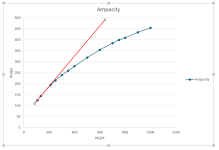
Like this? I drew the red line to show the linear trend of the smaller conductors.Seems to me the way to present the data would be to have MCM on the x-axis, rather than equally spacing the points. Then you could omit the blue line, as it would be straight, and we could see how much the orange line deviates from straight.
Cheers, Wayne

- Location
- New Jersey
- Occupation
- Journeyman Electrician (retired)
Where are the ampacity numbers from? 600 kcmil is much higher than ~350 amps. Are you using 60° C?Like this? I drew the red line to show the linear trend of the smaller conductors.
busman
Senior Member
- Location
- Northern Virginia
- Occupation
- Master Electrician / Electrical Engineer
Yes, these are all 60C numbers from the old 310.16. I thought I said that in an earlier post.Where are the ampacity numbers from? 600 kcmil is much higher than ~350 amps. Are you using 60° C?
Last edited:
busman
Senior Member
- Location
- Northern Virginia
- Occupation
- Master Electrician / Electrical Engineer
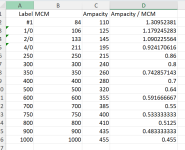
Even though I drew a "straight line" which is straight, the data is not "straight" even for smaller conductors. Raw data below:
wwhitney
Senior Member
- Location
- Berkeley, CA
- Occupation
- Retired
The trend will be the same whether you use 60C, 75C, or 90C. Based on equation 310.15(B)(1), for any given size, the 75C ampacity should be sqrt(3/2) times the 60C ampacity, and 90C ampacity should be sqrt(2) times the 60C ampacity.Where are the ampacity numbers from? 600 kcmil is much higher than ~350 amps. Are you using 60° C?
Cheers, Wayne
wwhitney
Senior Member
- Location
- Berkeley, CA
- Occupation
- Retired
Yes, precisely.Like this?
If you want to take this a step further, you could add in the data down to #8 (or even #14, but the rounding to the nearest 5A in the table will make the smallest sizes much noisier), and then plot the natural log (ln) of ampacity vs the nautral log of MCM. If the relationship is any kind of simple power law (like, say, ampacity = constant * MCM^(2/3) or something like that), then the plot will be a straight line.
If we see that the plot is a straight line for smaller sizes and then there's a curve or kink in the graph starting at quite large sizes, then that would be evidence that the data reflects some new phenomenon at those large sizes. E.g. skin effect.
Cheers, Wayne
Boingo1972
Member
- Location
- South Carolina
- Occupation
- Engineer for cable company
I would look at single conductor MC cables since they are rated "free air" and will have a much higher ampacity for a given wire size. Some of them you can even use the armor as the ground or if not, just run a seperate one for a ground. You can get that down to 2 sets which saves labor, time and space. Just make sure you cut a slit between the holes when terminating (if the panel/box/cabinet if ferrous). And since these are "bunched" (not grouped per NEC definition) they don't need derating either. Sure the cable costs more, but you may save on the labor/materials in the end.
busman
Senior Member
- Location
- Northern Virginia
- Occupation
- Master Electrician / Electrical Engineer
I did this earlier, but didn't have time to post it. I'll put it up on Monday when I'm back in the office.Yes, precisely.
If you want to take this a step further, you could add in the data down to #8 (or even #14, but the rounding to the nearest 5A in the table will make the smallest sizes much noisier), and then plot the natural log (ln) of ampacity vs the nautral log of MCM. If the relationship is any kind of simple power law (like, say, ampacity = constant * MCM^(2/3) or something like that), then the plot will be a straight line.
If we see that the plot is a straight line for smaller sizes and then there's a curve or kink in the graph starting at quite large sizes, then that would be evidence that the data reflects some new phenomenon at those large sizes. E.g. skin effect.
Cheers, Wayne
Mark

LarryFine
Master Electrician Electric Contractor Richmond VA
- Location
- Henrico County, VA
- Occupation
- Electrical Contractor
Don't metallic fittings and lock-nuts effectively shunt the slit?Just make sure you cut a slit between the holes when terminating (if the panel/box/cabinet if ferrous).