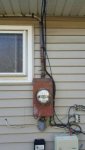
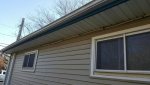
Question on new service

Merry Christmas
Status
Not open for further replies.

JohnDS

Senior Member
Location
Suffolk, Long Island
Occupation
Electrician
I have a few questions on code violations on this service.

1) is it a code violation to run sch80 pvc through this soffit and stapped to the 4x4?

2) Is it a code violation to run seu this close to windows?

3) Is it a code violation to run seu through the soffit like this?
123_1.jpg
A.jpg
818e0a3e7cfeabe55eb5b2e30a503d2c.jpg


Sent from my SAMSUNG-SM-G730A using Tapatalk
 
Are you asking what the rules are today or what the rules were when it was built?
 
No
No
No

the metal sofit was no doubt put in many years after SE.
My questions were referring to if it was redone today like this. This service will be replaced with a 200a service. Can you please confirm your answers given this information?

Sent from my SAMSUNG-SM-G730A using Tapatalk
 
Last edited:
Service drops can be attached to structure -- SE cable can be used as service conductors -- service drops shall be 3' from windows 230.9 for cable without a jacket cover -- the only question is the eve & if the service conductor needs to be protected from physical damage by either location or that it enters the building for 18".

1 - why not
2 - SE cable no
3 - good question for the AHJ
 
Last edited:
Service drops can be attached to structure -- SE cable can be used as service conductors -- service drops shall be 3' from windows 230.9 for cable without a jacket cover -- the only question is the eve & if the service conductor needs to be protected from physical damage by either location or that it enters the building for 18".

1 - why not
2 - SE cable no
3 - good question for the AHJ
Im sorry, I am still not understanding.

1)Why not what? Are you saying its ok to run sch 80pvc through soffit? If that is the case then I guess it would be better to just pipe the whole service out in sch 80pvc so it looks nice also.

2) Ok so seu is ok this close to windows. It looks like in the photos that the emt that protects the seu is not 10' from dirt which i believe is code. When replaced with new, I dont think it will be able to satisfy this code. What are options?

3) Just for the sake of argument about pvc through soffit ( i was thinking of transitioning to galvanized right before the soffit penetration. Maybe this would be a good idea in the case where the point of attachment is not high enough to meet code, it can be higher than 4x4, whereas if pvc, it can only be strapped no higher than 4x4? What do you think?

Sent from my SAMSUNG-SM-G730A using Tapatalk
 
The riser which the overhead service conductors enter at a weatherhead are generally required to be metal rather than PVC just for structural strength. But if the overhead conductors are supported separately by the building structure that is not an issue.
 
Im sorry, I am still not understanding.

1)Why not what? Are you saying its ok to run sch 80pvc through soffit? If that is the case then I guess it would be better to just pipe the whole service out in sch 80pvc so it looks nice also.

2) Ok so seu is ok this close to windows. It looks like in the photos that the emt that protects the seu is not 10' from dirt which i believe is code. When replaced with new, I dont think it will be able to satisfy this code. What are options?

3) Just for the sake of argument about pvc through soffit ( i was thinking of transitioning to galvanized right before the soffit penetration. Maybe this would be a good idea in the case where the point of attachment is not high enough to meet code, it can be higher than 4x4, whereas if pvc, it can only be strapped no higher than 4x4? What do you think?

Sent from my SAMSUNG-SM-G730A using Tapatalk

Yes sleeves through the soffit is your choice -- pvc does not need bonded

The protection from physical damage can be arbitrary to location but I think somewhere in the code (NM) it refers to 8' above grade

Why not just set the MDP directly below the roof penetration & run the feeder over to the subpanel
 
One question I would have is how is the penetration through the roof going to be sealed, other then gobs of roofing mastic which reeks of trouble, seems to me that getting rid of the 6X6 & using a rigid, or IMC, riser would clean things up a lot.
 
That is running the unprotected service conductors through the building and requires the use of rigid or IMC. 230.6(5).
 
That is running the unprotected service conductors through the building and requires the use of rigid or IMC. 230.6(5).


Don, I could read the RMC & IMC requirements through the eve are only due to using the raceway as an attachment point for the service drop -- Since the attachment point ( in this specific case) is the structural support the type of raceway could be per 230.32 - referencing 230.6 & 230.43 -- IMHO
 
One question I would have is how is the penetration through the roof going to be sealed, other then gobs of roofing mastic which reeks of trouble, seems to me that getting rid of the 6X6 & using a rigid, or IMC, riser would clean things up a lot.
That is my biggest issue with it. Many old farm buildings supplied by overhead wiring had similar wood masts to attach the overhead conductors to gain some height. I have replaced many of them that not only does the riser piece rot out but often what it is attached to on the building needs replaced as well. Roof flashings for RMC/IMC seem to last a lot longer

That is running the unprotected service conductors through the building and requires the use of rigid or IMC. 230.6(5).

Don, I could read the RMC & IMC requirements through the eve are only due to using the raceway as an attachment point for the service drop -- Since the attachment point ( in this specific case) is the structural support the type of raceway could be per 230.32 - referencing 230.6 & 230.43 -- IMHO
I think you will see varying enforcement on this just like they vary on how much service conductor can enter a structure before it needs to hit the service overcurrent device.
 
Don, I could read the RMC & IMC requirements through the eve are only due to using the raceway as an attachment point for the service drop -- Since the attachment point ( in this specific case) is the structural support the type of raceway could be per 230.32 - referencing 230.6 & 230.43 -- IMHO
The substantiation for the change had nothing to do with using the raceway as an attachment point. It was about unprotected service conductors in the building.
 
Thanks everyone for the replies. If I were to transition from pvc to galvanized right before it penetrates the soffit, I think it would satisfy this gray area of not being 100% on whether gal or pvc can be used. My concern now if it is done this way, that will I run into trouble bonding the galvanized pipe since pvc pipe is in between galvanized pipe and meter. Am I correct, or is there a way to still bond the gal, or do you even have to?

As for moving the meter directly under the point of attachment, I guess that is a possibility if all else fails.
 
Thanks everyone for the replies. If I were to transition from pvc to galvanized right before it penetrates the soffit, I think it would satisfy this gray area of not being 100% on whether gal or pvc can be used. My concern now if it is done this way, that will I run into trouble bonding the galvanized pipe since pvc pipe is in between galvanized pipe and meter. Am I correct, or is there a way to still bond the gal, or do you even have to?

As for moving the meter directly under the point of attachment, I guess that is a possibility if all else fails.
an isolated metal section of raceway will need bonded. A metal sleeve for physical protection of a cable would not need bonded. (not sure off top of my head if this would be different for service cables, but with other cables you don't have to bond a metal sleeve that is for physical protection only.
 
an isolated metal section of raceway will need bonded. A metal sleeve for physical protection of a cable would not need bonded. (not sure off top of my head if this would be different for service cables, but with other cables you don't have to bond a metal sleeve that is for physical protection only.

That's a really good idea. Can anyone confirm if a short piece of emt sleeved through the soffit would be acceptable if new SEU is ran?
 
That's a really good idea. Can anyone confirm if a short piece of emt sleeved through the soffit would be acceptable if new SEU is ran?
I believe that the intent of 230.6(5) is that the service conductors are run in a complete conduit system and not just sleeved, but it doesn't actually say that. 230.92 will require that this conduit be bonded.

The rule in the 2011 code said only conductors in overhead service masts could pass through the eave area.
(2011 NEC) 230.6(5) Where installed in overhead service masts on the outside surface of the building traveling through the eave of that building to meet the requirements of 230.24
This rule was placed into the code as a result of the panel action on comment 4-64.
(2011 ROC)4-24 Log #2545 NEC-P04 Final Action: Accept in Principle
(230.6)
_______________________________________________________________
Submitter: Frederic P. Hartwell, Hartwell Electrical Services, Inc.
Comment on Proposal No: 4-64
Recommendation: Accept the proposal in principle and in part. Continue to reject item (5). Accept item (6) [which will become (5)] reworded as follows:
(5) Where installed within rigid metal conduit (Type RMC) or intermediate metal conduit (Type IMC) used to accommodate the clearance requirements in 230.24 and routed directly through an eave but not a wall of a building.
Substantiation: At the most recent IAEI Section Meeting, considerable discussion took place around whether service conductors traveling within an outer building wall had actually entered the building. The consensus was that as soon as the outer membrane had been penetrated, the conductors had entered the building. This submitter fully endorses this conclusion, but it makes service masts of the sort described in the proposal substantiation problematic. Do they penetrate the outer building membrane? Of course they do. Does anyone in their right mind want to disallow such masts? Probably not, but the panel statement that the application is “clearly outside the building” is incorrect in this instance.
This proposal addresses the question, but limits the application to heavy wall steel raceways. Remember that masts are not necessarily steel pipe; a heavy timber with cable on it is a mast within the provisions of 230.28. This section clearly indicates this by addressing raceway masts as simply one possibility in the second sentence. Heavy wall conduit masts have been used for this purpose for generations without objections. The proposal further qualifies the acceptable use to a direct pass-through. The submitter was once presented, as an inspector, with a conduit run that went up the outside of a building, then horizontally through an eave cavity some ten feet, and then up to its eventual
weatherhead.
Panel Meeting Action: Accept in Principle
Revise the proposed text to read as follows:
(5) Where installed in overhead service masts on the outside surface of the building traveling through the eave of that building to meet the requirements of 230.24.
Panel Statement: The addition of item six in Proposal 4-46, renumbered as item 5, will clarify what the is allowed.
Number Eligible to Vote: 10
Ballot Results: Affirmative: 9 Negative: 1
Explanation of Negative:
ROGERS, J.: This change is not really necessary and the Panel should retain the rejection and rationale used in the ROP stage. In addition the change made by the Panel at the ROC meeting creates a greater enforcement problem.
Comment on Affirmative:
STAFFORD, T.: It appears that the panel statement is incorrect and incomplete as noted on the ballot document.

In the 2014 code the wording of 230.6(5) was changed to:
230.6(5) Where installed within rigid metal conduit (Type RMC) or intermediate metal conduit (Type IMC) used to accommodate the clearance requirements in 230.24 and routed directly through an eave but not a wall of a building.
This change was based on the following proposal:
4-103 Log #3067 NEC-P04 Final Action: Accept
(230.6(5))
________________________________________________________________
Submitter: Frederic P. Hartwell, Hartwell Electrical Services, Inc. / Rep.
Massachusetts Electrical Code Advisory Committee
Recommendation: Revise as follows:
(5) Where installed in overhead service masts on the outside surface of the building traveling through the eave of that building to meet within rigid metal conduit (Type RMC) or intermediate metal conduit (Type IMC) used to accommodate the clearance requirements of in 230.24 and routed directly through an eave but not a wall of a building.
Substantiation:
This proposal limits the application of the new NEC provision to heavy wall steel raceways passing directly through an eave cavity. Remember that masts are not necessarily steel pipe; a heavy timber with cable on it is a mast within the provisions of 230.28, which clearly indicates this by addressing raceway masts as simply one possibility in the second sentence. Heavy wall conduit masts have been used for this purpose for generations without objections. The proposal further qualifies the acceptable use to a direct pass-through. The Committee was presented with examples of installations such as one with a PVC conduit run that went up the outside of a building, then horizontally through an eave cavity some ten feet, and then up to its eventual weatherhead. This type of exposure was never intended.
Panel Meeting Action: Accept
Number Eligible to Vote: 11
Ballot Results: Affirmative: 11
 
Last edited:
I believe that the intent of 230.6(5) is that the service conductors are run in a complete conduit system and not just sleeved, but it doesn't actually say that. 230.92 will require that this conduit be bonded.

The rule in the 2011 code said only conductors in overhead service masts could pass through the eave area.

This rule was placed into the code as a result of the panel action on comment 4-64.

In the 2014 code the wording of 230.6(5) was changed to:

This change was based on the following proposal:

Now that's an answer! :thumbsup:
 
Status
Not open for further replies.
Top