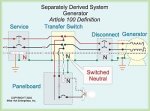
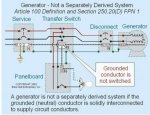
Separately derived system (generator) and selection of correct transfer switch

Merry Christmas
Status
Not open for further replies.
Hello-I would like too see if anyone typically specifies a separately derived system (generator) but uses 3 pole transfer switches with this system. This would be for the case where the loads served from the generator do not require a neutral at the present time however a neutral is brought to the generator distribution panel in case of future need for it.
 
Hello-I would like too see if anyone typically specifies a separately derived system (generator) but uses 3 pole transfer switches with this system. This would be for the case where the loads served from the generator do not require a neutral at the present time however a neutral is brought to the generator distribution panel in case of future need for it.

Assuming you are talking about three phase you can't have a three pole transfer switch and a SDS at the same time even if the neutral is not required for the loads served.
 
Assuming you are talking about three phase you can't have a three pole transfer switch and a SDS at the same time even if the neutral is not required for the loads served.

Please explain in more detail your above statement.

NEC Article 100
Separately Derived System. An electrical source, other than a service, having no direct connection(s) to circuit conductors of any other electrical source other than those established by grounding and bonding connections.
 
My understanding is that IF you decide to switch the neutral then it'an SDS. If you land the neutral on a common neutral bar it is not.
 
OP would need a 4 pole for a 3 phase SDS genny set up. Neutral would have to switched.

Agree.

Key words the OP used in his posted thread, "Separately Derived System".

Wherein the generator's neutral is grounded.

250.30
The informational note does a good job of explaining how to treat the neutral in a transfer switch when a generator is wired as a Separately Derived System or when it is not.
 
Hello-I would like too see if anyone typically specifies a separately derived system (generator) but uses 3 pole transfer switches with this system. This would be for the case where the loads served from the generator do not require a neutral at the present time however a neutral is brought to the generator distribution panel in case of future need for it.

You likely defeat ground fault systems by doing this.
 
Thank you for your responses! I wanted to add some additional information - the generator is outside of the building that it is serving; the feed from the generator goes to a generator distribution panel inside of the building (and the transfer switches are downstream from the generator distribution panel). The thought it to terminate the neutral at the GDP (distribution panel) and use 3 pole transfer switches. So I would like to know if this would be considered a separately derived system?
 
Thank you for your responses! I wanted to add some additional information - the generator is outside of the building that it is serving; the feed from the generator goes to a generator distribution panel inside of the building (and the transfer switches are downstream from the generator distribution panel). The thought it to terminate the neutral at the GDP (distribution panel) and use 3 pole transfer switches. So I would like to know if this would be considered a separately derived system?

Will the generator neutral conductor be grounded at the generator? If yes then it is wired as a Separately Derived System. Therefore IF a transfer switch, (TS), is used where a neutral is required the neutral shall be switched.

Say the TS will be transferring 3PH power loads only. There will not a neutral conductor entering the TS. (Generator feeder to TS is 3PH only, no neutral conductor. Then all that is needed is a 3 pole TS.)

>>

https://www.ecmag.com/section/codes-standards/generator-grounding-and-bonding-essentials

http://www.kinsley-group.com/files/..._When to switch transfer switch neutral 3.pdf
 
Thank you for your responses! I wanted to add some additional information - the generator is outside of the building that it is serving; the feed from the generator goes to a generator distribution panel inside of the building (and the transfer switches are downstream from the generator distribution panel). The thought it to terminate the neutral at the GDP (distribution panel) and use 3 pole transfer switches. So I would like to know if this would be considered a separately derived system?
The image Jumper posted is an excellent answer to your question. You have to have the generator neutral bonded whether you use it at the generator panel or not.

If you don't switch the neutral then you don't have an SDS. There isn't any advantage of switching the neutral unless you have ground fault protection.
 
The image Jumper posted is an excellent answer to your question. You have to have the generator neutral bonded whether you use it at the generator panel or not.

If you don't switch the neutral then you don't have an SDS. There isn't any advantage of switching the neutral unless you have ground fault protection.

Jennifer K. said:
"Thank you for your responses! I wanted to add some additional information - the generator is outside of the building that it is serving; the feed from the generator goes to a generator distribution panel inside of the building (and the transfer switches are downstream from the generator distribution panel). The thought it to terminate the neutral at the GDP (distribution panel) and use 3 pole transfer switches. So I would like to know if this would be considered a separately derived system?"


"The thought it to terminate the neutral at the GDP (distribution panel) and use 3 pole transfer switches. So I would like to know if this would be considered a separately derived system?"


Jennifer K would still be wiring the generator as a separately derived system.


Original thread:

Hello-I would like too see if anyone typically specifies a separately derived system (generator) but uses 3 pole transfer switches with this system. This would be for the case where the loads served from the generator do not require a neutral at the present time however a neutral is brought to the generator distribution panel in case of future need for it.

"This would be for the case where the loads served from the generator do not require a neutral at the present time"

 
Last edited:
Jennifer K. said:
"Thank you for your responses! I wanted to add some additional information - the generator is outside of the building that it is serving; the feed from the generator goes to a generator distribution panel inside of the building (and the transfer switches are downstream from the generator distribution panel). The thought it to terminate the neutral at the GDP (distribution panel) and use 3 pole transfer switches. So I would like to know if this would be considered a separately derived system?"


"The thought it to terminate the neutral at the GDP (distribution panel) and use 3 pole transfer switches. So I would like to know if this would be considered a separately derived system?"


Jennifer K would still be wiring the GDP as a separately derived system.
And I would imagine the GDP has a main at the GDP.


Original thread:


"This would be for the case where the loads served from the generator do not require a neutral at the present time"


I don't care if the neutral is used or not it gets brought to the transfer switch. The generator neutral gets bonded either to the buildings electrical or at the genny. If it gets bonded at the genny then it gets switched at the transfer switch and is an SDS. But there is no reason to do that.
 
Lets back up and take a deep breath. If you have 3 phase utility service (assume 480V for example) with no phase to neutral loads, the noodle stops at the first disconnect. Now you have a stand by 480V generator N bonded to EGC (and GEC for that matter), again the noodle stopes at first disconnect for stand by generator. Now you have a 3 phase transfer switch between stand by gen and utility. There would be no use or need to use a 4 pole transfer switch. I have seen many many systems set up this way all under very stringent inspection and engineering.
 
Hi ActionDave,

Not that it would change your previous response to my post but I did edit my post you responded to somewhat.

I don't care if the neutral is used or not it gets brought to the transfer switch. The generator neutral gets bonded either to the buildings electrical or at the genny. If it gets bonded at the genny then it gets switched at the transfer switch and is an SDS. But there is no reason to do that.


The generator neutral gets bonded either to the buildings electrical or at the genny. If it gets bonded at the genny then it gets switched at the transfer switch and is an SDS.
Totally 100% unequivocally agree.:happyyes: No where in any of my posts to this thread have I said otherwise.

I don't care if the neutral is used or not it gets brought to the transfer switch.

And there is where we part company.

If the existing connected load is 3ph only and the normal power that feeds the existing connected load is 3ph only, and a TS is installed to feed 3ph generator power to the 3ph only connected load, please explain how the dead ended neutral conductor from the generator, that is connected to a solid neutral bus in the TS, will bond the neutral conductor to the existing system ground of the building?

Just the basics.
Keep in mind the OP said in her original posted message (If I read it correctly) at first only a 3ph TS would be installed to feed generator power to a 3ph only load. No neutral is present/used at the existing 3ph normal power load.
How much of the existing building are you going to rewire to satisfy a non SDS system?

Best regards,
Jim


.
 
Last edited:
I don't care if the neutral is used or not it gets brought to the transfer switch. The generator neutral gets bonded either to the buildings electrical or at the genny. If it gets bonded at the genny then it gets switched at the transfer switch and is an SDS. But there is no reason to do that.

I think what James is saying is that if no loads require a neutral, the genny could be be up as a SDS and you would not have to switch the neutral. I think the noodle would only technically have to go to the disco. GES would still need to be at genny.

Problem is that if one does this, one is screwed if one has to add a load that needs a neutral later. The transfer switch would have to be swapped out.
 
Status
Not open for further replies.
Top