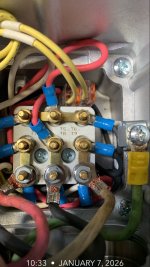
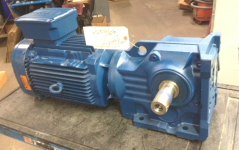
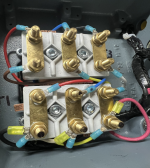
SEW EURO DRIVE 12 Lead Motor

That's a 10 like on your typical food processing conveyor

1768160564598.png

Makes my bones hurt just thinking about it. Probably in a waste or byproduct area covered in yummies. At least that would be my luck
 
1768221645688.png
I had to trace the wires back to what side of the motor they came up into the termination box. The wires themselves were not numbered. The terminal block was labeled. But this was all taken apart bagged separately.
 
Do you have all the nameplate info?

I remember some of these things being made for European voltages like 380/220, and some had delta and wye configurations listed for the same motor. Lots of variations.

It looks delta in the picture
 
Do you have all the nameplate info?

I remember some of these things being made for European voltages like 380/220, and some had delta and wye configurations listed for the same motor. Lots of variations.

It looks delta in the picture
Normally it is European 400/230 50Hz.
 
In the food plants they were all run off of VFDs. So they could be anything. I saw some weird SEW Eurodrives that made me do a double take. Candy machinery especially. Lots of German machinery. Bosch, Sig-Pac, Bindler, Buhler, Hebenstreit.
But they will still need some supply input.
 
But they will still need some supply input.
All typical us industrial. Mostly 480/277v 60hz, but coming out of the VFDs could be anything. They speed up and slow down while in operation. Even the ones not connected to the PLC are usually not running on any standard frequency, they are all set at whatever it needs to be to make production work right.

World needs their Cadbury eggs and their KitKat bars
 
Normally it is European 400/230 50Hz.
@Besoeker3 you will be pleased to learn that here in our 2026 code we added 416/240 as a 'standard' voltage [2026 NEC Section 120.6(A)], now its not your 400/230 but close enough eh?
Now you can remind us that among all our standard voltages we now have that one. :)
It will be helpful for engineers to not have to guess what voltage to use when doing calculations for loads in that now not uncommon but still not regulary used voltage range here.
 
@Besoeker3 you will be pleased to learn that here in our 2026 code we added 416/240 as a 'standard' voltage [2026 NEC Section 120.6(A)], now its not your 400/230 but close enough eh?
Now you can remind us that among all our standard voltages we now have that one. :)
It will be helpful for engineers to not have to guess what voltage to use when doing calculations for loads in that now not uncommon but still not regulary used voltage range here.
And still we use 50 Hz for the entire EU. And much of the African nations. And how about Australian Pounds?
 
The cast aluminum peckerhead on those motors was always a royal pain. Hard to make work well with regular standard US connectors and hardware. Yeah you can get the right stuff and do it nice. But at 3AM chances are you've got to make something work.

And not only is the hole metric, but the casting is thick in that spot, so it's hard to get enough reach out of standard connectors to get a locknut on the inside
 
US consumers carry more Pounds, and like larger trunks, because we need both metric & imperial standard tools when we break down.
Actually we Brits used Imperial units until about 1980 and many still do like my sister. In fact British pubs use pints to this day.
 
Actually we Brits used Imperial units until about 1980 and many still do like my sister. In fact British pubs use pints to this day.
Did not realize that. We have a lot more in common than I thought.

Now all you Brits need, it to drive on the Right side of the road, and we'll all get along fine.
 
Did not realize that. We have a lot more in common than I thought.

Now all you Brits need, it to drive on the Right side of the road, and we'll all get along fine.
Probably so. At least we have the English Language in common.
 
Sensor can't handle motor current unless it would be a pretty low power motor, like maybe 1/8 or 1/10 HP or less.
All of the motor senses that I came across only had two wires so even if the three phase motor current was under 0.1 amps it would have to be wired to a motor starter or contactor. Years ago while working in a large candy plant they had a 200' long room for mogul machines that stamped shapes into starch. Entire room was wired explosion proof. The lazy motor rewind shop would remove these temperature sensors when rewinding motors and never replace them. Could not weld in that room until all machines were done for the day and at least an hour to allow starch room dust to settle then had to hose area down. Not sure what some of the temperature sensors electronics were used back in the 1980's on 2 to maybe 20 HP water cooled Freon compressors but was told to only use a digital VOM to ring out continuity on them. Said typical analog ohmeter placed too much of a load on them.
 
Top