
stickboy1375
Senior Member
- Location
- Litchfield, CT



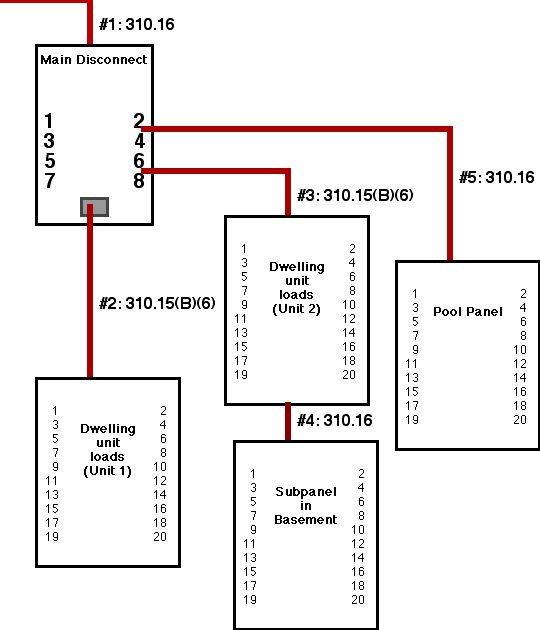

suemarkp said:What matters is what the code says, not what it doesn't say. 215.2(A)(3) says feeders for individual dwelling units can use 310.15(B)(6) for conductor size. It is not clear if that last sentence is modifying the previous sentence (which would be redundant since service conductors we know can be sized by 310.15(B)(6)), or it if it is a separate statement.
It is not clear what feeder is being referenced -- one as big as the service or any dwelling unit feeder. All it does is send us back to the confusing wording of 310.15(B)(6) which does limit the use to main power feeders and the specific definition of that feeder type defined in that section.
jwelectric said:What controls the size of the feeders are 215.2(A)(3) which states that the feeders that supply individual dwelling units meaning they must be supplying one dwelling unit and 310.15(B)(6) which states that they must be the main power feeder.
A subpanel installed downstream of the main panel such as a panel on the second floor or a panel installed for air conditioning units would not fit the description of a individual dwelling unit nor the main power feeders for an individual dwelling unit therefore Table 310.15(B)(6) cannot be used to size these feeders.

georgestolz said:I so do not understand what is being argued here. I haven't been able to devote much time here for the past couple weeks, but I've skimmed through here and not gotten it.
Could everybody clarify what their position is, on whatever's being argued, in two paragraphs or less? I want to participate.
M. D. said:Mike, I see what you are saying and it does make sense , more sense than how it is written. It gets alittle sticky for me around the use of the word "for"
these feeders are for an individual dwelling , not all of it I grant you but they serve it and they are feeders. I think for the sake of erring on the side of safety I'll be putting # 2 ser Al on 90 amp breakers. It is very common to use a 100 amp,.. most inspectors and electricians just kind of got in the habit I guess . I'm not sure what the danger is ,..in most applications in individual dwellings there is a $#!+ load of diversity
215.2 Minimum Rating and size
215.2(A)(3) Individual Dwelling Unit or Mobiloe Home Conductors .Feeder conductors for individual dwelling units or mobile homes need not be larger than service conductors. Paragraph 310.15(B)(6) shall be permitted to be used for conductor size.


stickboy1375 said:

racerdave3 said:I'll ask this question yet again..........BUT WHY??? And I don't want to hear "because the Code says so" I want to know what everyone thinks on their own about this discussion and the discrepancies. I know in reality it may seem petty to be dickering back and forth about a measly 10 amps, but I still just cannot understand the reasoning why the same cable can be used for 90 amps in one situation and 100 in another. The FACTS are that it is the same cable, made from the same material, with the same insulation, so what is the justification to provide 2 different values? It just seems much more complicated than it should be!
stickboy1375 said:Why are you so worried about it? just change your ways and be done with it...
