Torque

Merry Christmas
Status
Not open for further replies.

crispysonofa

Senior Member
Location
New England
Occupation
Electrical and Security Contractor
Looking for some input on what you like to use for properly torquing connections? Main lugs in a panel and also breakers and ground and neutral lugs? Is there one product that can take allen keys and bits like square drive and Phillips/flat head?
 
a 1/4" drive for most things
a 3/8" drive for some things
a 1/2" drive for the rare big stuff

you use adapters for the size of things you wish to attach (as needed). your drive bits should be on say 1/4" drive, or 3/8" drive, etc.
get your wrenches from just about anywhere (HF, blue/orange store, ace, etc etc)

the set i have i also have extensions in various sizes (~ 3 6 9"), but 1/4" extensions for the 1/4" drive, 3/8 for 3/8. 1/2 for 1/2, i find this better to work with rather than using a bunch of size adapters, etc.
 
a 1/4" drive for most things
a 3/8" drive for some things
a 1/2" drive for the rare big stuff

you use adapters for the size of things you wish to attach (as needed). your drive bits should be on say 1/4" drive, or 3/8" drive, etc.
get your wrenches from just about anywhere (HF, blue/orange store, ace, etc etc)

the set i have i also have extensions in various sizes (~ 3 6 9"), but 1/4" extensions for the 1/4" drive, 3/8 for 3/8. 1/2 for 1/2, i find this better to work with rather than using a bunch of size adapters, etc.

So you have three (3) torque wrenches?
 
So you have three (3) torque wrenches?
no, i have 4 of them.
i also have a big 3/4" one too. not all are used for electrical work.
most things will be in-lb (1/4in), perhaps some things in ft-lb.

i do not like to run torq wrenches at the ends of their scales.

if you go dig some, to get accurate torq on a threading, the threading should be lubricated, but most things in electrical is not lubricated, so i always wonder if the vendor spec accounts for that or not, or if the delta window is big enough to not care that its actually not accurate.


also depends on your efficiency model. the std torq wrenches we know of are bulky and heavy and may not work well in some locations, you can also use torq sticks like this
http://fixitsticks.com/torque-limiters
 
Last edited:
if you go dig some, to get accurate torq on a threading, the threading should be lubricated, but most things in electrical is not lubricated, so i always wonder if the vendor spec accounts for that or not, or if the delta window is big enough to not care that its actually not accurate....
To get a relatively precise, repeatable correspondence between measured torque and actual tension in the bolt or screw, yes, you want to lubricate the threads so that you have a simple to calculate relationship between torque and linear force based on the angle of the threads.
But that leaves you with a nut or screw that will just as easily loosen under vibration.
So instead the typical mechanical torque specification assumes a level of frictional force in the threads which depends on the tension in the bolt and the materials of the male and female threads without lubrication.
The automotive torque specs that I have seen explicitly (although maybe in fine print) state that the threads and the contact surfaces must NOT be lubricated in conjunction with the specified torque value.
There will be stick-slip (static versus lower coefficient kinetic friction is involved) which also means that you should measure the torque to keep the bolt or nut turning, not the value to start it moving.
 
in automotive, about 50% of the nuts/bolts on the vehicle have some sort of thread locker on them, which also serves as lubrication when tightening to spec.

so although i dont disagree with you, i would say "it depends".

and i didnt say you dont get accurate torq if its dry, but its way more complex to do accurately because so many other factors are involved. perhaps in the lower in-lbs range the dry friction makes no big diff, or they added a few in-lb to the spec?

and to lubricate i might choose a dry spray perhaps, or a thread lock paste or liquid, but typically not an oil.
 
171013-1145 EDT

GoldDigger --- Your statement is what I would describe as correct.

FionaZuppa --- Your statement is wrong and can get you into big trouble unless some specific lubrication was defined along with the torque specification. Torque specifications with no definition of required additional lubrication are for the torque of the fastener in an as is state.

But first to the subject of units. In-#, and ft-# are not units of torque, but are units of work. The correct units are #-in, and #-ft. Some torque wrench manufacturers have come around, and are now correctly labeling their wrenches. Much automotive literature is now using the correct units.

Torque measurements for measuring fastener tension are the only feasible method in most applications.

Torque measurements to be useful must be done under sliding friction conditions. That is while motion is taking place. Breakaway torque is always higher and and adds even more variability.

Sliding friction torque is not a good measure of fastener tension, but it is the best we have, and works fairly well throughout many industries.

One example of the bad results of a decision to lubricate a fastener.

Sometime in past history a person, ignorant to fastener theory, in production at Cadillac chose to have the wheel nuts lubricated but did not change the nut driver torque setting. I think this was in air wrench days. This resulted in putting too much tension in the wheel studs. The result was drivers having their wheels fall off after only a short time.

One test that is performed sometimes for the strength (fatigue life) of wheel fasteners is put the car in its tightest turn radius and drive in circles until a wheel falls off. Each revolution of the wheel the studs go from a minimum tension (initial preload) to a maximum tension. It does not take long to fatigue a stud under these conditions.

Automotive differentials have the axial force in the pinion shank controlled in two ways. Nut torque on solid spacer units, and collapsing force of a crush spacer. Crush spacers have fairly consistent crushing force, torque control not so good, especially since cadmium plating of nuts was banned.

There is lots more to the torque story.

.
 
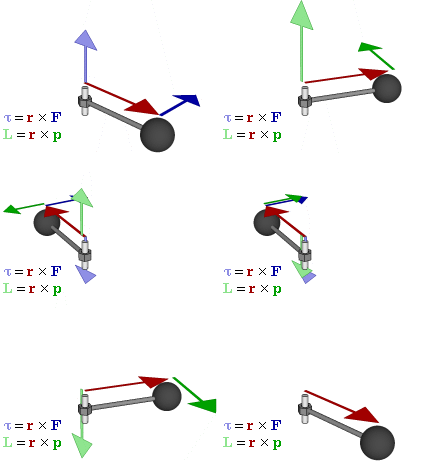
the std equations use r x F or ||r||*||F||sin(theta)


Torque_animation.gif


FionaZuppa --- Your statement is wrong and can get you into big trouble unless some specific lubrication was defined along with the torque specification. Torque specifications with no definition of required additional lubrication are for the torque of the fastener in an as is state.


i'll bet ya all you want that the real tension set into a threaded stud will match the tool setting better if i use water vs dry. dry will always have a frictional component that does not add into the tension from applied torque setting.

and just to note, i did not argue that a torque spec is not the right spec for the given fastener. i did mention as a Q if the torque specs shown on a ocpd paper accounts for dry or not, etc.
 
Last edited:
[copy paste as the timer ran dry on that last post]
and just to note, i did not argue that a torque spec is not the right spec for the given fastener/application. i did mention as a Q if the torque specs shown on a ocpd paper accounts for dry or not, etc. in other words, the paper says 20in-lb which relates to perhaps real 18in-lb in tension, etc. in other words, lubrication will always make real torque (tension) match the tool setting better, etc. how the spec is derived and written to paper is something completely different.

and yes, N∙m is not the same as m∙N

i think most will live with ft-lb when it comes to torque and not really worry about the work part ;)
 
Last edited:
if i look closer, i think it has been [distance] x [force], noted as in-lb, ft-lb, m-N, etc

because in right handed coord system the "x" matters, hence why it comes 1st.
 
[copy paste as the timer ran dry on that last post]
and just to note, i did not argue that a torque spec is not the right spec for the given fastener/application. i did mention as a Q if the torque specs shown on a ocpd paper accounts for dry or not, etc. in other words, the paper says 20in-lb which relates to perhaps real 18in-lb in tension, etc. in other words, lubrication will always make real torque (tension) match the tool setting better, etc. how the spec is derived and written to paper is something completely different.

and yes, N∙m is not the same as m∙N

i think most will live with ft-lb when it comes to torque and not really worry about the work part ;)

Totally off the mark. Note that tension is measured in pounds. The relation between torque (in pound-feet) and tension in pounds depends on the geometry of the bolt and the threads. Not only does the relationship depend on the diameter of the thread, but for a given tension a triangular thread and a square thread will produce different torque values (unlubricated.)
 
171013-1447 EDT

FionaZuppa:

I don't understand your previous post.

In a fastener application using a threaded clamping mechanism the desired end goal is the clamping force. That is measured in pounds or some other equivalent force unit.

Usually in a production application vs a lab setup the only practical means of measuring this tension or compression force is via the torque to the threaded fastener. So friction and mechanical advantage determine the scaling constant between torque and clamping force. Tension or compression is not measured in #-in, but in #.

Unfortunately friction in these applications is not very constant, and therefore that scaling factor can have a lot of variability.

Why are electricians so interested in being very precise relative to definitions and the NEC, but for anything else just plain sloppy? Sloppy definitions just do not contribute to clear communication.

.
 
post #13 - right, for a given fastener, tension = some function of torque, relates to some clamping force. i dont think i disagree with you, but then again, i missed the point you are making. and to note, take two 1" plates that are 1 million miles square and have a single 2"dia fine thread bolt in the center holding them together with 27k lb-ft of torque, the clamping force at the edges of the plate will be about zero :eek:hmy:

post #14 - again, not sure i disagree with anything you said, i just not seeing your point. did i say tension = torque measured in ft-lbs ?? i think what i said is that the torque applied by the setting of the wrench will never be the real torque (hence tension) on the fastener, and this diff is much worse using dry vs lubricated threads.
 
Last edited:
171013-1641 EDT

FionaZuppa:

In post 11 you said
in other words, the paper says 20in-lb which relates to perhaps real 18in-lb in tension, etc.
Here you said 18 in-lb in tension.

The clamping force of a threaded fastener is in the region where the force is applied.

I don't like click type torque wrenches. But, if the wrench works correctly and you are in sliding friction, then at break-over in the wrench you will have applied the torque you expect. If not in sliding friction, then you will not have applied the bolt tension you expected.

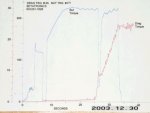
Just to give you a look at torque curves the following is the build of a prototype Ford Range front differential. This was a long time ago. One of the nicest curves I ever plotted. Probably Timken bearings at the time. The drag torque built very smoothly. My memory seems to put this in the early 80s.

.
PICT0941-M2X-25.jpg

.
Plotted is torque for two different transducers on the same part vs time in seconds. With no oil seal so it was easier to buld up and tear down.

The two plots are bearing drag torque, what is being adjusted by the machine, and pinion nut torque. This is a collapsible spacer type assembly.

From 0 to about 4 seconds an air motor is running the pmion nut at about 100 RPM to bring all the components together acainst the spacer. A crimped nut is used. This runs about 30 #-ft, then the components come together, and the air motor stalls at an inertia peak of about 140 #-ft, and falls back to its steady state stall value of 120 #-ft. This is not enough to collapse the spacer. At this point there is about 0.04 to 0.06 inches of bearing endplay. No axial force has been applied to the bearings.

The air motor connects thru a one-way clutch.

Air is removed from the air motor and an electric motor starts and rotates the flange or yoke at about 90 RPM. Via two clutches and gears the pinion nut is rotated somewhat faster than the flange.

Drag torque is very little, just from the carrier weight. Nut torque builds as the spacer is being compressed. When the spacer starts to collapse the nut torque levels.

When bearings make contact, then drag torque begins to build. At this time flange speed is high and fast clutch is on. Thus, drag torque builds fast. At a threshold we slow the flange down and at a somewhat higher threshold go to slow clutch.

When desired drag torque is reached the clutches are turned off and nut torque drops. The flange continues to rotate and the drag torque is checked.

Note: that when the nut speed drops the nut torque drops, but following this there is a gradual increase in nut torque because we now have additional axial force from preloading the bearings.

At this time in history an axial preload of about 2000 # was put on the bearings and the spacer collapsing force was about 30,000 #.

.

 
171013-1641 EDT

FionaZuppa:

In post 11 you said

Here you said 18 in-lb in tension.
oi yikes. right, whatever tension that 18in-lb provides, etc. torq to tension is the basic relationship, typically perpendicular to each other because std torq wrenches do not have auto angle measurement, etc. sorry that i skipped over lots of the 101's in the relationship between torq & tension. my statements still hold, more accurate with lubricated threads, in that the real tension matches the torq setting of the wrench, not in units.

the early 80's ??
doesnt the graph itself say Dec 30 2003 ??

attachment.php
 
Last edited:
171013-1957 EDT

FionaZuppa:

The original plot was directly from our gaging equipment to an HP XY plotter. In 2003 I photo copied the plot and added notes to it.

.
 
171013-2343 EDT

A torque specification for a particular joint will be based on knowledge of joints, and probably a fair amount empirical data along with general theory.

In a threaded joint one wants adequate clamping, and at the same time avoidance of joint loosing.

After tightening a joint there will be a residual preload force left at the joint interface. If you yield at least one of the joint interface materials, then when tightening stops you are left with the maximum possible residual clamping force.

In the design of a joint (selection of a torque specification) a desired clamping force will be selected. Mechanical advantage and frictional losses of the screw will determine the torque to produce this force. This will be based on an as is condition of the screw.

As a general rule a screw can not be back driven if its efficiency is less than 50%. Efficiency is power out / power in. Don't confuse with this mechanical advantage.

We don't want to lubricate threads because this reduces the torque to achieve a given clamping force and at the same time makes it easier for the fastener to back off.

None of this suggests what torque driver to use. But possibly it gives you some understanding of what goes on in the clamping of the joint.

.
 
a thread locker will not allow the threads to back out ;)
it also serves as a lubricant.

you keep mentioning spec torque, which as you say already has the application accounted for.

if backing out was of big concern then why are engine block mains and rod bolts oiled before torque?
 
Last edited:
Status
Not open for further replies.
Top