tonype
Senior Member
- Location
- New Jersey
Stupid engineer question - what is a "red leg" panel?
Tony Shupenko, PE
Tony Shupenko, PE


My guess is a high leg check this outtonype said:Stupid engineer question - what is a "red leg" panel?
Tony Shupenko, PE

tonype said:What is the benefit?
infinity said:One benefit is that if you have a large number of 3 phase loads they can operate at 240 volts vs. 208 volts which will use less current and may allow you to install a smaller service, and smaller feeders etc. This system is only really beneficial when the 120 volt loads are very small vs. the 3 phase loads.

tonype said:What is the benefit?


iwire said:Here is a diagram of a 3 phase 4 wire open delta connection

I have always connected consumer transformers and panels that way, but the diagrams from Cooper Power Systems' Distribution Transformers documentation (below) and American Electricians' Handbook both depict the "high leg" as being "a".JohnJ0906 said:408.3(E) Shouldn't the "high leg" be "B" phase? Or is this a local thing?
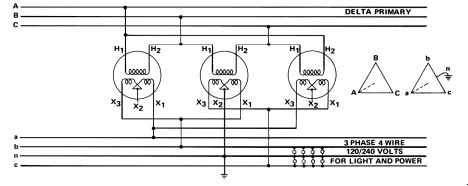
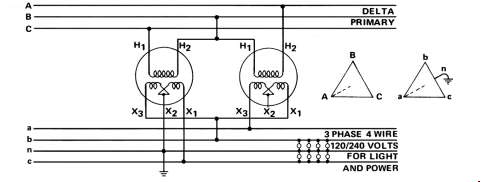


Here too. Except the panel I was in last week. It was marked A (blue) B (yellow) C (red) with C as the high leg. Building owner could not figure out why the new lights that he installed kept frying ballast. Yep, he put them on the high leg!russ said:In my area the High leg is the C phase at the utility meter. It's rotated to be the center phase at the main.
Minuteman said:Here too. Except the panel I was in last week. It was marked A (blue) B (yellow) C (red)
Minuteman said:Here too. Except the panel I was in last week. It was marked A (blue) B (yellow) C (red) with C as the high leg. Building owner could not figure out why the new lights that he installed kept frying ballast. Yep, he put them on the high leg!
Smart $ said:I have always connected consumer transformers and panels that way, but the diagrams from Cooper Power Systems' Distribution Transformers documentation (below) and American Electricians' Handbook both depict the "high leg" as being "a".
LarryFine said:We also always make the high-leg B phase, although the POCO meter diagrams show it as C.
russ said:In my area the High leg is the C phase at the utility meter. It's rotated to be the center phase at the main.
dnem said:What if noone had been there to tell you that the high leg was C ?
dnem said:How is it "effective" if it's not obvious without needing insider information ?
As an inspector I would not consider that installation "effective" so the addition of orange would be needed.
David


Are you sure about that? I believe that the high leg is only landed in the meter can on the C phase position so that the older type meters will read correctly. It is my understand that even though this conductor is landed in the right terminal, it is still electriclly B phase, not C phase.The NESC mandates that the "C" leg is the "high" leg.

