Why don't water heaters require GFCI protection

Seems I have seen the death claim debated. I wasnt in on it but is there actually a requirement it kills someone, doesnt count if it burns their house down? I cant recall anyone finding the actual language about 2 deaths or any number for a requirement.
 
I think there is one coming, not sure it will be in 26 but deals with wire sized landing on breakers, circuits that might have reduced conductors down stream and have actually seen this recently. Not sure it has killed anyone but confuses the crap out of the handiman or the janitor.
 
This is a bit theoretical,,, why or how could it not be better to trip a fault at 6ma vs hundreds of amps to clear it?

The same as any 'protective relay'. If the protective relay is too sensitive, then it will trip unnecessarily. If the protective relay is not sensitive enough then it won't when it should. All protective relays suffer from the challenge of reliably tripping when there is a real fault while not tripping when there isn't a real problem. Ideally you design your equipment so that there is a broad and clear distinction between 'not perfect but safe' and 'something is broken'.

For an appliance where the electrical components are behind metal shield, and you have a reliable EGC, the danger from even 100mA of leakage is negligible. At the same time, electric heating elements have a real (if small) amount of leakage.

The safety risk to people is all carried in the phrase 'you have a reliable EGC'. EGCs fail, and 100mA is enough for a fatal shock. So now you have a real debate: do you trust the EGC to provide enough safety, or do you use a sensitive device to trip at low enough levels to protect people even if the EGC fails. Or do you come up with some other protective scheme.

For a stationary appliance in a basement like a water heater, the powers that be have agreed that the EGC is enough. But for lots of other things they've mandated sensitive GFCI protection. I personally believe that we would be better served (for appliances such as refrigerators or HVAC equipment) by protective devices that include the EGC in the protective scheme: if the EGC is present then the trip value is 60mA, if the EGC is compromised then the trip value is 6mA. But on this point I am not part of any of the relevant professional groups; I'm just an amateur shouting from a soapbox :)
 
With the cost of a new home now, it probably wouldn’t be a substantial percentage of the total cost to do, but I just don’t see any real payoff. Just a solution looking for a problem, creating another problem.
 
I haven't had much trip up since we installed them early on and it weeded out some old stuff. I understand the parameters but the question being,, why wouldn't we want the trip at lower level. 60, 100ma, even 30 which is designed for heating equipment rather than wait till we have high current fault?
 
This is where the AI often understands questions well. I wasn't advocating it. I wasn't suggesting we clip the wire. The question being why would we not want to clear it at low current level?
 
I haven't had much trip up since we installed them early on and it weeded out some old stuff. I understand the parameters but the question being,, why wouldn't we want the trip at lower level. 60, 100ma, even 30 which is designed for heating equipment rather than wait till we have high current fault?

IMHO tripping on ground fault at 100ma would be a distinct improvement over standard breakers, and could be done purely electromechanically.

I don't know if the improvement would be worth the cost. At the present time using electromechanical ground fault detecting breakers (if they exist in the US market) would be a design decision, not a code requirement. So called 'RCD' breakers have been around for a long time in Europe, but I think they're being replaced with electronic ones.
 
I went around GFCI for engine block headers. They are fussy and even intermittent. Seems it trip them on occasion. Next time might work. I was considering 30 for it but it was simply pondering at this point
 
water heaters are prohibited by the NEC itself, from requiring GFCI protection, by the very first article of the NEC, article 90.

PRACTICAL SAFEGUARDING. there is nothing practical about requiring another $100 breaker for a safety concern that doesn't exist. yet, we have arc fault breakers......
 
One thing you can do that does not cost any extra money is actually use the breaker the manufacturer recommends , instead of the maximum breaker the NEC allows, this would give the breaker better ground fault response.
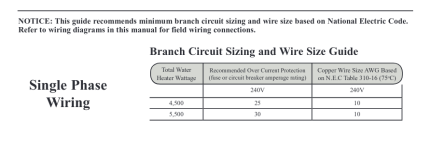
manufactures supply a chart that specifies a max breaker size based on the element size for example a 4500W 50 gallon water heater often lists a 25A breaker.
The difference between a 2p 30 and a 2p 25 in the time current curve for a bolted fault looks to be about 100 amps at the 300-400ms. range.water_heater-sizing.png

I have seen some require it, but this manual said recommends so no 110.3(B)
 
Seems to be an issue with lake water. It appears to have enough conductivity to electrocute someone.
So it wouldn’t be so far fetched that tap water wouldn’t.
One huge difference is body contact area in a lake vs contact with running water
Maybe in a bathtub with running water, but only if there is a ground path which is not very likely given most drainage piping is non-metallic.
That water is a rather poor conductor therefore not a lot of current flows but voltage drops quite a bit over short distance. Being immersed, increases your contact area with the voltage gradient zones compared to touching same object when not immersed.

The more conductive the water is the larger the voltage gradient zones willl be which would lessen the potential for shock/electrocution as you won't be able to reach across as much potential.
 
Top