I'll have to go back and check. That's why I asked if #1 was good.
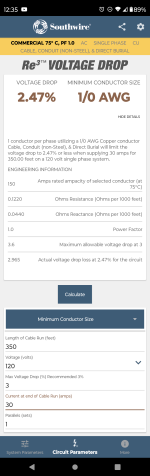
Is your screen shot from a Southwire app that runs natively on your phone?
Apparently the difference in results is attributable to your having chosen "Commercial 75C" and my having chosen "Residential". Investigating a little further, when you choose Commercial and 60C, 75C, or 90C, the answers you get vary with the insulation temperature you provide. The calculator is increasing the resistance/kft with increasing insulation temperature. Which would be accurate if you were specifying operating temperature, but the actual operating temperature won't depend on the insulation temperature. It will instead depend on the current specified and the conductor size; when you are upsizing cables for voltage drop, the operating temperature will go down.
So it seems like the Southwire calculator is oversizing cables a bit by assuming an elevated operating temperature and thus elevated resistances. If the cable size you are using is such that the 60C ampacity is sufficient, I suggest always using the Commerical 60C setting to minimize this effect.
There's also another bug in the calculator (at least the web version, but as the results match, presumably the app too). Which is that the answers are only accurate for PF = 0.9. For other PF, the app messes up the calculation of the effective impedance. But the discrepancy is only significant when the conductor reactance is signficant compared to the resistance, e.g. for 250 mcm and above. I reported this bug to them in July 2024, but they still haven't fixed it.
As to the "Residential" setting, from the info text it sounds like it should match the Commercial 60C setting. They are close but slightly different; not sure what it is doing differently.
Cheers, Wayne