I have an application in a commercial kitchen where I need to feed a 120v - 20amp duplex receptacle with two circuits. (top half / bottom half) This needs to be GFI protected, and since I have two circuits feeding one device it will need to be a two pole breaker. My question is, will a two pole GFCI breaker work in this application. Obviously there will be an imbalance between the two legs, but will that cause the GFCI to trip? I haven't run across this before, and I'm not sure how the breaker actually functions. Thanks in advance.

You are using an out of date browser. It may not display this or other websites correctly.
You should upgrade or use an alternative browser.
You should upgrade or use an alternative browser.
2 pole GFCI breaker
- Thread starter shockin
- Start date
- Status
- Not open for further replies.

- Location
- Windsor, CO NEC: 2023
- Occupation
- Hospital Master Electrician
Yes, as long as the 2-pole breaker is rated 120/240, it has a neutral wire with the breaker that connects to the neutral bar.
So the breaker looks at the entire picture when determining when to trip. Line-to-line loads are fine, line-to-neutral loads are fine, combinations of the two are fine, but as soon as it sees a line-to-question mark load, it trips.
No: if you were to use two single pole breakers, and connect the handles with a handle-tie, then you could use single pole breakers. (210.7).
You'd then have box-fill issues, because you'd have to have two sets of neutrals, and hots, and you'd have to break the neutral tab on the receptacles as well as the hot side, and wire-nut the neutrals and pigtail off to the single screw provided on the receptacle.
Just being technically correct.
So the breaker looks at the entire picture when determining when to trip. Line-to-line loads are fine, line-to-neutral loads are fine, combinations of the two are fine, but as soon as it sees a line-to-question mark load, it trips.
I'm going to get silly but technically correct here.This needs to be GFI protected, and since I have two circuits feeding one device it will need to be a two pole breaker.
No: if you were to use two single pole breakers, and connect the handles with a handle-tie, then you could use single pole breakers. (210.7).
You'd then have box-fill issues, because you'd have to have two sets of neutrals, and hots, and you'd have to break the neutral tab on the receptacles as well as the hot side, and wire-nut the neutrals and pigtail off to the single screw provided on the receptacle.
Just being technically correct.
- Location
- Wisconsin
- Occupation
- PE (Retired) - Power Systems
George,
Two single poles GFCI breakers cannot share a common nuetral without nusiance tripping. The only way to GFCI protect a 3 wire circuit is with a two pole breaker.
Two single poles GFCI breakers cannot share a common nuetral without nusiance tripping. The only way to GFCI protect a 3 wire circuit is with a two pole breaker.
- Location
- Windsor, CO NEC: 2023
- Occupation
- Hospital Master Electrician
Jim,
georgestolz said:You'd then have box-fill issues, because you'd have to have two sets of neutrals, and hots, and you'd have to break the neutral tab on the receptacles as well as the hot side, and wire-nut the neutrals and pigtail off to the single screw provided on the receptacle.

1793
Senior Member
- Location
- Louisville, Kentucky
- Occupation
- Inspector
georgestolz said:...and you'd have to break the neutral tab on the receptacles
...wire-nut the neutrals and pigtail off to the single screw provided on the receptacle.
Why break off the neutral bridge of the receptacle to only pigtail together again?

busman
Senior Member
- Location
- Northern Virginia
- Occupation
- Master Electrician / Electrical Engineer
I think what George is proposing is correct. If the box is fed by two independent circuits (2 hots and 2 neutrals) then each half of the duplex woulud be on a different circuit. Since it would not be a multiwire, simultaneous disconnection would not be required and the SP GFCI's would not nuisance trip becuase they would not share a neutral.
Mark
Mark
- Location
- Windsor, CO NEC: 2023
- Occupation
- Hospital Master Electrician
Quit arguing, you're both wrong. :lol:
They are multiple branch circuits on one yoke.
They are not a multiwire branch circuit. See "Branch Circuit, Multiwire" in Article 100.
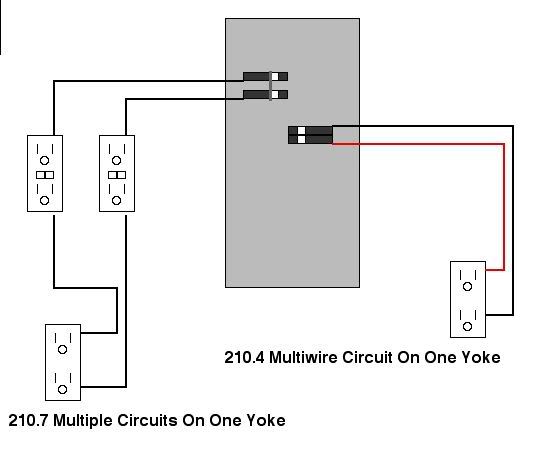
They are multiple branch circuits on one yoke.
They are not a multiwire branch circuit. See "Branch Circuit, Multiwire" in Article 100.
210.7(B) requires simultaneous disconnection of the two circuits.busman said:Since it would not be a multiwire, simultaneous disconnection would not be required...
- Location
- Windsor, CO NEC: 2023
- Occupation
- Hospital Master Electrician
Because, there are two circuits in the box. Like two 12-2's running side by side into each box, and out again. You couldn't combine the two circuit's neutrals together without a 310.4 violation and a GFCI trip.1793 said:georgestolz said:...and you'd have to break the neutral tab on the receptacles
...wire-nut the neutrals and pigtail off to the single screw provided on the receptacle.
Why break off the neutral bridge of the receptacle to only pigtail together again?
1793
Senior Member
- Location
- Louisville, Kentucky
- Occupation
- Inspector
Re: 2 pole GFCI breaker
there is no mention of feeding through to another set of receptacles. So I still contend that we break the neutral bridge and the hots and use two single pole gfci breakers with handle tie or two pole gfci breaker feeding this with a MWBC.
shockin said:I have an application in a commercial kitchen where I need to feed a 120v - 20amp duplex receptacle with two circuits. (top half / bottom half)...
there is no mention of feeding through to another set of receptacles. So I still contend that we break the neutral bridge and the hots and use two single pole gfci breakers with handle tie or two pole gfci breaker feeding this with a MWBC.
georgestolz said:Because, there are two circuits in the box. Like two 12-2's running side by side into each box, and out again. You couldn't combine the two circuit's neutrals together without a 310.4 violation and a GFCI trip.1793 said:georgestolz said:...and you'd have to break the neutral tab on the receptacles
...wire-nut the neutrals and pigtail off to the single screw provided on the receptacle.
Why break off the neutral bridge of the receptacle to only pigtail together again?
I think George mean to say wire nut the grounds (there isn't a single screw for the neutrals).
- Location
- Wisconsin
- Occupation
- PE (Retired) - Power Systems
George I am not denying that two single pole breakers can be used to feed receptacles using variations of a multi-wire circuit.
But. if you have two single pole GFCI breakers that share a neutral at any point on their load side you will have the probability of a nuisance trip due to the division of neutral currents. If they are two completely different circuits then no handle tie would be required at all.
But. if you have two single pole GFCI breakers that share a neutral at any point on their load side you will have the probability of a nuisance trip due to the division of neutral currents. If they are two completely different circuits then no handle tie would be required at all.
busman
Senior Member
- Location
- Northern Virginia
- Occupation
- Master Electrician / Electrical Engineer
Maybe the code on my desk here is too old (1996). The 2002 is at home. This code says in 210-4 "In dwelling units, a multiwire branch circuit supplying more than one device or equipment on the same yoke shall be provided with a means to disconnect simultaneously all ungrounded conductors..."
Did this at some point become a requirement for separate circuits on the same yoke?
Thanks,
Mark
Did this at some point become a requirement for separate circuits on the same yoke?
Thanks,
Mark

Pierre C Belarge
Senior Member
- Location
- Westchester County, New York
Yes, 210.7(B) in the 2005 NEC.
busman
Senior Member
- Location
- Northern Virginia
- Occupation
- Master Electrician / Electrical Engineer
I guess I'm too far behind. We just adopted the 2002 after a long time on 1999. I don't even own 2005 (no need for it). Learn something new everyday. Sorry George.
Mark
Mark
- Location
- Windsor, CO NEC: 2023
- Occupation
- Hospital Master Electrician
No, I meant wirenut the neutrals.paul32 said:georgestolz said:Because, there are two circuits in the box. Like two 12-2's running side by side into each box, and out again. You couldn't combine the two circuit's neutrals together without a 310.4 violation and a GFCI trip.1793 said:georgestolz said:...and you'd have to break the neutral tab on the receptacles
...wire-nut the neutrals and pigtail off to the single screw provided on the receptacle.
Why break off the neutral bridge of the receptacle to only pigtail together again?
I think George mean to say wire nut the grounds (there isn't a single screw for the neutrals).
Not true.Jim Dungar said:George I am not denying that two single pole breakers can be used to feed receptacles using variations of a multi-wire circuit.
But. if you have two single pole GFCI breakers that share a neutral at any point on their load side you will have the probability of a nuisance trip due to the division of neutral currents. If they are two completely different circuits then no handle tie would be required at all.
- Picture a 1/? panel. You install two single pole breakers.
- Being an unabashed eccentric, you put the first breaker in space 1, and the second breaker in space 5. You install a third breaker in space 3 solely so that you can tie handles 1 and 5 together.
- These two breakers are on the same phase.
- They are GFCI breakers.
- You pull two runs of 12-2 to a duplex receptacle.
- You pull two runs of 12-2 from this receptacle to another, and end the circuit there.
- You install the receptacles. In the first box in the circuit, you have four 12-2's.
- Two 12-2's for circuit 1, and two 12-2's for circuit 5.
- You break the neutral tab, and the ungrounded tab, on the duplex receptacle.
- You must wirenut circuit 1's neutrals together, because circuit 1 has only one screw to use on the duplex.
- The same goes for the hots connecting to the receptacle for circuit 1.
- The same goes for the neutrals connecting to the receptacle for circuit 5.
- The same goes for the hots connecting to the receptacle for circuit 5.
These are not multiwire circuits. They do not have a voltage between them, because they're on the same phase.

- Location
- Massachusetts
Holy Shnikies how did a simple thread get so complicated? :lol: :?
- Location
- Wisconsin
- Occupation
- PE (Retired) - Power Systems
George,
Your last explanation finally clarified that you were talking about continuing the circuits to feed multiple receptacles. You are correct you have multi circuits. However your previous posts did not make clear the purpose of your "wire-nut the neutrals" comment.
Your last explanation finally clarified that you were talking about continuing the circuits to feed multiple receptacles. You are correct you have multi circuits. However your previous posts did not make clear the purpose of your "wire-nut the neutrals" comment.
- Status
- Not open for further replies.