Gas, oil, and mining work can have some unusual grounding arrangements and voltages. When looking at a system for the first time, I ask two questions about grounding (earthing):
What is the relationship of the distribution transformer or power source to the Grounding Electrode System (GES)?
What is the relationship of the exposed-conductive-parts and any equipment grounding conductors to the GES?
Then I use a letter code system to note those two answers so I can quickly convey the grounding system
(see wiki on earthing systems IEC 60364).
The first letter (I or T) indicates the relationship of the distribution transformer or source to ground:
T = Grounded system (Terra). One point on the source is directly connected to the GES.
I = Ungrounded system. All live parts are isolated from earth, or one point is connected to the GES through an impedance, also called resistance grounding.
The second letter (T or N) indicates the relationship of all exposed-conductive-parts and any equipment grounding conductors (EGC) the GES they are connected to and the power source.
T = Exposed-conductive-parts have equipment grounding conductors that are directly connected to a GES, but there is no main or system bonding jumper back to the power source. The exposed parts are simply bonded to a local GES, such as ground rods on site. The grounded conductor and equipment grounds may be many volts apart.
N = A main or system bonding jumper connects a grounded conductor to the equipment grounding conductors or supply-side bonding jumpers. The grounded conductor and equipment grounds are close to zero volts apart, or at zero volts apart.
A subsequent letter, with a dash if needed, describes the arrangement of the grounded conductor and equipment grounding conductor, how they relate to each other, when a main or system bonding jumper is present:
S = The equipment grounding conductor and grounded conductor (neutral or grounded phase) are run separately all the way from the distribution transformer.
C = The grounded conductor and equipment grounding functions are Combined as in provided by the same conductor. (MGN utility in the US)
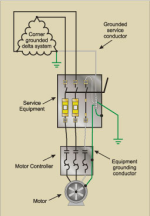
So, what we typically have here under the NEC is called TN-C-S.
T) Because at the secondary we have a direct connection of a phase conductor to a GES.
N) We have a direct electrical connection between a grounded phase conductor and the equipment grounding system at a main or system bonding jumper.
Then for the conductors:
-C The utility grounded B phase in the OP's case, is combined with the equipment grounding conductor function up to the service disconnect.
-S After the service disconnect, they are separate conductors with separate functions joined by the main bonding jumper.
An ungrounded system is an IT system.
I - All phase conductors are isolated from the GES.
T - There is a GES present, and the equipment grounding system bonds the exposed metal parts.
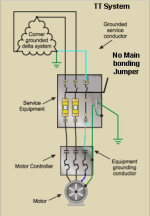
What you are seeing is a TT system. A TT system has no main or system bonding jumper.
T - A phase conductor is connected to a GES at the utility pole.
T - There is a GES present and equipment grounding at the building.
But these are not connected together by a main bonding jumper, so there is no -S.
TT systems are not permitted under the NEC.
In places where TT systems are used, the breakers are typically ground-fault type breakers.
The fix to be a TN-C-S is to add a main bonding jumper.