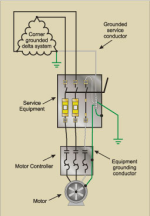
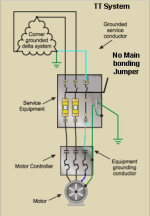
480v grounded 3 phase serving an oil well pump jack

amerijet

Member
Location
Kansas
Occupation
Electrical contractor oilfield
I am located in a state that has adopted UEC however it is only licensed and inspected by cities that require it. Hence the problem. I have seen older oil wells that have a 3 wire grounded phase 480 to ground reference on two legs and 0 on the other phase usually B phase.
I have no fourth wire coming as a low impedance circuit to the main disconnect at the utility pole hence the ECG is only tied to the grounding rods.
I have talked with inspectors in the cities, power companies and other electricians and don't really get any feedback on this subject. I ve milled through NEC and feel 4th wire or changing to single phase is the only real option here to protect myself and others. Any feedback on this would be extremely helpful!
 
Protect from what? As long as you have (properly installed) overcurrent protection at the well, it’s not unsafe. It’s just like the 3 wire service entrance to your house.
 
Yes, after the main disconnect, an EGC is required. If one of the ungrounded conductors would fault to any metal part, you would have 480 volts from that part to the earth. There is no fault clearing path.
The grounding electrodes should be at the service disconnect connected to the grounded circuit conductor, and the EGC originates at that point.
Are the circuit conductors between the service disconnect and the equipment in metal conduit? If so, the metal conduit would be the EGC.
 
Please clarify: is the EGC only tied to grounding rods, or is the EGC tied to both grounding rods and the Grounded Conductor from the utility? Is this supposed to be an ungrounded system that happens to have a fault, or is this supposed to be a corner grounded delta?

If the EGC is properly bonded to the grounded conductor, then you have a low impedance circuit for fault current. This is exactly how most utility service drops work; you have a single grounded circuit conductor that also functions as the fault current return path from the utility to the service, then at the service you have the EGC (and ground rods) connected to the grounded circuit conductor, and from the service onwards you have separate grounded circuit conductors and EGCs. This is(was?) sometimes permitted for some feeders, and I'm not going into the specifics of when feeders are permitted without a separate EGC; the key point is that in these situations the EGCs are bonded to the grounded conductor.

Don't get tripped up by the fact that the grounded conductor might not be the neutral. It is still a conductor intentionally held at ground potential by connection to grounding electrodes and bonding to the EGCs.

A corner grounded delta system, where the EGCs are properly bonded to the grounded conductor has a perfectly fine fault current path.

Now: if you have a corner grounded delta system, and then have EGCs that are only connected to ground electrodes without the necessary bonding, then you do have a safety issue, one that needs to be fixed with proper bonding.
 
Winnie thank you for your reply. Yes it is a corner grounded system as I know it. Leg A 496v to ground rods leg B 0v to ground rods leg C 496 to ground rods
The EGC is only to the ground rods which I feel is unsafe as I have seen two applications where the motor has shorted and not blown any of the fuses. One of the utility companies want a slug in the grounded phase so it doesn't blow fuses till you have a second phase to phase fault. Tying to EGC to the grounded phase just blows the fuses as it is considered a currant carrying conductor by one of the utility companies. Also wonder if a fault alarm is needed and if it would work as it could only be connected to the ground rods. Thank you for your help as I don't like the situation and it doesn't blow a fuse when there is a motor fault. Ground fault and turn to turn fault.
 
3 wire grounded phase 480 to ground reference on two legs and 0 on the other phase usually B phase.
I have no fourth wire coming as a low impedance circuit to the main disconnect at the utility pole hence the ECG is only tied to the grounding rods.
So at the service disconnect one of the phases is bonded to the metal enclosure?
 
You still have to bond that grounded conductor at the service equipment and run separate EGC beyond the service equipment just like you do with a grounded neutral conductor on systems that have one of those. In both cases it creates a low impedance path back to the source to help facilitate overcurrent protection at clearing ground faults when they occur. This source has no neutral you can ground any ONE of the conductors to create a grounded system.
 
Winnie thank you for your reply. Yes it is a corner grounded system as I know it. Leg A 496v to ground rods leg B 0v to ground rods leg C 496 to ground rods
The EGC is only to the ground rods which I feel is unsafe as I have seen two applications where the motor has shorted and not blown any of the fuses.

If the EGC only goes to the ground rods but is not bonded to the grounded conductor, that is _very_ unsafe. A fault to from hot to EGC will energize the EGC without tripping breakers.

Note that a motor can short internally and the motor winding will limit current flow so that you wouldn't blow fuses; so you the fact that you've seen motor failures without fuses blowing doesn't say much one way or the other about your overcurrent protection.

One of the utility companies want a slug in the grounded phase so it doesn't blow fuses till you have a second phase to phase fault.

You _don't_ want a fuse in the grounded phase. Just like not having a switch on the neutral; when the circuit opens you want everything downstream of the switch the be at ground potential, not energized at 480V.

Tying to EGC to the grounded phase just blows the fuses as it is considered a currant carrying conductor by one of the utility companies.

Current carrying conductor or not shouldn't matter. You _should_ be able to connect the grounded phase to the EGC. If this causes high current flow or blows fuses, then you have something else going on that is causing the problem. The voltage between EGC and grounded conductor should be low, and when you connect the two very little current should flow.

Also wonder if a fault alarm is needed and if it would work as it could only be connected to the ground rods. Thank you for your help as I don't like the situation and it doesn't blow a fuse when there is a motor fault. Ground fault and turn to turn fault.

Maybe try drawing out the entire system, from the utility transformers with their grounding, to the service, feeder, motor, EGCs, ground rods, etc. That might help clarify what you actually have going on.

IMHO it still isn't clear to me if you are _supposed_ to have a corner grounded system, or if you are supposed to have an ungrounded system but have a persistent ground fault that makes it look corner grounded.
 
One of the utility companies want a slug in the grounded phase so it doesn't blow fuses till you have a second phase to phase fault.
Only OCPDs that open all of the circuit conductors, that is the two ungrounded conductor and the grounded conductor are permitted in the grounded conductor.
Also wonder if a fault alarm is needed
Fault alarms are not needed on a corner grounded system. They are only needed on ungrounded systems.
I don't like the situation and it doesn't blow a fuse when there is a motor fault. Ground fault and turn to turn fault.
Based on your description, you don't have a fault return path back to the service neutral, so ground faults on the ungrounded conductors are not likely to open an OCPD. It appears that the only fault return path you have is via the earth.

While not code complaint, other than running an EGC back to the main bonding jumper, the safest thing would be to bond the grounded conductor to the equipment and the grounding electrode. Again that is not a code complaint solution, but in my opinion would be safer than the current installation.
 
Thank you Winnie you get my problem. It's only happened twice on motor faults and appears to burn up the equipment till it breaks the fault. One time it burned up the HOA switch which should have disengaged the contactor and the motor tested ground faulted to the ground rods. The other time it melted the knife switch on the disconnect and the motor wasn't faulted to the ground rods but had no continuity between the windings. Assuming the winding became fuse. Neither time was the EGC energized when found however I am betting it was while it burned things up.
 
You could have a ungrounded delta. Put in some grounding lights. Have some local testing engineering company come by and do some insulation tests or resistance testing on your equipment. Possibly clean the gear as well.

You are running this set up because in theory any individual fault could cause more of a hazard if the equipment tripped off. When you choose a ungrounded service you are making the choice that it is better to do scheduled maintenance on a faulted leg than it is to have that equipment trip offline randomly.

As long as you are treating the hazardous locations appropriately and are addressing faults on maintenance cycles then you are okay.


Thank you Winnie you get my problem. It's only happened twice on motor faults and appears to burn up the equipment till it breaks the fault. One time it burned up the HOA switch which should have disengaged the contactor and the motor tested ground faulted to the ground rods. The other time it melted the knife switch on the disconnect and the motor wasn't faulted to the ground rods but had no continuity between the windings. Assuming the winding became fuse. Neither time was the EGC energized when found however I am betting it was while it burned things up.

This is all normal on a ungrounded system. You should have grounding lights so that you can address the issues before the equipment fails. But this is very common on ungrounded systems. I had to deal with 3 different locations with ungrounded 480V systems and they all had a fault on a single leg. Intermittent faulting on insulation failures of old wire and terminations and dirty environments of high resistance fault paths will have larger than normal current draws and voltage shifts. OCPDs are usually oversized to the application because they tripped once and they just thought they needed to increase the fuse sizes. But the faults look like ghosts and appear to effect equipment randomly. Also remember that your system is probably designed to fail in a controlled manner to avoid sparks and "explosive" type fuses. You might also want to check your method of overload protection on the motors.
 
I have seen older oil wells that have a 3 wire grounded phase 480 to ground reference on two legs and 0 on the other phase usually B phase.
I have no fourth wire coming as a low impedance circuit to the main disconnect at the utility pole hence the ECG is only tied to the grounding rods.
The EGC is only to the ground rods
Gas, oil, and mining work can have some unusual grounding arrangements and voltages. When looking at a system for the first time, I ask two questions about grounding (earthing):

What is the relationship of the distribution transformer or power source to the Grounding Electrode System (GES)?

What is the relationship of the exposed-conductive-parts and any equipment grounding conductors to the GES?

Then I use a letter code system to note those two answers so I can quickly convey the grounding system (see wiki on earthing systems IEC 60364).

The first letter (I or T) indicates the relationship of the distribution transformer or source to ground:

T = Grounded system (Terra). One point on the source is directly connected to the GES.

I = Ungrounded system. All live parts are isolated from earth, or one point is connected to the GES through an impedance, also called resistance grounding.

The second letter (T or N) indicates the relationship of all exposed-conductive-parts and any equipment grounding conductors (EGC) the GES they are connected to and the power source.

T = Exposed-conductive-parts have equipment grounding conductors that are directly connected to a GES, but there is no main or system bonding jumper back to the power source. The exposed parts are simply bonded to a local GES, such as ground rods on site. The grounded conductor and equipment grounds may be many volts apart.

N = A main or system bonding jumper connects a grounded conductor to the equipment grounding conductors or supply-side bonding jumpers. The grounded conductor and equipment grounds are close to zero volts apart, or at zero volts apart.

A subsequent letter, with a dash if needed, describes the arrangement of the grounded conductor and equipment grounding conductor, how they relate to each other, when a main or system bonding jumper is present:

S = The equipment grounding conductor and grounded conductor (neutral or grounded phase) are run separately all the way from the distribution transformer.

C = The grounded conductor and equipment grounding functions are Combined as in provided by the same conductor. (MGN utility in the US)

So, what we typically have here under the NEC is called TN-C-S.

T) Because at the secondary we have a direct connection of a phase conductor to a GES.

N) We have a direct electrical connection between a grounded phase conductor and the equipment grounding system at a main or system bonding jumper.

Then for the conductors:

-C The utility grounded B phase in the OP's case, is combined with the equipment grounding conductor function up to the service disconnect.

-S After the service disconnect, they are separate conductors with separate functions joined by the main bonding jumper.

An ungrounded system is an IT system.

I - All phase conductors are isolated from the GES.

T - There is a GES present, and the equipment grounding system bonds the exposed metal parts.

What you are seeing is a TT system. A TT system has no main or system bonding jumper.

T - A phase conductor is connected to a GES at the utility pole.

T - There is a GES present and equipment grounding at the building.

But these are not connected together by a main bonding jumper, so there is no -S.

TT systems are not permitted under the NEC.
In places where TT systems are used, the breakers are typically ground-fault type breakers.
The fix to be a TN-C-S is to add a main bonding jumper.

 
Last edited:
Gas, oil, and mining work can have some unusual grounding arrangements and voltages. When looking at a system for the first time, I ask two questions about grounding (earthing):

What is the relationship of the distribution transformer or power source to the Grounding Electrode System (GES)?

What is the relationship of the exposed-conductive-parts and any equipment grounding conductors to the GES?

Then I use a letter code system to note those two answers so I can quickly convey the grounding system (see wiki on earthing systems IEC 60364).

The first letter (I or T) indicates the relationship of the distribution transformer or source to ground:

T = Grounded system (Terra). One point on the source is directly connected to the GES.

I = Ungrounded system. All live parts are isolated from earth, or one point is connected to the GES through an impedance, also called resistance grounding.

The second letter (T or N) indicates the relationship of all exposed-conductive-parts and any equipment grounding conductors (EGC) the GES they are connected to and the power source.

T = Exposed-conductive-parts have equipment grounding conductors that are directly connected to a GES, but there is no main or system bonding jumper back to the power source. The exposed parts are simply bonded to a local GES, such as ground rods on site. The grounded conductor and equipment grounds may be many volts apart.

N = A main or system bonding jumper connects a grounded conductor to the equipment grounding conductors or supply-side bonding jumpers. The grounded conductor and equipment grounds are close to zero volts apart, or at zero volts apart.

A subsequent letter, with a dash if needed, describes the arrangement of the grounded conductor and equipment grounding conductor, how they relate to each other, when a main or system bonding jumper is present:

S = The equipment grounding conductor and grounded conductor (neutral or grounded phase) are run separately all the way from the distribution transformer.

C = The grounded conductor and equipment grounding functions are Combined as in provided by the same conductor. (MGN utility in the US)

So, what we typically have here under the NEC is called TN-C-S.

T) Because at the secondary we have a direct connection of a phase conductor to a GES.

N) We have a direct electrical connection between a grounded phase conductor and the equipment grounding system at a main or system bonding jumper.

Then for the conductors:

-C The utility grounded B phase in the OP's case, is combined with the equipment grounding conductor function up to the service disconnect.

-S After the service disconnect, they are separate conductors with separate functions joined by the main bonding jumper.

An ungrounded system is an IT system.

I - All phase conductors are isolated from the GES.

T - There is a GES present, and the equipment grounding system bonds the exposed metal parts.

What you are seeing is a TT system. A TT system has no main or system bonding jumper.

T - A phase conductor is connected to a GES at the utility pole.

T - There is a GES present and equipment grounding at the building.

But these are not connected together by a main bonding jumper, so there is no -S.

TT systems are not permitted under the NEC.
In places where TT systems are used, the breakers are typically ground-fault type breakers.
The fix to be a TN-C-S is to add a main bonding jumper.
You are making it extremely complicated for a user of the NEC who has no idea of all of those letters.

The only thing we need to know the answer to is the utility supplying an ungrounded system or is the utility supplying a corner grounded system.

However in either case the NEC requires a grounding electrode at the service equipment and an EGC from the service equipment to the pump. The only difference is that the corner grounded system requires a main bonding jumper and the ungrounded system does not have a main bonding jumper.
 
Top