
You are using an out of date browser. It may not display this or other websites correctly.
You should upgrade or use an alternative browser.
You should upgrade or use an alternative browser.
A little more fun:
- Thread starter rattus
- Start date
- Status
- Not open for further replies.

mivey
Senior Member
I didn't catch that. I wonder if the batteries on his HP are in series or parallel? :grin:spsnyder said:Might want to redo the conversion again Rattus. My HP says 207.9@30. Double checking magnitude (R^2+X^2)^.5 give 207.9.
Double Checking angle arctan(104/180) = 30 degrees.
[edit: in phase or out of phase]
rattus said:Vab = 120V -(-60 -j104)V = 120V + 60V + j104V = 180V + j104V
Sorry. I am with Rattus up to this point....(180 + j104)V
To convert back to polar form we need two components, magn. and direction.
Magnitude uses pathagarium's theorum c^2=a^2+b^2 or
c=sqrt[a^2 + b^2]
c (our polar equivelant of magnetude) = sqrt (180^2+104^2) = 207.88V
Direction (Angle) from arctan(b/a). Remember tan (angle) = opp. length/adjacent length. Look at the triangle and the angle. The "imaginary" length os opp. the angle we want and the real component is adjacent. Inverse tan of that ratio gives us the angle.
arctan (104/180) = arctan(.5778) = 30.0 degrees.
Therefore in polar form .... 207.88<30. My fluke is correct!
mivey
Senior Member
It's just a fluke :grin:spsnyder said:...My fluke is correct!
Here's the way I remember the relationships:
Oscar Had A Heck Of A Time Chasing Sallie
Opposite
Hypotenuse = Sine
Adjacent
Hypotenuse = Cosine
Opposite
Adjacent = Tangent
spsnyder said:rattus said:Vab = 120V -(-60 -j104)V = 120V + 60V + j104V = 180V + j104V
Sorry. I am with Rattus up to this point....(180 + j104)V
To convert back to polar form we need two components, magn. and direction.
Magnitude uses pathagarium's theorum c^2=a^2+b^2 or
c=sqrt[a^2 + b^2]
c (our polar equivelant of magnetude) = sqrt (180^2+104^2) = 207.88V
Direction (Angle) from arctan(b/a). Remember tan (angle) = opp. length/adjacent length. Look at the triangle and the angle. The "imaginary" length os opp. the angle we want and the real component is adjacent. Inverse tan of that ratio gives us the angle.
arctan (104/180) = arctan(.5778) = 30.0 degrees.
Therefore in polar form .... 207.88<30. My fluke is correct!
You don't have to use Phythagoras to get the magnitude; it is simply,
|Vab| = 180/cos(30) = 208V

Whooaaa... slow down there buckwheat...rattus said:Let me summarize what mivey has done. Correct me if I make a typo.
First, Kirchoff to the rescue. We sum the phasors in a CCW direction, but CW would work just as well.
Vbn + Vab - Van = 0
Vab = Van - Vbn
Now let,
Van = 120V @ 0
Vbn = 120V @ -120
Now convert to rectangular and collect terms,
Vab = 120V -(-60 -j104)V = 120V + 60V + j104V = 180V + j104V
And then back to polar (courtesy of hp)
Vab = 120V @ 60
Note that we had to use subtraction because one of the phasors was pointing against the direction of summation. Note also that algebraic subtraction is nothing more than changing the sign and adding.
Now isn't someone going to ask about sqrt(3)?
Vab = 120V @ 60???
I don't think so!!!
...and mivey missed something. See following depiction for hint.
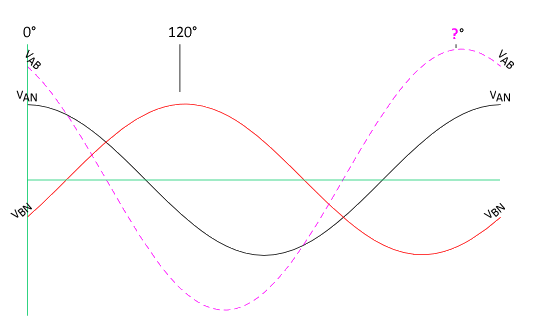
Vab = 207.8845833V @ 30.01836743 (courtesy of Radio Shack):smile:rattus said:Vab = 120V -(-60 -j104)V = 120V + 60V + j104V = 180V + j104V
And then back to polar (courtesy of hp)
Vab = 120V @ 60

frizbeedog
Senior Member
- Location
- Oregon
We already know the answer, so no funny stuff.
Well la de ding dang doodely da, Look how smart I am.

Good for you rattus. Hope that wasn't too funny fer ya.
Don't mind me, I'm just upset cause you lost me at hello.
Some calculators should definitely not be used for mission critical data :grin:jghrist said:Vab = 207.8845833V @ 30.01836743 (courtesy of Radio Shack):smile:
Courtesy of Windows Calculator: Vab=207.8460969082652752232935609807@-330? (the angle is precise to the same decimal places as magnitude)
I've verified this to be accurate to at least the tenth decimal place using three other sources: AutoCAD, TurboCAD (both using geometric results), and a Casio calculator.
mivey
Senior Member
But not that slow buckwheat. spsnyder caught rattus's typo 3 hours before you. I did not catch it because I skimmed over his post too fast (too fast buckwheat). :grin:Smart $ said:Whooaaa... slow down there buckwheat...
Vab = 120V @ 60???
I don't think so!!!
...and mivey missed something...
mivey said:But not that slow buckwheat. spsnyder caught rattus's typo 3 hours before you. I did not catch it because I skimmed over his post too fast (too fast buckwheat). :grin:
And, don't blame the calculator!
My K&E only reads out to three significant figures!
mivey
Senior Member
What about your slide rule? (I have a plastic one as I came up in the calculator era)rattus said:And, don't blame the calculator!
My K&E only reads out to three significant figures!
Slide rules:
Slide rules:
All I have left is a cheapie from the kid's HS days. I sold my Log-log decitrig with my hp-35.
Slide rules:
mivey said:What about your slide rule? (I have a plastic one as I came up in the calculator era)
All I have left is a cheapie from the kid's HS days. I sold my Log-log decitrig with my hp-35.
Actually, this site has been loading slow lately on my system. I hit the Quote button before the page was finished loading :grin:mivey said:But not that slow buckwheat. spsnyder caught rattus's typo 3 hours before you. I did not catch it because I skimmed over his post too fast (too fast buckwheat). :grin:

Rick Christopherson
Senior Member
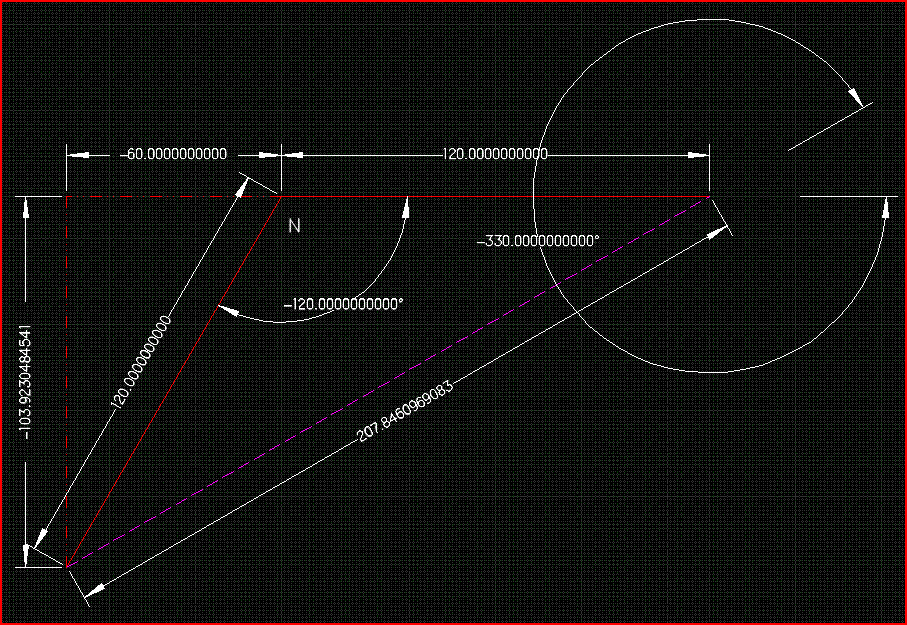
Just for giggles, I decided to solve this graphically, and I used Rattus' "faulty" posting to plug in the numbers. :grin: (yes, I know it was just a typo, and that was actually why I started this graphical solution.)
I have a CADD system that lets me type in Rectangular and/or Polar coordinates on the keyboard, and it drops lines exactly on those coordinates at real (1:1) scale. From these, I can dimension the resulting lines and get an accurate dimensional picture of the problem.
The bottom image is actually Rattus' rectangular solution from his previous post. The upper image is the full polar (vector) solution.
[edit] Oops. The vector I dimensioned at 120@60 is actually the negative of 120@-120. I entered the vector as -120@-120, but I created the dimension backward. The solution is correct, but it was my dimension (after the fact) that is wrong.
Important Edit After going back to a couple of postings, I see that there was some disagreement as to the actual numbers, so I changed the display of the resultant vector to be in "Decimal inches" instead of the "fractional inches" that I had it previously set for. I use this CADD system for woodworking, so the display was set to fractions by default. If there is a discrepancy between my drawing and a calculator, I've got $1000 that says my CADD system is more accurate.

I have a CADD system that lets me type in Rectangular and/or Polar coordinates on the keyboard, and it drops lines exactly on those coordinates at real (1:1) scale. From these, I can dimension the resulting lines and get an accurate dimensional picture of the problem.
The bottom image is actually Rattus' rectangular solution from his previous post. The upper image is the full polar (vector) solution.
[edit] Oops. The vector I dimensioned at 120@60 is actually the negative of 120@-120. I entered the vector as -120@-120, but I created the dimension backward. The solution is correct, but it was my dimension (after the fact) that is wrong.
Important Edit After going back to a couple of postings, I see that there was some disagreement as to the actual numbers, so I changed the display of the resultant vector to be in "Decimal inches" instead of the "fractional inches" that I had it previously set for. I use this CADD system for woodworking, so the display was set to fractions by default. If there is a discrepancy between my drawing and a calculator, I've got $1000 that says my CADD system is more accurate.
Last edited:
You'll have to define accurate. Otherwise, you lost before you wagered. The magnitude value I posted earlier using Windows Calculator is far more precise than your drawing. ...or are you going to say it's not really a calculator?Rick Christopherson said:...I've got $1000 that says my CADD system is more accurate.
Regardless, I've got $1000 bucks that says my CAD drawing is more accurate and precise than yours :grin:

- Status
- Not open for further replies.