A little more fun:

Status
Not open for further replies.
Rick, it is pretty common terminology to say that the two ends of a center tap transformer are 180 degrees out of phase when the center tap is grounded. This is quite common when making full wave rectifiers without using a bridge rectifier.

Just to clarify what you are saying, are you disagreeing with the following statement that the center-tapped transformer has voltage phasors with a phase difference of 180 degrees?:
mivey said:
From pg 90 of "Techniques of Circuit Analysis" 1972 Carter/Richardson where they were talking about forming polyphase sources by using voltage sources separated by phase differences:

"...two voltage phasors in opposition-that is, with a phase difference of 180 degrees; a single-phase transformer with a center-tapped secondary winding would be such a source."
I can't be 100% sure, but it appears that this is what rattus is trying to say.

Or, is there something in his diagram/statements that is indicating something in addition to this common 180 degree phase difference concept?
 
mivey said:
Or, is there something in his diagram/statements that is indicating something in addition to this common 180 degree phase difference concept?
I don't care if someone wants to view the sources as being out of phase, and even solve their circuits in that manner--that is their preference. But as soon as he put it into a nodal phasor diagram, it became wrong. It's poor engineering; and what's worse, is that he doesn't even know it.
 
Rick Christopherson said:
...But as soon as he put it into a nodal phasor diagram, it became wrong. It's poor engineering...
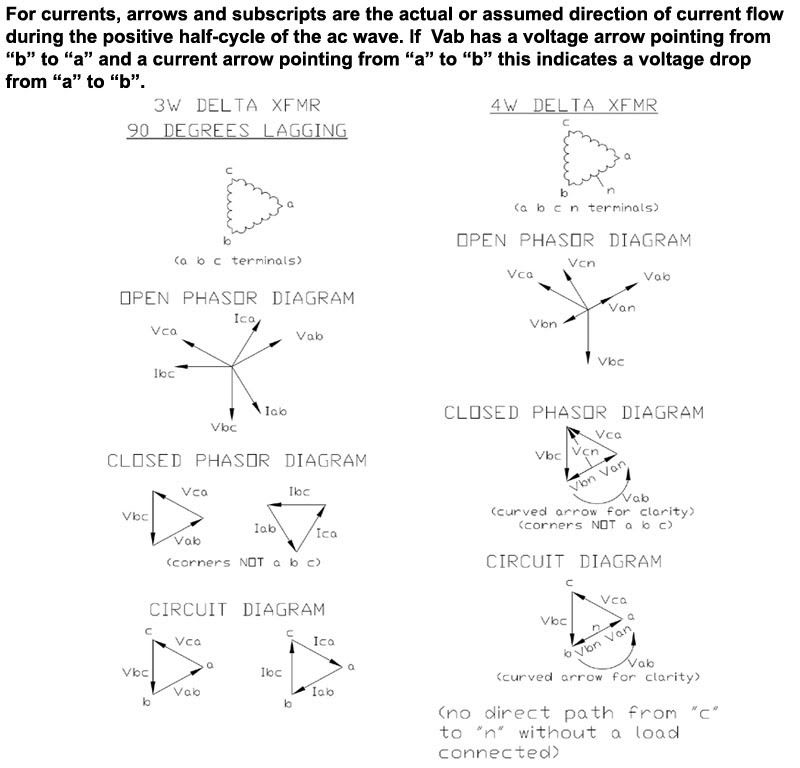
This the first time I've heard reference to a nodal phasor diagram. Not that I have a problem with it, just that I'm not sure how it is defined. I have heard of open and closed phasor diagrams as shown here:
phasorvscircuitdiagram.jpg


I don't see a problem with the phasors pointing away from the neutral. They can point in whatever direction is needed for what you are doing. If you wanted to find the voltage drops in the following delta with the currents shown, where do you think the arrows would point?
DeltaCurrents.jpg


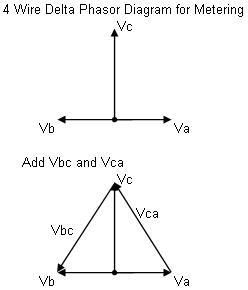
Using arrows pointing away from the neutral is quite common in phasor diagrams used with metering, and I would call it more of the norm. Consider the following phasor diagram for 4-wire delta metering. It looks like an inverted "T" and the phasors point away from the neutral. Now add in two additional measurement quantities where you want to measure the voltage between phases a & c and phases b & c. This gives you a phasor diagram like rattus had with an additional phasor between a & n.
DeltaPhasors.jpg


[edit:typo]
 
Last edited:
Here's your homework assignment: Why is it that all of the diagrams in your full-page text book example are correct, but the diagrams that you and rattus have drawn are not? (Hint, see my previous post.)
 
Rick Christopherson said:
Here's your homework assignment: Why is it that all of the diagrams in your full-page text book example are correct, but the diagrams that you and rattus have drawn are not? (Hint, see my previous post.)
Which specific diagrams that I drew are you saying are wrong?

Also, are you referring to the "nodal phasor diagram" note from your previous post as explaining why something is wrong? If you are, I would appreciate some definition (other than your own, say something from a reference book) of a "nodal phasor diagram". I've already explained that I am not familiar with this definition. Once you have the definition, then explain how a "nodal phasor diagram" makes what I drew incorrect and maybe I can understand where you are coming from.

[edit to add the following]

Maybe it is the notation you take issue with. Do you mean this is better?:
DeltaPhasors2.jpg
 
Last edited:
Still waiting:

Still waiting:

Rick Christopherson said:
Here's your homework assignment: Why is it that all of the diagrams in your full-page text book example are correct, but the diagrams that you and rattus have drawn are not? (Hint, see my previous post.)

Rick,

Since I have heard no valid reason that my diagram is incorrect, I can only assume that you cannot justify that claim. Therefore, any resulting claims are flawed, and any further discussion is useless.

Smoke and dust won't get it. You must back up your statement with something more than your own interpretation. Failure to do so just emphasizes the fact that you are wrong.
 
rattus said:
... Smoke and dust won't get it. You must back up your statement with something more than your own interpretation. Failure to do so just emphasizes the fact that you are wrong.
Oh, I'm saving this one!:D

carl
 
Come on Carl:

Come on Carl:

coulter said:
Oh, I'm saving this one!:D

carl

Carl, maybe you could explain why my diagram is wrong?? I will tell you why it is right.

It is easily shown that the voltage at C relative to G is,

Vcg = 120V @ 180 degrees = 120V[cos(180) + jsin(180)]
= 120V[-1 + j0] = -120V + j0

(Note that the magnitude is still positive which it must be!)

Clearly, the arrow should point from G to C.

Now what could be wrong with that?
 
rattus said:
Carl, maybe you could explain why my diagram is wrong?? ...
Nope - haven't been following it enough to show you the places your model is inconsistent.

rattus said:
...I will tell you why it is right. ...
I'm sure you will, and I'll listen politely.

I mostly just want to save the highlighted phrase to remind the master of mis-direction and repeated assertion of opinion as truth, that such things are - how did you say that? ...:rolleyes:

carl
 
Finis:

Finis:

Since no one has proven otherwise, it must be correct to point the phasor arrows in either direction. After all, it is just a matter of complex numbers and algebra, and the results are correct.

Case closed again.
 
Rattus? Kindergarten Corollary:
Since no one has proven that life doesn?t exist on Mars, then it must be true that life does exist on Mars.

Arguing with you is like arguing with a 6 year old. If someone says something that you cannot defend, you try to distract the discussion by sidestepping to another topic. If someone backs you into a corner with no way out, you put your hands over your ears and chant, ?La...La...La...Case Closed... La...La...La...Case Closed...La...La...La? :roll:
 
Rick Christopherson said:
Arguing with you is like arguing with a 6 year old...
Rick,
This last post presents no evidence. It is the response of someone who is backed into a corner with no means to defend their position other than by lashing out. It is an emotional response and I would expect more from you. Take a breath and get back on point.

From what I can tell, you have tried to make the case that it is wrong to draw phasors with a neutral reference. You have been presented evidence that is contrary to that position. I will say now, and have in the past, that there are times when it makes more sense to draw the phasors in one direction. Coulter's working of the simple resistor circuit showed that to be true in that case.

It appears you fail to accept is that there are times when it is perfectly valid, and not "poor engineering" to use the neutral as a reference. I find accepting only one way as restrictive and, to put it bluntly, shallow. Winnie presented some fine examples of neutral references. There are many times when it is a common practice by engineers and technicians alike to use this method. I have provided examples in circuits and metering where this is the case. Drawing resolved voltage and current phasors can also produce these results.

The evidence shows that it is perfectly valid and reasonable, in some cases, to draw the phasors directed away from a neutral point. This fact is undisputed. It has been a part of engineering work since before you and I were born.

The mental giants of our industry found in the 1920's and 1930's that using a neutral reference point was very useful in the method of symmetrical coordinates/components. For you to come along almost a century later and make the claim that it is "poor engineering" to use a neutral reference is just ludicrous. These pillars of our industry realized that phasors can be drawn in either direction. The choice of direction is dependent on what you are trying to do. Calling one way the "correct way" and another the "wrong way" is utter nonsense.

Also, you have yet to validate the "nodal phasor diagram" idea and why it makes drawing phasors away from a neutral "wrong" or "poor engineering".

As far as what it is like to argue with rattus, I could not tell you. He has said some things I did not agree with in the past but I have not found myself having to argue with him, yet. I put forth the effort it took to try to understand what he was saying instead of trying to catch him saying something wrong. Maybe the sidestepping is an attempt to get you to try to get what he is saying by looking at it from another perspective.

I have not been here long enough to be party to all of the past arguments but I will say this: if we track what any of us say over a long enough time, you will find something stupid said. This is what makes us human, some more than others. We all get emotional at some point and say things we probably shouldn't, but who can throw stones? Hopefully, we will all be here for a long time as we all bring value to the table but we will have to overlook the times we step on each other's toes because it is bound to happen.

That being said, it certainly can be entertaining to spar with someone over an opinion. It can also be a good exercise in communication skills, so it is probably not a complete waste of time. Just try not to confuse fact with opinion.

[edit: typo]
 
Last edited:
Status
Not open for further replies.
Top