Help with getting the right voltage output from a transformer.

mike1061

Senior Member
Location
Chicago
My question is about reducing the voltage of a transformer. What happened is, a heating company replaced a comercial root top unit. Heat and cool. The problem with Chicago’s electrical grid seems to be the imbalanced voltage. We have a 240 volt, delta, 3 phase service. The manufacturer of the equipment is Trane. The equipment has a VFD drive blower. The VFD can not take the unbalanced power. My solution was to intercept the the wires feeding the blower and connect them to a transformer. The transformer is a 5kVA, 240 delta primary with a 240 Y secondary. Now Trane is saying that the moter is not getting up to speed because it needs 208 Y. So, is there a way to get 208 out of this transformer? Meaning connecting the line side to different tap conductors, or any outer way?
The current readings are line side 125, 125, 215 phase to ground. 250, 250, 225, pause to phase. The Load side readings are, 140, 140, 140, phase to ground, 250, 250, 225, phase to ground.
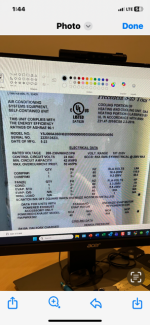
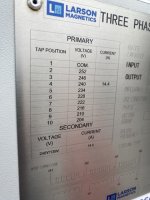
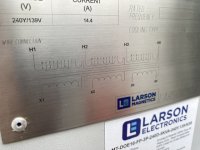
Picture 1, is the transformer label.
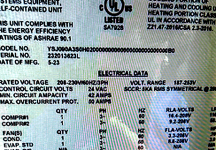
Picture 2, is the scep sheet of the RTU
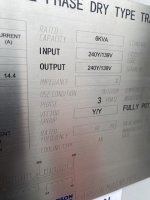
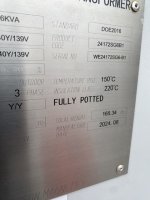
Pictures 3-6 are the technical label on the transformer. Sorry, but no matter what I did part of the label was unreadable, so I cut it up.
Thanks
Mike

 

Attachments

  • IMG_0738.jpeg
    IMG_0738.jpeg
    149.2 KB · Views: 18
  • IMG_0747.png
    IMG_0747.png
    900.6 KB · Views: 19
  • IMG_0742.jpeg
    IMG_0742.jpeg
    86.7 KB · Views: 19
  • IMG_0743.jpeg
    IMG_0743.jpeg
    72.8 KB · Views: 16
  • IMG_0744.jpeg
    IMG_0744.jpeg
    72.5 KB · Views: 15
  • IMG_0745.jpeg
    IMG_0745.jpeg
    79.3 KB · Views: 18
Because your incoming voltages is already high, at 250V, the taps on your transformer will not help. What you have is a 240/120V 3 phase 4 wire service from a transformer bank with a center tapped unit.

As Don said you need a different transformer.

It is possible you could use a buck-boost transformer arrangement along with your incorrect transformer, but it maintains be worth the effort.
 
A 208 Y transformer may not even help, that’s a substantial difference phase to phase on that one leg. That’s probably what the vfd is not liking. Sounds like the poco has one leg loaded much heavier than the other two. They probably need to shift some single phase loads around on their end.
 
a heating company replaced a comercial root top unit. Heat and cool. ..We have a 240 volt, delta, 3 phase service. The manufacturer of the equipment is Trane. The equipment has a VFD drive blower. The VFD can not take the unbalanced power. My solution was to intercept the the wires feeding the blower and connect them to a transformer.
Thats a curious approach, a in unit delta wye transformer for just the evaporator blower fan?,

looking at the nameplate of the unit you posted its hard to read but I think it says
Trane YSJ090
thats a 7.5 ton gas/electric series, and for YSJ090A3 the electrical table lists 208/230 V, 3 phase,
MCA 42
max fuse / breaker 50.
Input voltage range looks to be 187-263 volts 3 -phase

If I am reading that right according to my old Trane book it should support 240/139 wye,
if the unit needs 208V as Trane tech support suggests Trane needs to send you a new nameplate.
I would also be surprised if they suggested the transformer configuration you have.

If the nameplate is indeed correct, I suspect your issue is the Compressor VFD, can't run off a 240 (likely open) delta or whatever your utility does, you likely need a transformer sized to the entire load like a 20kVA 240: 240/139 (at minimum) and that would need to supply the entire package.

Since more and more things don't support 'delta' services I'd ask the utility if its possible to convert to a wye service such a 120/208
or if the building has mostly 240 3 phase loads and not much 120 you might explore other options such as settings and jumpers in the VFD that may make it run better on a delta supply.
 

Attachments

  • trane_model_mca_detail-s.png
    trane_model_mca_detail-s.png
    1.1 MB · Views: 4
Last edited:
Funny: The transformer label says 'Primary 240V Delta' but the data plate says it is a wye:wye transformer.

I don't think you can use a wye:wye transformer to derive a low impedance neutral for drive isolation because they don't develop a low impedance neutral.
 
The wiring diagram shows a wye connected primary isolated from the wye connected secondary. As long as the primary wye (H0) is not used, as a Yg-Yg, the secondary neutral would look just like one created by a delta primary.
 
The wiring diagram shows a wye connected primary isolated from the wye connected secondary. As long as the primary wye (H0) is not used, as a Yg-Yg, the secondary neutral would look just like one created by a delta primary.

Say you ground the secondary neutral, and then have a ground fault on the secondary side.

Where does the current flow on the primary side? Remember that except for magnetizing current, current doesn't flow throw a primary coil without current on the corresponding secondary coil.
 
YASKAWA dealer here:

Another way to deal with this issue is to use a line reactor and input the drive as single phase, (using the balanced phases) with three phase output on the drive to the motor, you can also lower the voltage output to 208. This would require replacing the drive with one that is rated 2x of the motor load. I know this gets expensive and you already have the transformer, but it's the wrong transformer. 208 cannot be made through changing taps.
 
I don't think you can use a wye:wye transformer to derive a low impedance neutral for drive isolation because they don't develop a low impedance neutral.
Is that a requirement for this application, or is the need for balanced voltages around a neutral point?

Yes, most drive isolation applications are looking to control 'harmonics' but isn't this one intended for voltage matching?
 
I am curious why just one component the blower fan VFD is the issue?
Its a 17.5 kVA load (42A 240V 3PH) I'd be inclined to use a 240V delta / 240V wye transformer ahead of the entire load that is sized to carry the load.
 
...
The current readings are line side 125, 125, 215 phase to ground. 250, 250, 225, pause to phase.

Were those voltage readings taken with an averaging meter? If so, try measuring with a true RMS meter. If the phase-to-phase voltages get significantly closer to each other when using an RMS meter, that probably indicates that there is significant harmonic content (for example third harmonic). The problem is that the diode bridge rectifier in a VFD is responsive to peak voltages, not RMS or average voltages. However, if both RMS and average measurements show balanced voltages, then it's likely that there is low harmonic content and the peak voltages should also be balanced.

It should be possible to get the peak voltages more balanced in the presence of harmonics with, for example, buck boost transformers. But especially if we are dealing with an open delta service, harmonics could even make the peak voltage across the phases where 225V was measured even higher than where 250V was measured. So in this case you'd want a buck boost to reduce the voltage where 225 was measured, as counterintuitive as that sounds.
I believe this is why there was only current flowing on phases B and C on the feed to a VFD in this previous post, even though the measured B-C voltage was less than the A-C and A-B voltages:

 
A 208 Y transformer may not even help, that’s a substantial difference phase to phase on that one leg. That’s probably what the vfd is not liking. Sounds like the poco has one leg loaded much heavier than the other two. They probably need to shift some single phase loads around on their end.
Is this an open delta? Or a full delta?
Open. Sorry I didn’t remember what it was. I looked all this up last year.
 
Were those voltage readings taken with an averaging meter? If so, try measuring with a true RMS meter. If the phase-to-phase voltages get significantly closer to each other when using an RMS meter, that probably indicates that there is significant harmonic content (for example third harmonic). The problem is that the diode bridge rectifier in a VFD is responsive to peak voltages, not RMS or average voltages. However, if both RMS and average measurements show balanced voltages, then it's likely that there is low harmonic content and the peak voltages should also be balanced.

It should be possible to get the peak voltages more balanced in the presence of harmonics with, for example, buck boost transformers. But especially if we are dealing with an open delta service, harmonics could even make the peak voltage across the phases where 225V was measured even higher than where 250V was measured. So in this case you'd want a buck boost to reduce the voltage where 225 was measured, as counterintuitive as that sounds.
I believe this is why there was only current flowing on phases B and C on the feed to a VFD in this previous post, even though the measured B-C voltage was less than the A-C and A-B voltages:

My solution might not work either. :0(
 
Thats a curious approach, a in unit delta wye transformer for just the evaporator blower fan?,

looking at the nameplate of the unit you posted its hard to read but I think it says
Trane YSJ090
thats a 7.5 ton gas/electric series, and for YSJ090A3 the electrical table lists 208/230 V, 3 phase,
MCA 42
max fuse / breaker 50.
Input voltage range looks to be 187-263 volts 3 -phase

If I am reading that right according to my old Trane book it should support 240/139 wye,
if the unit needs 208V as Trane tech support suggests Trane needs to send you a new nameplate.
I would also be surprised if they suggested the transformer configuration you have.

If the nameplate is indeed correct, I suspect your issue is the Compressor VFD, can't run off a 240 (likely open) delta or whatever your utility does, you likely need a transformer sized to the entire load like a 20kVA 240: 240/139 (at minimum) and that would need to supply the entire package.

Since more and more things don't support 'delta' services I'd ask the utility if its possible to convert to a wye service such a 120/208
or if the building has mostly 240 3 phase loads and not much 120 you might explore other options such as settings and jumpers in the VFD that may make it run better on a delta supply.
I wouldn’t say they recommend this set up. This was my way of solving the problem. It is the evaporator motor. Or should I say, it’s the motor that blows thru the coils. The reason I did this was because the transformer for the whole unit is a lot more money. I did and experiment with the unit next to this one and it seems to have worked. This 2nd one won’t. They have replaced the VFD, the board and everything. So they say. Now they are kicking it back to me.
It is an open delta on the line. But the output is supposed to be balanced Y 240.
 
Funny: The transformer label says 'Primary 240V Delta' but the data plate says it is a wye:wye transformer.

I don't think you can use a wye:wye transformer to derive a low impedance neutral for drive isolation because they don't develop a low impedance neutral.
Ive looked at that plate a dozen times. I didn’t see that. Wye on the input. That might be the problem, yea?
 
The wiring diagram shows a wye connected primary isolated from the wye connected secondary. As long as the primary wye (H0) is not used, as a Yg-Yg, the secondary neutral would look just like one created by a delta primary.
Meaning that is why the secondary has the different phase to phase readings? The line side high leg is used.
 
YASKAWA dealer here:

Another way to deal with this issue is to use a line reactor and input the drive as single phase, (using the balanced phases) with three phase output on the drive to the motor, you can also lower the voltage output to 208. This would require replacing the drive with one that is rated 2x of the motor load. I know this gets expensive and you already have the transformer, but it's the wrong transformer. 208 cannot be made through changing taps.
Before i even attempt this, I was thinking swapping the transformer with a 208 secondary. It would take a learning curve to figure all that. Thanks
 
Top