makeup air dumper to range hood

So I've been looking at a make up air system {HVACQuick Ruck MUA System). It is basically a roof cap, some duct work, damper, fan, and filter enclosure. The fan is made by a German company called Ruck and the fan speed is controlled by 0-10 volts. The range hood that will interconnect with the MUAS is a 4 speed fan. Now the issue is how do you get the hood motor to interface with the fan motor. My thought is some type of current transformer that measures the hood fan current and then outputs 1-10 volts according to the hood fan speed. Does this seem possible? I've looked for online for a device that would do this and it does seem like there may be a commercially available product to make this work.

MUA Fan Motor:

MUAS:

 
So I've been looking at a make up air system {HVACQuick Ruck MUA System). It is basically a roof cap, some duct work, damper, fan, and filter enclosure. The fan is made by a German company called Ruck and the fan speed is controlled by 0-10 volts. The range hood that will interconnect with the MUAS is a 4 speed fan. Now the issue is how do you get the hood motor to interface with the fan motor. My thought is some type of current transformer that measures the hood fan current and then outputs 1-10 volts according to the hood fan speed. Does this seem possible? I've looked for online for a device that would do this and it does seem like there may be a commercially available product to make this work.

MUA Fan Motor:

MUAS:

Should the hood fan be VFD driven the VFD likely has digital and analog output capabilities for interfacing with other components.
 
Should the hood fan be VFD driven the VFD likely has digital and analog output capabilities for interfacing with other components.
The range hood is a 4 speed motor with a mechanical control so I'm not sure how that would work. It's the remote wall mounted blower version below:

 
The range hood is a 4 speed motor with a mechanical control so I'm not sure how that would work. It's the remote wall mounted blower version below:

Current transducer on the exhaust fan conductor(s) possibly, one like this one
 
Current transducer on the exhaust fan conductor(s) possibly, one like this one
Yup that's the one I already downloaded the current sheet for to provide the 0-10 volts to the make up fan. As Tom suggested I was also looking at a current relay to provide on/off control to the fan motor.
 
ACSN100-AE-F
Yes that's the exact same one that I have in my file. :cool:

Since there are several options given the components already mentioned, the ACT050-10-F and the ACSN100-AE-F, how would you wire them? The 0-10 volt fan control (ACT050-10-F) should be Class 2? The On/Off (ACSN100-AE-F) Class 2 if using a Class 2 control transformer and a relay at the make up air fan?

 
What is the voltage of your VFD control? Control + to the contacts of the relay on back to the Run/Fwd input of the drive. No interposing relay. Mine go to a 24 volt PLC input. Class 2, IDK, your choice. The current switch will activate any time the hood fan is on. Loop it a few times if needed.
The 0-10 should then control the speed of the exhaust fan.
 
What is the voltage of your VFD control? Control + to the contacts of the relay on back to the Run/Fwd input of the drive. No interposing relay. Mine go to a 24 volt PLC input. Class 2, IDK, your choice. The current switch will activate any time the hood fan is on. Loop it a few times if needed.
The 0-10 should then control the speed of the exhaust fan.
I'll have to look at the fan literature. If I remember correctly the fan gets fed with 120 volts and there is a terminal block for the 0-10. Everything else is internally wired in the fan.
 
Ooh,

I see, I see, said the blind man as he stuck his wooden leg out the window to feel if it was raining.
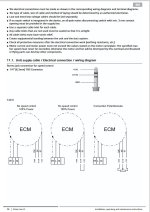
I found this for the Ruck MUA fan. Typically these fans (exhaust and make up air) are part of a dual fan system designed to work together. The speed control is just a 1-10 variable speed potentiometer style switch. My system has an existing 4 speed hood motor.

Ruck Fan Control Wiring.JPG
 
I found this for the Ruck MUA fan. Typically these fans (exhaust and make up air) are part of a dual fan system designed to work together. The speed control is just a 1-10 variable speed potentiometer style switch. My system has an existing 4 speed hood motor.

View attachment 2581968
Be nice if the 4 speed hood motor had a potentiometer (or some equivalent arrangement) that changed resistance accordingly as you changed hood speed to drive this ECM speed control input.

An option but probably one users won't understand well enough is to just use a potentiometer near the speed control to adjust inlet speed. Might actually need pressure gauge (one that shows both positive and negative air pressure) and instructions to adjust it to maintain near zero pressure. But that might be asking too much depending on who is expected to use it.
 
I found this for the Ruck MUA fan. Typically these fans (exhaust and make up air) are part of a dual fan system designed to work together. The speed control is just a 1-10 variable speed potentiometer style switch. My system has an existing 4 speed hood motor.
The only issue I have is limiting the top speed if it is not inherently done so in the design of the ECM. Make sure your monitored fan current is less than the max range of the transducer. Changing scales and adjusting loops thru the transducer would work.
I would feel better with it, but you may not need a current switch and relay at all. 0 volt from the transducer would mean 0 speed.
Make Up Air may vary a bit as the initial startup or speed change of the Hood current.

None of which you don't already know.

Is this a home project?
 
The only issue I have is limiting the top speed if it is not inherently done so in the design of the ECM. Make sure your monitored fan current is less than the max range of the transducer. Changing scales and adjusting loops thru the transducer would work.
I would feel better with it, but you may not need a current switch and relay at all. 0 volt from the transducer would mean 0 speed.
Make Up Air may vary a bit as the initial startup or speed change of the Hood current.

None of which you don't already know.

Is this a home project?
Haven't used one of those but would think it is capable of at least some adjustment of minimum/maximum input to output values, or even inverting input to output direction if needed.
 
Is this a home project?
Yes. I'm working on plans for a kitchen renovation and as I mentioned prior my HVAC guy wants to dump the make up air into the AC system return. Since we've had below 0 weather this winter I'm liking that system less and less even though it would be the easiest and cheapest way to go. The thought of dumping frigid outside air into the AC system where it can be pulled in every room that has a AC register now seems highly unappealing. The HVAC guy can install whatever I want so I was seeking an alternative.

This new separate MUAS would supply air through a ceiling register directly above the hood where it would have minimal impact elsewhere in the house. Also a duct heater can be incorporated to preheat the air before it reaches the kitchen for winter operation. One advantage of the AC return system is that if the system is running most of the outside air will go through the AC unit and be dehumidified during the summer.
 
Yes. I'm working on plans for a kitchen renovation and as I mentioned prior my HVAC guy wants to dump the make up air into the AC system return. Since we've had below 0 weather this winter I'm liking that system less and less even though it would be the easiest and cheapest way to go. The thought of dumping frigid outside air into the AC system where it can be pulled in every room that has a AC register now seems highly unappealing. The HVAC guy can install whatever I want so I was seeking an alternative.

This new separate MUAS would supply air through a ceiling register directly above the hood where it would have minimal impact elsewhere in the house. Also a duct heater can be incorporated to preheat the air before it reaches the kitchen for winter operation. One advantage of the AC return system is that if the system is running most of the outside air will go through the AC unit and be dehumidified during the summer.
They dump it into the return so it will go through the heat exchanger (if heating/cooling is running) and will be conditioned before being pumped all over the house. If you just bring it in at some random place you are still going to incur the heat gain or loss but maybe at less of a comfort level.

Other options are an energy recovery ventilator or the duct heater idea.

Also as you mentioned closer you bring this air in to the exhaust fan the less impact it will have on comfort as well as on heating/cooling costs.

Bottom line is if air is being pulled out replacement air must come in, you either let it find a way or you provide more of an intended way.

I had a situation several years ago, small restaurant gas company was called in because water heater pilot light kept going out. They ended up determining cooking exhaust hood causing back draft and blowing out the pilot, they shut the gas off because of the potential hazards and wasn't turning it on until the situation was remedied. Owner wanted me to hook up an electric water heater. I knew this owner since I was a kid, man with some money but also had money because he is very tight with it, I sort of learned that back when I was like 12 years old and did yard work and other small jobs for him. All he could think of was how much cold /hot air that would pull in through the make up vent. I told him if air goes out air has to come in. I also knew it would be more than a simple job the condition that electrical system was in to just add an electric water heater.
 
Last edited:
They dump it into the return so it will go through the heat exchanger (if heating/cooling is running) and will be conditioned before being pumped all over the house. If you just bring it in at some random place you are still going to incur the heat gain or loss but maybe at less of a comfort level.
The system is AC only so for 6 months a year it's not running and the air getting pulled in from outside would be unconditioned for those 6 months. Although some of that air would go through the AC supply ducts a majority of it would likely get pulled through the return duct which is on the second floor. So in mind that would be equivalent to opening a window in the middle of the house when it's 10° outside.
 
Top