Re: Neutral sharing
This is an area of Theory, which really requires the person(s) being taught, to have some sort of text reference(s) - which can be used to interpret the reply messages in a BBS message.
I like Roger's reply - as it definitely covers the 1? 3W system accurately.
In a Kind-of complex EE nerd way of explaining it, the Magnetic Flow in the Core (talking Net flow - as results of Primary Flux and Secondary Flux), will be flowing in a certain direction per ? Cycle, thus determines the direction for Secondary Current to flow.
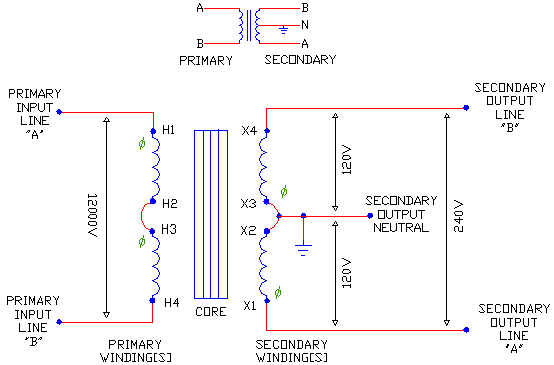
If the Secondary Winding is Center Tapped (either physically, or a split coil setup in series with a tap at the series jumper), there will be ? the maximum Potential of the entire Winding found at the Center Tap point.
This explains the 240/120 VAC part. Same results for remaining half of Cycle.
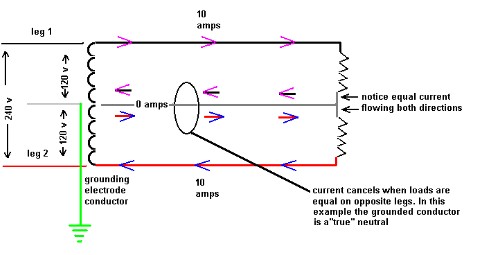
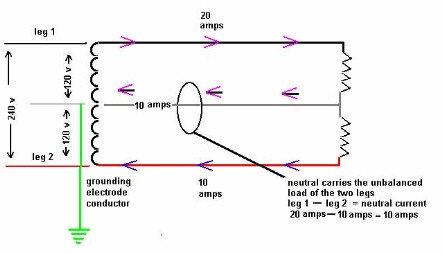
Currents balance across the Ungrounded Conductors, due to this being the "Actual Point Of Influence" from the Flux in the Core.
Simply, the Currents flowing through the connected loads are created as if the coil is only a 2 wire situation.
With equal loads across all L-C connection ("L-C" = Line-to-Common), this appears as if there are series loads of equal Impedance, connected between the coil's ends. Results = Currents flow L-L ("L-L" = Line-to-Line).
An imbalance will result in the "Odd" level of Current - which flows through the "Odd" level of Impedance, to be derived from the place of origin - the Center Tapped position of the coil. Results = Balanced Currents flow L-L, Imbalanced Currents flow L-C &/or C-L.
That's the "Crash-Course" techee way of saying it, which really is of no value to you, but may shed some light on the whole thing.
In reality, the whole thing has nothing to do with the type of currents - AC or DC! The same 3 Wire "Edison" Circuitry will work for AC and DC Power alike! Only on DC, there's two separate Power Sources conencted in Series Additive, with a tapped circuit conductor coming from the series jumper between the "+" of one source and the "-" of the other source.
The Common Center Tapped Conductor is both Polarities - "+" and "-".
I have Schematics of this baloney posted on-line if you (or anyone else) would like to view them.
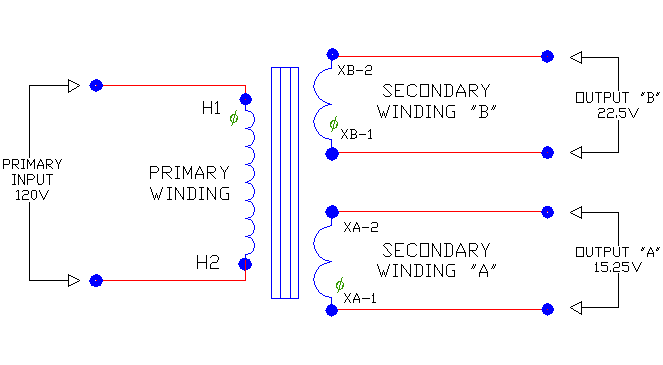
Schematics of 3 and 5 Wire DC Systems, along with 1? Transformers having one, two and 3 taps off the Secondary. Also 1? Xformers with multiple Secondaries.
These drawings can be of great help when discussing this area of Theory.
Items may be found at ECN (Electrical Contractors Network) in the Technical Reference Section.
Can supply links if needed - just let me know either by posted reply, P.M. (Private Message) or direct E-mail (adst at pacbell dot net).
Lastly, while it's great that someone knows the tech reasons of operation for a common noodle, it's not the only judgement of any Electricians' abilities or level of expertness (is that a word???...hee hee hee).
Installing the stuff properly is of key importance.
A nice balance of both really makes me impressed!
Leaving the Soapbox...
Next Speaker, please take the 'box!
Scott35
p.s. - To Jason;
Jim, isn't that the other way around? The voltage drop across the 50 watt bulb would be 80,
and the voltage drop across the 100 watt bulb would be 160. Right?
Saw this after posting my message.
Jim is right. The Higher Impedance will need a Higher Voltage (Pressure) to push the Current through it.
The 50 Watt Lamp is in series with the 100 Watt Lamp, and thus results in the 50 Watt Lamp having a much higher Impedance than the 100 Watt Lamp - which will result in the higher Voltage being measured at the 50 Watt Lamp.
(Since these Lamps are Incandescent, we may say they are "Resistance Loads" and can swap the opposition from Impedance to Resistance - but this is another story...hee hee).
Also, just FYI - the 50 Watt Lamp will be twice as bright in this series scenario, than the 100 Watt Lamp.
End of extra fill!
Scott35
[ January 17, 2004, 06:47 PM: Message edited by: scott thompson ]


 )
)