Electromatic
Senior Member
- Location
- Virginia
- Occupation
- Master Electrician
As a home project, I'm trying to convert the ringer of an old rotary phone for use as a doorbell. I thought it would be relatively simple, but I'm having no luck.
The phone is ca1970 Western Electric.
I know that the ring state for old POTS is typically around 90VAC, 20Hz. I've tried briefly applying 24VAC (from a transformer I have) and even straight 120VAC to what I believe to be the appropriate coil wires but get nothing. Is this to be expected? I thought I'd get some kind of reaction despite the out-of-spec V and Hz.
The coil assembly is (from research) apparently two coils for L1 and L2. Each one reads what I think is correct at ~1kΩ and ~2.6kΩ. There is also a capacitor within the phone's assembly that seems to be out of spec, reading ~1.2uF vs 0.5uF. My understanding is that this is more for actual phone line usage than the electromechanical operation of the ringer.
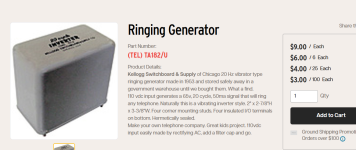
Am I completely missing something other than getting closer to 90V, 20Hz? I don't care about actually getting a "ring-ring" pattern--just for the bells to ring when someone presses the door bell button. (I know they sell ring generators, but I'm trying to keep it simple and cheap.)
TIA
The phone is ca1970 Western Electric.
I know that the ring state for old POTS is typically around 90VAC, 20Hz. I've tried briefly applying 24VAC (from a transformer I have) and even straight 120VAC to what I believe to be the appropriate coil wires but get nothing. Is this to be expected? I thought I'd get some kind of reaction despite the out-of-spec V and Hz.
The coil assembly is (from research) apparently two coils for L1 and L2. Each one reads what I think is correct at ~1kΩ and ~2.6kΩ. There is also a capacitor within the phone's assembly that seems to be out of spec, reading ~1.2uF vs 0.5uF. My understanding is that this is more for actual phone line usage than the electromechanical operation of the ringer.
Am I completely missing something other than getting closer to 90V, 20Hz? I don't care about actually getting a "ring-ring" pattern--just for the bells to ring when someone presses the door bell button. (I know they sell ring generators, but I'm trying to keep it simple and cheap.)
TIA