old phone as doorbell

Electromatic

Senior Member
Location
Virginia
Occupation
Master Electrician
As a home project, I'm trying to convert the ringer of an old rotary phone for use as a doorbell. I thought it would be relatively simple, but I'm having no luck.

The phone is ca1970 Western Electric.
I know that the ring state for old POTS is typically around 90VAC, 20Hz. I've tried briefly applying 24VAC (from a transformer I have) and even straight 120VAC to what I believe to be the appropriate coil wires but get nothing. Is this to be expected? I thought I'd get some kind of reaction despite the out-of-spec V and Hz.

The coil assembly is (from research) apparently two coils for L1 and L2. Each one reads what I think is correct at ~1kΩ and ~2.6kΩ. There is also a capacitor within the phone's assembly that seems to be out of spec, reading ~1.2uF vs 0.5uF. My understanding is that this is more for actual phone line usage than the electromechanical operation of the ringer.

Am I completely missing something other than getting closer to 90V, 20Hz? I don't care about actually getting a "ring-ring" pattern--just for the bells to ring when someone presses the door bell button. (I know they sell ring generators, but I'm trying to keep it simple and cheap.)

TIA
 
as I recall from my telephony days, you also need the 48V DC and then *add* the 90V at 20 Hz or whatever ring cadence you want
 
If all you want is it to ring, 120vac thorough a small capacitor
I believe he actually tried that. The .5uF cap is in series with the windings (to block the 48VDC). I never tried applying 60Hz to a ringer, but I suspect that it is "tuned" to 20Hz and will do little at 60 probably for a reason. Further, the 20Hz makes the ringer sound the way it does as it follows the slow 20Hz waveform.

Look on eBay for ring generators. I used to find old 1A2 system power supplies all over still plugged in after 50 years! Can't be more than a few dollars. Or keep your eyes open in old building telecom rooms.

-Hal
 
Thanks, all, so far.

Yes, I've tried briefly applying 120V and 24V both directly to either coil or through the phone's capacitor and get absolutely nothing. I expected a fast ring or at least a single clunk from the clapper.
My searches for ring generators yield either fancy stage production battery modules for ~$100 or differently fancy Arduino-based solutions. I'll do some searching for 1A2.
Alas, nothing is as easy or cheap as one would think!
 
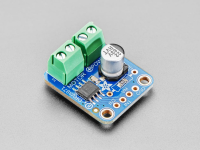
To make a telephone bell ring, you don't even need a sine wave, (VOIP / ATA adapters generate square wave) you make a H-brige with MOSFETS (or a 555 IC) or these days just use cheap mini robotics brushed DC motor driver like this:
You do need to boost it to ~90VAC so get a small 120v transformer with, say, a 12v secondary. Drive the secondary with the waveform from the H-bridge/motor driver and adjust the signal to be ~20 hz and the bell should ring:
1768859885563.png
 
Thanks for the high-tech, @tortuga . Adafruit has some clever things.
Will this drive the AC coils of the ringer? My electronics knowledge is short of H-bridge rectifiers. I was hoping to keep the project low-brow, but I'll take cheap and simple. 😏
 
Yeah you drive the ringer like a stepper motor.
I'd do something like meanwell 24V DC supply ---> Adafruit DRV8871 ---> (12V:120V transformer) drive the 12V secondary side --> primary side to bells. Set up the DRV8871 to 20HZ.
For control use a
 
Last edited:
I never tried applying 60Hz to a ringer, but I suspect that it is "tuned" to 20Hz and will do little at 60 probably for a reason.
Dunno, it always worked for us, probably depends on the ringer itself. Granted it's not the right way to do things, but for a poor community theater in the 70s and 80s, it did the job. Now, I'll just grab a small ring gen off the shelf in the garage.

BTW, there were 30Hz ringers, too, as well as a bunch of other freq's used for frequency-selective ringing on party lines; those are quite uncommon.
 
Let's assume that to get the desired ringer output we drive a transformer with a square wave at 20Hz using an H-bridge or a push-pull with a transformer center tap, etc., and powering it from a low voltage DC source.

To get a square wave with a fundamental sine wave component of 90Vrms at 20 Hz (a 1.414 x 90V = 127V peak), you need a square wave with a pi/4 x 127V = 100V peak value. This is from the Fourier series of a square wave.

To keep from saturating the core of a transformer, we have to keep below a certain number of volt-seconds per each half cycle (i.e. the area under a half cycle of the voltage waveform in volt-seconds). If we operate the transformer with a square wave drive, the peak value of the input and output voltage waveforms will need to be 2/pi or ~ 0.637 times the peak of a sine wave to get an equivalent amount of volt-seconds per half cycle.

And so if we drive a transformer with a 20Hz square wave obtain the desired 100V peak output without saturation, the rated output voltage of a transformer at 60 Hz should be at least 60/20 x (100V/0.637) x 0.707 = 333Vrms.

Also, if we drive the transformer with a square wave, it should have a 50% duty cycle to prevent a DC component from saturating the transformer. You might also have a coupling capacitor in the phone to block DC.

Of course, if you have money to waste you could use a VFD to drive the ringer at 20 Hz or whatever frequency you want. :)
 
Use this and you won't even need an external electrical supply. Doubles as a way to 'enlighten' unsuspecting nieces and nephews:

1768939029520.png

 
Let's assume that to get the desired ringer output we drive a transformer with a square wave at 20Hz using an H-bridge or a push-pull with a transformer center tap, etc., and powering it from a low voltage DC source.

To get a square wave with a fundamental sine wave component of 90Vrms at 20 Hz (a 1.414 x 90V = 127V peak), you need a square wave with a pi/4 x 127V = 100V peak value. This is from the Fourier series of a square wave.

To keep from saturating the core of a transformer, we have to keep below a certain number of volt-seconds per each half cycle (i.e. the area under a half cycle of the voltage waveform in volt-seconds). If we operate the transformer with a square wave drive, the peak value of the input and output voltage waveforms will need to be 2/pi or ~ 0.637 times the peak of a sine wave to get an equivalent amount of volt-seconds per half cycle.

And so if we drive a transformer with a 20Hz square wave obtain the desired 100V peak output without saturation, the rated output voltage of a transformer at 60 Hz should be at least 60/20 x (100V/0.637) x 0.707 = 333Vrms.

Also, if we drive the transformer with a square wave, it should have a 50% duty cycle to prevent a DC component from saturating the transformer. You might also have a coupling capacitor in the phone to block DC.

Of course, if you have money to waste you could use a VFD to drive the ringer at 20 Hz or whatever frequency you want. :)
Kinda how Western Electric made their frequency generator that takes 125VAC and with a big torroid inductor and some caps outputs 20Hz @ 90VAC. I used to have a schematic and theory of operation.

-Hal
 
Making the ring signal is _exactly_ what that generator in post #13 is supposed to do.

I saw it but didn't recommend it because the hard part will be controlling it with a doorbell button. You need to switch the 120V AC or the 125V DC or the 20 Hz 90V AC. So that means you need to add a relay.

I prefer the recommendations that start with 12 or 24V.

That said, a suitable 125V DC supply, that ring generator, and a relay to switch the ringing voltage should work just fine.

I _suspect_ that because the ringers were intended to work with very long phone circuits, that if you supply 20Hz AC at less than the nominal 90V you will still get good ringing.

-Jonathan
 
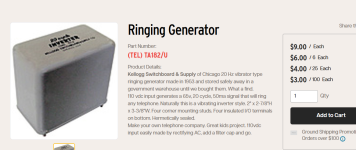
Would the generator @Joethemechanic posted basically get the job done? I noticed that when I checked out @winnie 's post from the same website. It looks like I can get a rectifier for about $5. <$20 in parts for the project works for me!

Definitely worth giving that ringing genertor a try.
A 120VAC sinewave has a peak value of around 170 volts, and so that's what the no-load voltage of a rectifier with filter cap will be. Without a filter cap, the average value will be 0.9 x 120V = 108V, but with 170V peaks and 0V nulls. Maybe the inductance of the solenoid in the vibrator is large enough that it can ride through this amount of voltage variation over a 60 Hz half cycle.

It's conceivable that the vibrator with a rectifier could trip an AFCI breaker, and so that's something to be aware of.
If that becomes a problem, you could see if inserting a transformer before the rectifier would help.
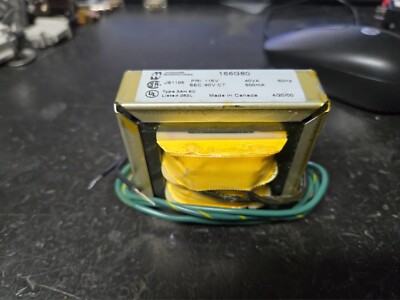
You could use one of these transformers with a rectifier cap:


Definitely worth giving that ringing genertor a try.
A 120VAC sinewave has a peak value of around 170 volts, and so that's what the no-load voltage of a rectifier with filter cap will be. Without a filter cap, the average value will be 0.9 x 120V = 108V, but with 170V peaks and 0V nulls. Maybe the inductance of the solenoid in the vibrator is large enough that it can ride through this amount of voltage variation over a 60 Hz half cycle.

It's conceivable that the vibrator with a rectifier could trip an AFCI breaker, and so that's something to be aware of.
If that becomes a problem, you could see if inserting a transformer before the rectifier would help.
You could use one of these transformers with a rectifier cap:


Nice find the 80V + filter cap would rectify to ~113 VDC
 
Top