questions about this small "utility" water heater

Status
Not open for further replies.

RustyShackleford

Senior Member
Location
NC
Occupation
electrical engineer
I just received this 10 gallon "utility" water-heater (meant to be used as point-of-use in a kitchen far from the main water heater) and a couple of issues have come up.

First, it comes standard with 1500watt heating element (120v, I believe), but was special-ordered to be 3500watts/240v. (The idea is that such a small tank and such a high wattage can recover so quickly that it's kinda like a tankless unit, without the enormous electrical load). The shipper made a mistake and it has the standard element. I'm wondering if it can be fixed simply by installing the correct heating element, or if there might be something about the thermostat, or (worse still) the internal wiring, that would require the entire unit to be swapped out. Tech service at Bradford-White refers me to the regional rep, which is kinda discouraging: if tech support at the mother-ship doesn't know, who would ?

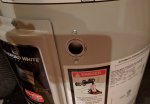
Second, I'm a little perplexed about how the wiring should be attached. It's not the usual setup where there's a small access panel in the top, See the picture. There's a small hole just to the right of the access cover (for the thermostat and heating element). The hole looks like where a Romex clamp should be installed (you can even see where you can knock it out for a bigger size clamp). But there's no way to access the locknut for a clamp, other than by sticking your finger through from the access panel opening and trying to hold it tight enough to lock it in place by rotating the outside part of the clamp). Worse still, the threaded body of a clamp would stick in close enough to the metal plate (you can see behind the clamp through the hole) that there's hardly room for the wires to go left to the access area - even though I'm only using 12-2. I guess I could use one of the little plastic Romex connectors, like:


http://www.supplyhouse.com/Topaz-45...7xcCnGf1V5f_o8_rHM-zDEBZbkVsUNQyN0aAoza8P8HAQ

... but those seem pretty marginal for a water heater. I guess, since the standard configuration for this unit is 120v/1500w (I special-ordered the higher wattage) that they figure you'll be using 14ga wire, but still ...


Attachments
  • IMG_20161126_183410.jpg
    IMG_20161126_183410.jpg
    128.4 KB · Views: 3
Last edited:
What you have is a Bradford White heater that is designed for use where space is tight and where little hot water is required. I have seen them crammed under a utility sink in a garage, for example. Thermostat is probably ok, but to be sure I would check the number against the parts list for a 240 unit. Since you are already looking a modified unit. You could just drill a hole in the top, or other convenient location for your Romex entrance. A much better choice would be one of their electric tankless units - they do have a 3500W model.
 
What about a none threaded snap in fitting? Majority of those are connected via MC or AC btw due to the physical damage concern.


850ST.jpg
 
I just received this 10 gallon "utility" water-heater (meant to be used as point-of-use in a kitchen far from the main water heater) and a couple of issues have come up.

First, it comes standard with 1500watt heating element (120v, I believe), but was special-ordered to be 3500watts/240v. (The idea is that such a small tank and such a high wattage can recover so quickly that it's kinda like a tankless unit, without the enormous electrical load). The shipper made a mistake and it has the standard element. I'm wondering if it can be fixed simply by installing the correct heating element, or if there might be something about the thermostat, or (worse still) the internal wiring, that would require the entire unit to be swapped out. Tech service at Bradford-White refers me to the regional rep, which is kinda discouraging: if tech support at the mother-ship doesn't know, who would ?

Second, I'm a little perplexed about how the wiring should be attached. It's not the usual setup where there's a small access panel in the top, See the picture. There's a small hole just to the right of the access cover (for the thermostat and heating element). The hole looks like where a Romex clamp should be installed (you can even see where you can knock it out for a bigger size clamp). But there's no way to access the locknut for a clamp, other than by sticking your finger through from the access panel opening and trying to hold it tight enough to lock it in place by rotating the outside part of the clamp). Worse still, the threaded body of a clamp would stick in close enough to the metal plate (you can see behind the clamp through the hole) that there's hardly room for the wires to go left to the access area - even though I'm only using 12-2. I guess I could use one of the little plastic Romex connectors, like:


http://www.supplyhouse.com/Topaz-45...7xcCnGf1V5f_o8_rHM-zDEBZbkVsUNQyN0aAoza8P8HAQ

... but those seem pretty marginal for a water heater. I guess, since the standard configuration for this unit is 120v/1500w (I special-ordered the higher wattage) that they figure you'll be using 14ga wire, but still ...


Tank water heaters are continuous loads thus a 14ga wouldnt cut it for a 1500W 120V (12.5+A) heater, you'd be looking at 12. 3500W on 240V is fine on 12ga, (14.6A x 1.25 = <20A).

eta: nothing wrong imho with a 'pop-in' (plastic) nm connector in this application.
 
Worse still, the threaded body of a clamp would stick in close enough to the metal plate (you can see behind the clamp through the hole) that there's hardly room for the wires to go left to the access area - even though I'm only using 12-2. I guess I could use one of the little plastic Romex connectors, like:
I would not use plastic!

What ever fitting you use of the lock nut variety; put the first lock nut tight to the body of the fitting, insert and use the second locknut to make the mechanical connection.

I've modified the threads by cutting some off, too
 
Thermostat is probably ok, but to be sure I would check the number against the parts list for a 240 unit.
Good idea, if I could find the rights partslist.
Since you are already looking a modified unit. You could just drill a hole in the top, or other convenient location for your Romex entrance.
I shouldn't need to do that. There must be a reasonable way to do it.
A much better choice would be one of their electric tankless units - they do have a 3500W model.
Really ? That's only good for about 1/2 gallon per minute (simple computation).
 
What about a none threaded snap in fitting? Majority of those are connected via MC or AC btw due to the physical damage concern. DELETED PHOTO
That solves the tightening problem, but I think it'd still stick into the hole too far.
 
What ever fitting you use of the lock nut variety; put the first lock nut tight to the body of the fitting, insert and use the second locknut to make the mechanical connection.
So it doesn't stick in so far ? Good idea. Might be able to stick a angled pair of needle-nose pliers back behind there and grab the locknut too.

I've modified the threads by cutting some off, too
Am I only imagining I've seen a clamp manufactured where there's a good-sized gap in the threaded part ?
 
How are you going to change the tag to reflect 240 vs 120. I am sure this will violate the listing of the device.
Not something I would recommend or do.
We electricians can do lots of things, but should we.
 
... The shipper made a mistake and it has the standard element. ...

The shipper did his job. It got to you. The supplier made a mistake. He needs to eat it and send you the product you ordered and have his carrier pick up the wrong one. I wouldn't go making modifications to listed equipment to help someone else mitigate their error.
 
Good idea, if I could find the rights partslist.

I shouldn't need to do that. There must be a reasonable way to do it.

Really ? That's only good for about 1/2 gallon per minute (simple computation).
1. I found the parts lists on the Bradford White web site- that's why I mentioned it.
2. I'm sure there is.
3. Sure, but either way, you are only going to get a relatively small amount of hot water from 3500W. Depends on how much you need and how fast.

i agree with an earlier post suggesting that if did not get what you ordered, the vendor should replace it.
 
The shipper did his job. It got to you. The supplier made a mistake. He needs to eat it and send you the product you ordered and have his carrier pick up the wrong one. I wouldn't go making modifications to listed equipment to help someone else mitigate their error.
You're entirely correct and that's exactly what I'm going to do. Although I meant to say vendor, not shipper. It's actually Bradford-White who I blame; the order clearly shows the suffix on the part number that denotes the heating element I specified. I discarded all the packing material, and I told 'em "tough, I'll do the best I can, and if it comes back damaged, it's on you, unless you want to pay a shipping company to pack it up".

I'm going to return the thing and get one from AO Smith instead. I've been very unfavorably impressed with Bradford-White as a consequence of this experience. They've completely given me the run-around (called tech support to ask about the thermostat replacement issue, and they told me I needed to talk to the regional rep).


Anyhow, the issue of how to run the wiring will hopefully be irrelevant with the AO Smith.
 
13. Sure, but either way, you are only going to get a relatively small amount of hot water from 3500W. Depends on how much you need and how fast.
I'm going to get 10 gallons of water as hot as I want. Even if I completely drain the tank, it'll take 20min or so to completely re-heat it. That should be fine to start a dishwasher cycle and handwash a few items.
 
I have the 120 volt version of that Bradford-White 10 gallon in my detached garage. I do not recall any problem installing Romex into it. Works great when I'm in there. I have a 20 amp wall switch to turn it off when I'm not.

I think the point was missed that this is a supplemental heater in the OPs use. In this case, the hot water line feeds the small tank unit. By the time it runs out of hot water (not really 10 gallons, that's some rating number), the pipe feeding the tank has hot water in it, so it (hot water) flows through to the sink without the need for heating again. Once the flow stops, the tank will keep the water in the tank at temperature.

These systems are used with tankless heaters in cases where the home owner wants quick hot water without a lot of downtime energy loss of a large storage tank.

On the other end of the spectrum, I installed two 54KW 80 gallon Bradford-White water heaters that made a testing rig for cooling systems. 480 V, 108 KW total circuit and set for 180 °F! Those units have a large terminal box on the side. They make hot water NOW.:D
 
I think the point was missed that this is a supplemental heater in the OPs use. In this case, the hot water line feeds the small tank unit. By the time it runs out of hot water (not really 10 gallons, that's some rating number), the pipe feeding the tank has hot water in it, so it (hot water) flows through to the sink without the need for heating again. Once the flow stops, the tank will keep the water in the tank at temperature.
Yeah, it's supplemental. But I think I'll feed it with cold water. The main reason is to avoid long waits for hot water in the distant kitchen. But also to save the wastage of all the hot water that remains in those long pipes when you shut the faucet off. Feeding the satellite with the main hot system would defeat this. Won't be too hard to change if I change my mind because I'm running the tank dry in the kitchen a lot. But right now, I just like having one 3/4" cold line going to the kitchen.
 
Yeah, it's supplemental. But I think I'll feed it with cold water. The main reason is to avoid long waits for hot water in the distant kitchen. But also to save the wastage of all the hot water that remains in those long pipes when you shut the faucet off. Feeding the satellite with the main hot system would defeat this. Won't be too hard to change if I change my mind because I'm running the tank dry in the kitchen a lot. But right now, I just like having one 3/4" cold line going to the kitchen.
Yeah, it's supplemental. But I think I'll feed it with cold water. The main purpose of the small heater is to avoid long waits for hot water in the distant kitchen. But also to save the wastage of all the hot water that remains in those long pipes when you shut the faucet off. Feeding the satellite with the main hot system would defeat this. Won't be too hard to change if I change my mind because I'm running the tank dry in the kitchen a lot. But right now, I just like having one 3/4" cold line going to the kitchen.

FWIW, I think this wastage of "stranded hot water" is usually ignored. It's one of several reasons I think tankless water heaters are generally not a great idea. With the efficiency of modern electric tanks, that wastage dwarfs the standby losses (through the tank's surface area). If I had natural gas instead of propane, I might feel differently - it's a lot easier to supply a gas-type tankless (than an electric tankless), and standby losses on a gas tank are way higher (because of the flue losses, an "efficient" gas unit is something like 70% I think, whereas a electric tank is pushing 95%).
 
If you feed it cold water, it is NOT supplemental, it is the hot water source for your kitchen sink and dishwasher.

If you have a new energy efficient dishwasher, that should be enough water to feed it, and the dishwasher will heat it the rest of the way depending on cycle you choose (regular, sanitize, etc). Might not have any hot water for hand washing items (pots/pans) at the same time. Only time will tell. That and how many people will be using it. The chart for reheat times in on the Bradford-White website. If you are in an area that always has 65-70 °F water then you are quicker than us in the winter with 40-45 ° water.

You might set that thermostat to any temperature you like, but if over 120°F, scalding is a real threat. I know, I grew up in a house that had 160 °F water. One of my earliest memories is getting burned by water.:eek:

Bradford-White go the voltage right, just not the wattage. Twice as slow to recover at 1500 W.
 
Status
Not open for further replies.
Top