
Speed Control for Split Capacitor Motor

Status
Not open for further replies.

ramsy

NoFixNoPay Electric
Location
LA basin, CA
Occupation
Service Electrician
Does a Speed Control exist for a Split Capacitor Motor, less than 2-Amp.
If no such switch exists, are variable frequency controls a solution?
1.jpg

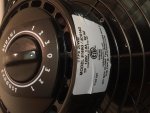
120v Cord & Plug, House exhaust, Window fan.
 
VFDs for Permanent Split Capacitor motors exist, but will likely cost you more than a new fan with speed control included. But if you persist in doing this, in the US you can buy them from a company called Bardac. They are made by a U.K. company called Invertek, but they are only sold through brand label agreements like Bardac here.
 
Thank you immensely, will ckeck out Bardac.

Perhaps for tomarrow, I should also ask if a another type of 120v reversable fan is better suited for simpler speed controls?
 
Most of the residential type ceiling fan/light kits have permanent split capacitor type motors and most are less than 2 amp rated. Switches are purchased at most Electrical Supply Houses complete with instructions. Typically the motor is connected to the highest speed with the speed control connected in series with the hot wire. The type where the switch actually goes click click click seems to work better for me.
 
If you want the fan to go really fast, make sure you get a speed control knob that goes to eleven.


Sent from my iPhone using Tapatalk
 
The motor has two coils inside. The direction switch changes flips the coils relative to each other and the different speeds are actually like transformer taps. Full voltage, reduced voltage and even lower voltage. You wouldn't be able to switch the direction remotely. The speed reduction works like spinning your tires in slush. There is no friction material to wear, but it's just as inefficient and this is why this kind of speed reduction is not used for larger motors. You should be able to use ceiling fan speed control.

You should use a fully variable one like the SFS‑5E It's similar in design to dimmers, but you need to use one made for fans for trouble free operation.
The muti-speed ceiling fan controls are designed specifically for ceiling fan motors and I've seen them not work properly in many general purpose applications. http://www.lutron.com/en-US/Product...ntrols/Skylark/ModelNumbers.aspx#SectionHead7
 
Lutron & Broan both sell ceiling fan speed controls over 1.5A, so tech support was contacted.

Broan tech. support has a 3A speed control, but warned that "Permanent Split Capacitor" motors use capacitors in different ways, so low RPM ceiling fan designs may not follow 1600 RPM window fan designs.

Apparently Permanent Split Capacitor motors can be used for different purposes, with some capacitors not intended for variable voltages. I am told speed controls that change voltage can damage these motors, and was directed to the motor OEM for further info..

The window fan OEM, Air King / Lasco tech. support said speed controls will void the warranty. Support staff seemed familiar with the question, and do not recommend it, but are not familiar with any further technical details, or explanation of capacitor configurations. Further, they did not recommend a different model that was compatible with variable voltage speed controls.
 
Ceiling fan type speed control cuts a capacitor in line.
Variable type like the specific model I mentioned is intended for a wider range of fans, including exhaust fans. What did Lutron say?
 
Agriculture/livestock confinements use up to about 1 hp PSC motors on a variable speed control all the time. Some controls vary speed according to a temp sensor connected to the drive to try to achieve a certain comfort level within the space. Even see multiple stage controllers where stage 1 is a variable speed fan, stage 2 is another variable speed fan, if it is still too warm in the space stage 3 is often just an on /off control but controls an even larger non variable speed fan. Stage 4 and 5 are often heating stages, but even when heating, stage 1 might run at a low speed just to maintain some fresh air exchange.
 
Ceiling fan type speed control cuts a capacitor in line.
Variable type like the specific model I mentioned is intended for a wider range of fans, including exhaust fans. What did Lutron say?

You are correct.
Lutron has a 2-Amp fan-speed control that uses capacitors, rather than voltage regulation.

Lutron single pole, 120 V / 2.0 ASFSQ‑F‑HO is a 3-speed fan switch, not stocked in stores, and not tested with my 1600 RPM fan, but self testing is possible at the fan's highest setting only.

If special ordered, testing may determine if Lutron's control is slower than the built-in 3-position switch of 1600, 1450, & 1100 RMP.
 
All the solid state speed controllers do from basics perspective is shave some of the waveform so it draws current for less time during each cycle, which results in the motor developing less torque.
 
You are correct.
Lutron has a 2-Amp fan-speed control that uses capacitors, rather than voltage regulation.

Lutron single pole, 120 V / 2.0 ASFSQ‑F‑HO is a 3-speed fan switch, not stocked in stores, and not tested with my 1600 RPM fan, but self testing is possible at the fan's highest setting only.

If special ordered, testing may determine if Lutron's control is slower than the built-in 3-position switch of 1600, 1450, & 1100 RMP.

You can't use that one. Notice it's listed for ceiling fan. The SFS-5E is listed for fans, including exhaust fan and this is the one you would have the best success with.

Looks like you have a 4 pole 1800 base with taps set to cause 11, 20, 40% slip. The RPMs are completely load dependent and not hard-linked like mechanical speed control.
 
Lutron tech. support said Voltage varying speed controls will damage my fan, since the capacitors are not designed to vary voltage.
I believe Lutron's SFS-5E varies voltage, if I understood correctly.
 
VFDs for Permanent Split Capacitor motors exist, but will likely cost you more than a new fan with speed control included. But if you persist in doing this, in the US you can buy them from a company called Bardac. They are made by a U.K. company called Invertek, but they are only sold through brand label agreements like Bardac here.

Bardac products are controlled substances, perhaps not by federal mandate like drugs, but privately-controlled substance.

They have 2A 120v VFD's for my fan, but can't sell to me, won't disclose cost, and either can't find or won't provide a distributor.

They asked me if I was a distributor, once I said no, that was it, SOL.
 
Thank you immensely, will ckeck out Bardac.

Perhaps for tomarrow, I should also ask if a another type of 120v reversable fan is better suited for simpler speed controls?
What are you looking for? Looks like the unit already has three forward and three reverse speeds from the control mounted on the unit, which is likely switching three different capacitance values into one winding to get different torque value out of the motor at each speed.
 
Correct, the built-in 3-position switch isn't slow enough, too noisy & overkill for simple circulation when dwelling is empty.

SPEED, HIGH, MED, LOW
....CFM 3560, 3120, 2510
....RPM 1600, 1450, 1100

When dwelling is occupied, lesser fans had failed to keep it cool during hot days, inadequate CPM.
 
Correct, the built-in 3-position switch isn't slow enough, too noisy & overkill for simple circulation when dwelling is empty.

SPEED, HIGH, MED, LOW
....CFM 3560, 3120, 2510
....RPM 1600, 1450, 1100

When dwelling is occupied, lesser fans had failed to keep it cool during hot days, inadequate CPM.
By slowing it down you are effectively making it a lesser fan and may not meet your goals of cooling dwelling down once you slow it down enough to meet desired noise level.

If that is the case you need a different fan design.
 
Status
Not open for further replies.
Top