Water Pipe ground

Merry Christmas
Status
Not open for further replies.
macmikeman said:
Nope, that wouldn't be it cause it contains the word "interior". Thanks anyway, you have helped me to establish my point.

Electrode
The water pipe is only an electrode when it meets ALL the criteria of 250-52(A)(1) and if it does it must also be supplemented as per 250-53(D).

Bonding of Piping Systems and Exposed Structural Steel
The water must be bonded as per 250-104(A) and this bond is sized from table 250-66. This bond can connect anywhere accessible and 5' has nothing to do with this water pipe bond.

These are two different items, they can only be used like one when the electrode is "qualified" and the GEC is sized at 250-66 and connected not more than 5' from the point of entrance in the building.

I think you can connect to it more than 5' outside the building, as long as the pipe remains an electrode, but if it is also the water bond it shall be accessible.

The OP was asking if they can bond anywhere accessible and yes you can bond the water pipe anywhere accessible.
 
If the water pipe qualifes as a GE per 250.52(A)(1) then it is bonded within 5 ft of entrance with some exceptions, 08 adds schools I believe.
If not a GE then it is bonded per 250.104 but the connection must be accessible.
 
I agree with you macmikeman in that the wording in 250-52(A)(1) does not prohibit us from connecting the GEC farther than 5' outside the building.

This can be re-phrased because it may be required, "...from the point of entrance to the building" meaning ahead of the building. There need to be some "English Majors" involved in authoring the NEC!
 
Last edited:
Not trying to poke anybody's eye, just trying to remind many that there is an option, and all to often that option is called incorect by many simply because they always insist that a water pipe gec "must" be attached to within 5' of the entrance to the building" without any exceptions. And a misread by the majority get translated into a "reality", sometimes more difficult installation process mandated than what is really necessary. If I locate an exterior water pipe close to my service that comes out of the ground, is 10 foot or more in contact with the soil and has a place where I can attach an "exposed" clamp, I should not have to run that gec all the way around to another remote spot where that same pipe actually enters the building and hook on within 5 feet of that spot. However I get constantly pressured from inspection authorities to do exactly that and I feel it's because of the common overlooking of the word "interior" as I have already spoken about. And I often read the same instructions given as fact in realm of electrical forums. It is not fact it is error, and I believe I should attempt to point out that error when I see it, unless somebody is able to show me I am wrong about it. If I am, I will have no problem accepting the fact.
 
Wow it seems like you have a real hair across your rear on this and I have no idea why. :-? You are in the 'right'.

Very few areas attach to the water pipe outside and most areas that would be underground.

Here if I wanted to attach the GEC outside I would have to have the EI comeout and inspect it before it was backfilled which would mean cordinating that with the plumbers.

I find it much easier to connect inside, but of course I am in the land of full basements with the panels tyically located just a few feet from the water service. :smile:

All that said it says what it says and there is no reason not to connect it outside if that is what you want.
 
infinity said:
iwire said:
jwelectric said:
This is taught in Elec. 101 and is pretty fundamental with just a little understanding of grounding and bonding.
Why do you have to be like that? You know Trevor is not a newbie.
Thanks Bob, maybe after Mike finishes re-reading his insults he can actually answer the question I asked.

This was not meant as an insult and I apologize if it struck a nerve with anyone. I was simply pointing out that at least I teach this in the first class of electrical installations and it is very fundamental if one understands the difference between connecting to earth and bonding.

iwire said:
jwelectric said:
From the outside to five feet inside metal water pipe is an electrode. In other words the electrode stops at 60 inches after it enters a building or at the first removable device such as a meter, filter, softener or any other device that can be removed. This first five feet is electrode and fall under 250.52(A)(1)
iwire said:
That is not the answer to his question, you had said
iwire said:
Trevor asked this
infinity said:
Mike, Where does it say that the electrode ends at the water meter etc.?
iwire said:
So can you bring me to electric 101 and explain the fundamentals?

At the risk of sounding like I am trying to insult you or Trevor again ??
250.52(A)(1) Interior metal water piping located more than 1.52 m (5 ft) from the point of entrance to the building shall not be used as a part of the grounding electrode system or as a conductor to interconnect electrodes that are part of the grounding electrode system.
There is an exception that will let a system that is part of an installation that has a program that ensures that only qualified persons service ?..

Now that we have established that the first five feet is allowed to be the connection point for the grounding electrode conductor to the electrode let?s address the removable devices such as meters, filters and such devices.

In 250.53(D)(1) we are told, Continuity. Continuity of the grounding path or the bonding connection to interior piping shall not rely on water meters or filtering devices and similar equipment.

This section will let us bond the interior part of a metal piping system as outlined in 250.104 by bonding across the removable device but I don?t see anything that allows the connection to the electrode itself by this bonding.

As outlined in 250.64(C) the grounding electrode conductor must be continuous unless it is a bonding jumper from one electrode to another as outlined in 250.53(C) in which case 250.52(A)(1) again requires this to take place within the first five feet of the entry of the water pipe if the pipe is part of the electrode system.
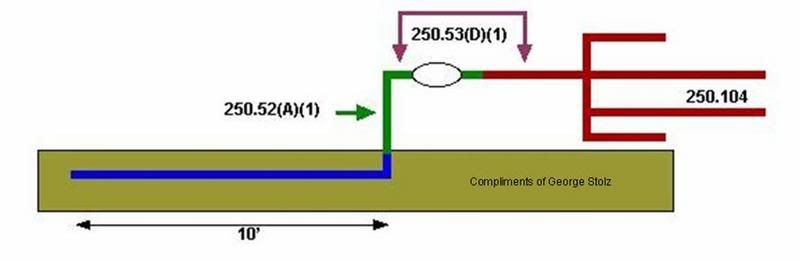
The first five feet of continuous water pipe after entry can be used to terminate the grounding electrode conductor or to the first removable device.

In the illustration below the correct manner to install a grounding electrode conductor as outlined in 250.52(A)(1) and the bonding conductor as outlined in 250.104 is made using section 250.53(D)(1).

complimantsofGeroge.jpg


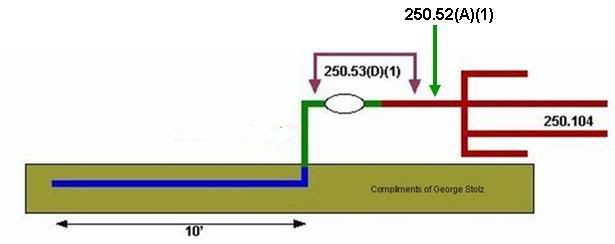
What would not be allowed to be done is to move the grounding electrode conductor (250.52(A)(1)) from the electrode side of the meter and install it on the interior side of the meter or on the red pipe.

electrodeconnection.jpg


The removable device even if it is within the first 12 inches stops the grounding electrode and starts the interior part of the piping system.
 
iwire said:
Very few areas attach to the water pipe outside and most areas that would be underground.

Here if I wanted to attach the GEC outside I would have to have the EI comeout and inspect it before it was backfilled which would mean cordinating that with the plumbers.

I find it much easier to connect inside, but of course I am in the land of full basements with the panels tyically located just a few feet from the water service. :smile:

All that said it says what it says and there is no reason not to connect it outside if that is what you want.

Here in CA we are mostly on slabs, so just outside is
often the only accessible location close to the entry
if there is metal water service unless we want to
put an access panel in the wall where the water
service enters.
 
rexowner said:
Here in CA we are mostly on slabs, so just outside is
often the only accessible location

The connection to a buried electrode is not required to be accessible.

Exception 1 250.68
 
Mike as you know I have ADD.

So to keep it simple I can run the GEC to a point 59" in from the entrance regardless of any meters, filters etc.

All I have to do is jump them.
 
Your right Bob, I do have a hair about it. Lets just say I have had to install a few "lightning rods", I mean gec's thru dwelling attics from one side of the structure to the complete opposite corner for no real compelling reason other than to pass inspection, and that time consuming offense is what bites my rear. I know most of you guys have basements and your service disconect is inside, but not all area's are like that. When I started out in this trade it was very common to hear the phrase repeated " electricity follows the path of least resistance". I remember hearing it from the vocational school instructor first. Then also from a huge majority of the senior peers on jobsites and in the trades. It wasn't true then nor now, but most accepted it because it was repeated as fact so often. Same goes for the misquote of 250-52.
 
jwelectric said:
This was not meant as an insult and I apologize if it struck a nerve with anyone. I was simply pointing out that at least I teach this in the first class of electrical installations and it is very fundamental if one understands the difference between connecting to earth and bonding.

Mike if you keep that up I will just ignore you.

You are well aware that both Trevor and I understand grounding and bonding.


At the risk of sounding like I am trying to insult you or Trevor again …

You mean for a third time?

250.52(A)(1) Interior metal water piping located more than 1.52 m (5 ft) from the point of entrance to the building shall not be used as a part of the grounding electrode system or as a conductor to interconnect electrodes that are part of the grounding electrode system.
There is an exception that will let a system that is part of an installation that has a program that ensures that only qualified persons service …..
No one has disputed that at all.

In 250.53(D)(1) we are told, Continuity. Continuity of the grounding path or the bonding connection to interior piping shall not rely on water meters or filtering devices and similar equipment.
No one has disputed that.


This section will let us bond the interior part of a metal piping system as outlined in 250.104 by bonding across the removable device but I don’t see anything that allows the connection to the electrode itself by this bonding.

I do not need permission for what is not prohibited. 250.104 is not saying it is OK to use jumpers, it says we must use jumpers.

The removable device even if it is within the first 12 inches stops the grounding electrode and starts the interior part of the piping system.

That is false, there is nothing in the NEC to back that view.
 
iwire said:
Mike as you know I have ADD. So to keep it simple I can run the GEC to a point 59" in from the entrance regardless of any meters, filters etc. All I have to do is jump them.

No this is not true. The grounding electrode conductor must be connected to the electrode or a bus that meets the requirements of 250.64(C)(3)

iwire said:
Mike if you keep that up I will just ignore you.
iwire said:
You mean for a third time?
I am doing everything I know how to say that I am not trying to be insulting.

If you want to disagree with me I have no objection to you disagreeing.
 
From the Original Post:
If you use an ufer ground as your primary electrode, do you still need to bond the water system within 5 feet of its entrance to the building?

Just for clarity.....

Rolling around in my mental archives is the term, All avaiable electrodes must be used. It got in there from somewhere. Not sure where.

If the water pipe is the so called primary electrode as the OP called it, is the ufer considered a supplemental electrode? That being if the water pipe meets the qualifications of an electrode, meaning length has been verified?
 
jwelectric said:
No this is not true. The grounding electrode conductor must be connected to the electrode or a bus that meets the requirements of 250.64(C)(3)
Mike, IMO, the electrode includes the water meter and the piping running into the interior of the building, into eternity.

We are restricted in what portion of that electrode we are permitted to connect to.

When we connect to the electrode on the "load" side of the water meter, then we are required to install a jumper to maintain the integrity of the GEC's connection to the business end of that grounding electrode. We are also required to install a jumper to maintain the bonding connection from the GEC to the interior piping. These two jumpers are normally one and the same.

Do you dispute any of these statements, and if so, why? :)
 
frizbeedog said:
If the water pipe is the so called primary electrode as the OP called it, is the ufer considered a supplemental electrode?

There is no NEC support for the "primary/secondary" electrode concept - all electrodes are required to be used, as you stated. The fact that the Ufer exists simply means we don't have to install a "made" electrode to supplement the water pipe, since the water pipe is required to be supplemented by something.
 
georgestolz said:
There is no NEC support for the "primary/secondary" electrode concept - all electrodes are required to be used, as you stated. The fact that the Ufer exists simply means we don't have to install a "made" electrode to supplement the water pipe, since the water pipe is required to be supplemented by something.

OK .
 
iwire said:
Mike as you know I have ADD.

So to keep it simple I can run the GEC to a point 59" in from the entrance regardless of any meters, filters etc.

All I have to do is jump them.

I agree Bob and that's all that I was asking. Where does it say that you can't use a jumper around the device to provide the continuity? I don't believe it says that.
 
Status
Not open for further replies.
Top