So Why Doesn’t My Contactor Work?

rather hard to tell if your system will work for the contactor. what is the activated voltage for the coil? do you have that voltage in the cabinet available to go through the timer contacts? cant really tell what is going on with the red and black wires connected to the contactor coil.
 
New contactor looks to be electrically held, only the relay can be deleted, and power straight off the time clock. Unlike the old contactor, the coil is not dual voltage, and it appears you are tapping 208 for the controls. Look on the side or between the coil terminals to check its voltage. If it is a dc coil, it will not work also.
 
Hard to tell from the picture, it looks like you have a black wire on one side of the coil, and nothing on the other. If the black and red wires lugged under the line side go to the relay, that is part of the problem.
 
So what is supplying the pulse? It’s just a standard Intermatic digital timer, connected to a LV relay.

The system is pretty simple: I have 3 phase input off an MCB, 3 phase output to a backfed breaker in a panel with all the lighting, and a digital timer.

I *should* be able to just place a contactor in the circuit, and control it with a timer. Regardless of what was there before. Why not?
You are correct, a mechanically held contactor rarely ever needs a pulse, although it can be controlled by one.

The original contactor shows a black and white wire for the close control, and a red and white wire for the open. This was probably a 120V circuit.
You new contactor shows a black and red wire for the coil.
Check you are getting the proper voltage.

If you push in the center "bump" in your new contactor you should be able to move it's mechanism. If the coil has "melted" it may be pinching the mechanism and keeping it from moving.
 
You are correct, a mechanically held contactor rarely ever needs a pulse, although it can be controlled by one.

The original contactor shows a black and white wire for the close control, and a red and white wire for the open. This was probably a 120V circuit.
You new contactor shows a black and red wire for the coil.
Check you are getting the proper voltage.

If you push in the center "bump" in your new contactor you should be able to move it's mechanism. If the coil has "melted" it may be pinching the mechanism and keeping it from moving.
Most likely the wrong coil voltage, existing voltage applied, letting out the magic smoke.
 
You are correct, a mechanically held contactor rarely ever needs a pulse, although it can be controlled by one.
Technically, and here we are often very technical. A mechanically held contactor always needs a pulse to open or close. IF you wish to control it with a constant on/off signal additional components are required. I still remember the first time I discovered this it was ASCO and the component was an accessory 47 which will still come up on Google (which didn't exist then) as to what it does. So, one must, at a minimum request a mechanically held contactor with 2 wire control, or be more specific about the other parts, or expect to have the above problem.

I do agree that most of the time, 2 wire control is needed for typical commercial applications.
 
Technically, and here we are often very technical. A mechanically held contactor always needs a pulse to open or close. IF you wish to control it with a constant on/off signal additional components are required. I still remember the first time I discovered this it was ASCO and the component was an accessory 47 which will still come up on Google (which didn't exist then) as to what it does. So, one must, at a minimum request a mechanically held contactor with 2 wire control, or be more specific about the other parts, or expect to have the above problem.

I do agree that most of the time, 2 wire control is needed for typical commercial applications.
Most have built in clearing contacts, but there are still manufacturers that need a pulse kit. The cheap GE ones still do, I think ASCO makes them, but also carries the Siemens name too.
 
100A MCB in adjacent panel.

Feeder goes to panel board. Here it splits. One feeder to bottom panel, 120V SP breaker feeds timer.

Rest is direct feed to line side of contactor. Load side of contactor feeds upper panel, with all individual lighting breakers.

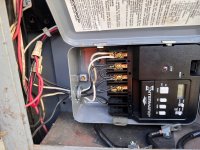
Out of timer is the two switch legs, standard, and a neutral, to line side of relay. Load side of relay is black and red. 12” away, someone extended the red wire with A piece of black, and the black with a piece of red. Why I don’t know.

The output of this relay is shown as 30VDC. Red and black land on A1 and A2 of new contactor.

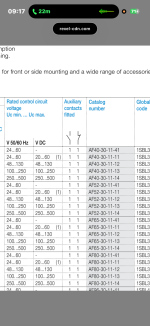
New contactor is an ABB AF-52-30-11-13. My supplier found it for me, based on needing a 3 phase contactor for 208Y, at minimum 75 Amps, as that is what was there before. Box says 100-250VAC. Worthless papers shipped in the box show short circuit rating for 480 and 600 volts.

I cannot seem to find any info on what the required input voltage on the control circuit is. When I called them yesterday at 1:00 in the afternoon, they were already closed. 😡
I did find one website where it said input voltage on the control circuit is 20-60VDC, and 24-60VAC. I usually just run the control wires from the Intermatic direct to the A1 and A2, but I can’t seem to confirm this is what this contactor can handle.

 
100A MCB in adjacent panel.

Feeder goes to panel board. Here it splits. One feeder to bottom panel, 120V SP breaker feeds timer.

Rest is direct feed to line side of contactor. Load side of contactor feeds upper panel, with all individual lighting breakers.

Out of timer is the two switch legs, standard, and a neutral, to line side of relay. Load side of relay is black and red. 12” away, someone extended the red wire with A piece of black, and the black with a piece of red. Why I don’t know.

The output of this relay is shown as 30VDC. Red and black land on A1 and A2 of new contactor.

New contactor is an ABB AF-52-30-11-13. My supplier found it for me, based on needing a 3 phase contactor for 208Y, at minimum 75 Amps, as that is what was there before. Box says 100-250VAC. Worthless papers shipped in the box show short circuit rating for 480 and 600 volts.

I cannot seem to find any info on what the required input voltage on the control circuit is. When I called them yesterday at 1:00 in the afternoon, they were already closed. 😡
I did find one website where it said input voltage on the control circuit is 20-60VDC, and 24-60VAC. I usually just run the control wires from the Intermatic direct to the A1 and A2, but I can’t seem to confirm this is what this contactor can handle.
Are you measuring the voltage across the black and red? If so you are reading phantom voltages since there should not be any voltage between them. The black should read 120 volts to the white when the contactor is told to close by the time clock and the red should read 120 volts to white when the contactor is told to open.

If the current set up provides a constant voltage your new contractor should be connected to the black and white. If the current setup provides a pulsed voltage you will need to make some modifications to use the new contactor.
 
Are you measuring the voltage across the black and red? If so you are reading phantom voltages since there should not be any voltage between them. The black should read 120 volts to the white when the contactor is told to close by the time clock and the red should read 120 volts to white when the contactor is told to open.

If the current set up provides a constant voltage your new contractor should be connected to the black and white. If the current setup provides a pulsed voltage you will need to make some modifications to use the new contactor.


No I didn’t check voltage on control wires/ A1-A2.

I have good voltage on line side of contactor, I have 120V into timer.

I bypassed the contactor and all the lights come on fine.

I’m guessing that it’s the LV relay that is messing things up, but until I can confirm the contactor can take line voltage I’m reluctant to try it.

I currently on eternal hold with ABB
 
Then your contactor is jammed. Time for a new one.
I have seen several coils that have melted due to having the wrong voltage applied.

Open the time clock and chase through the contacts and wiring.

Time clock looks fine. It’s wired as it should be. It’s just run through a relay.

Voltage is 120 on the input of the relay.

IMG_8336.jpeg
 
Your original contactor had a 110-277 volt coil. It would not work off of low voltage DC.

The original contactor closed when the black wire was energized 120V and opened when the red wire was energized 120V.

You connected the black and red to the new coil. These wires will never have 120V between them unless you made other modifications.

Check voltage between black and white the red and white.
 
What would make you think a coil would be melted on a brand new contactor that has never been used?

Only thing that has been done to it is power input, and LV control input.
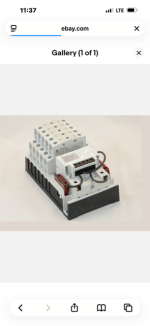
It’s either melted from the wrong voltage applied, or defective from the factory. The white bar should easily push in, and return out on its own. It is made to attach auxiliary contacts to, and activate those contacts when the coil is energized. Can you get a better picture of the contact block on the bottom? That should be the coil. Where the red and black wires are now, are power terminal screws for providing power to the control circuit off the line side. I will see if I can get a 360 picture of that contactor to be sure.
 
Top