So Why Doesn’t My Contactor Work?

A quick note on replacing lighting contactors UL used to use terms like 'Electronic Ballast' or 'Tungsten' Manufacturers like ABB have long ago switched to IEC terminology so simplify labeling around the globe, IEC 60947-4-1 standard in particular.
All you need to know is look at the AC-5a (Electric discharge lamp controls) or AC-5b (Incandescent lamps). This is due to the Inrush even though LEDs pull very little power while running, the drivers inside them have capacitors that charge up instantly when the timer flips the switch. This creates an Inrush Current that can be 20 to 100 times the running current for a few milliseconds. ABB might provide a specific "Lighting" table in their extended technical catalog. For LED or old MH loads, you use the AC-5a rating or look for a "Max. lamps per contactor" chart.
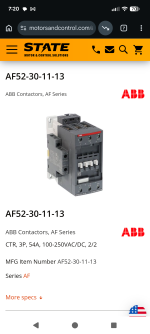
Since AC-5a closely matches the AC-3 (Motor) rating withing a amp or two, without digging thru catalogues you can see your contactor is good for a 53A lighting load right where it says:
Rated Operational Current AC-3 (Ie): (220 / 230 / 240 V) 60 °C 53 A
When I order them from a counter person at a supply house I ask for AC-3 or AC-5a rating of x many amps.

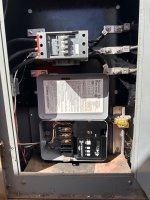
As others have noted the Russelectric RCS-753 Bulletin RCS was a 3 wire control the ABB one is a two wire control, for the two wire contol you simply need to provide 120V from the time clock to the coils of the ABB, omit the ice cube that was generating the 3 wire, and go from the 120V time clock to the coil. you might consider adding a snubber.
 
It looks like the coil is missing, if I’m not mistaken, the coil voltage appears in that window between the terminals.

Found a 360 view online, didn’t see a coil voltage anywhere. I wouldn’t think they would ship without a coil, but GE does ship the Spectra breakers without a rating plug, and since ABB is part of GE now, I wouldn’t doubt it! LOL!
 
🥵

Hour and a half later I finally get someone from tech support from ABB, and he can’t find info on coil voltage. 😡😡🙄

Says he’s finding both 24-60v and 100-250.

Has to look it up and email me. My money is on it being line voltage, and I need to eliminate the ice cube control relay.

I’ll keep y’all’s posted. I really appreciate all the help.
 
I am pretty sure that ABB line are universal voltage coils, it looked from your photo you had 'On' and 'Off' from the old 3-wire control going to the new ABB coil. Verify the time clock is 120V and go from it to the coil.
post some photos of the Russel unit you removed, but I think those are 120-277 control voltage, and the ice cube, I suspect its a 120V coil controlled by the 120V intermatic time clock using NO and NC to generate ON and OFF for the Russel unit. Perhaps also there is or was a photo eye hard to guess form here.
 
is it not a problem that the original switch was pulse on or off (with intermatic controlling that) but now using a standard contactor that needs a constant coil voltage? seems like you need a new timer control that feeds On 120v signal during night and Off no 120v during day.
 
is it not a problem that the original switch was pulse on or off (with intermatic controlling that) but now using a standard contactor that needs a constant coil voltage? seems like you need a new timer control that feeds On 120v signal during night and Off no 120v during day.
From the looks of that intermatic timer clock I'd wage thats exactly what that does, The ICE cube relay was probably switching the neutral hence only 4 wires to the relay.
 
is it not a problem that the original switch was pulse on or off (with intermatic controlling that) but now using a standard contactor that needs a constant coil voltage? seems like you need a new timer control that feeds On 120v signal during night and Off no 120v during day.
If that was the case, the cube relay would not have been needed. Old Kmarts used those pulse time clocks, much larger than that one. They used two programmable outputs, one for latch, the other for unlatch.
 
The old contactor had a 120v coil. It was a mechanically held contactor, with continuous power on open or close. The timeclock fires the coil of the ice cube relay, so when the clock energizes the output, it fires the coil and the normally open contact closes and closes the old contactor. When the time clock shuts off, the coil of the ice cube relay shuts off, and the normally closed contact closes, powering the "open" of the lighting contactor.

You need a contactor with a 120v coil, and wire the "close" wire from the old contactor and the neutral to the new contactor coil. That or wire the coil right from the time clock and throw away the ice cube relay.
 
Also, your abb contactor had a 120v coil so you are good.

Just pull the black and white going to the coil of the ice cube relay, and swing them up to the coil of your ABB contactor. The black wire behind the black and white of the ice cube relay coil wires is a constant hot common, probably wire nutted by the timeclock.
 

Attachments

  • Screenshot_20260319-192003.png
    Screenshot_20260319-192003.png
    432 KB · Views: 3
The only ones I have used in the past 35 years that didn’t have clearing contacts, was the one I pictured. I have used GE, Square D, Siemens and ASCO. ASCO has a model that looks like a heat sink with a coil in the center. Siemens, GE and Square D all put their name on it. Those have a single coil.
I am just saying that the clearing contacts are an option, not integral with the contactor. In your area, or dealing with your company, maybe your supply house are smart enough to automatically include that option when supplying to you, but you can get those contactors without the accessory. I am not trying to "win" and argument, but pointing out that novices must be aware of the component so they don't have the same issues that the OP did.
 
no disrespect intended, but how do you know the old contactor was bad, if you are unsure of how it was supposed to run in the first place?

is it possible that there was simply an input issue to the old contactor controls, and that was why it stopped operating correctly? or was there some other tell that led you to believe the contactor needed to be replaced?

 
Thanks for all the help.

ABB got me info, it is a 120V input. Even tech support was confused, because he was finding both LV and line voltage instructions. But it is in fact a simple 120V coil.

I just removed the control relay and direct wired it and everything is grand.


IMG_8352.jpeg
 
no disrespect intended, but how do you know the old contactor was bad, if you are unsure of how it was supposed to run in the first place?

is it possible that there was simply an input issue to the old contactor controls, and that was why it stopped operating correctly? or was there some other tell that led you to believe the contactor needed to be replaced?


I inherited this shopping complex from a previous electrician. I got the call that lights were out. The previous electrician told me that they have been having problems with the contactor for years, and he has to go and “wiggle”’it and manually switch it off and on to get it to work.

I reset everything, set the timer to turn on, couple times it wouldn’t switch, sometimes it would, and one time the contactor let out a fair amount of magic smoke while trying to close.

I replaced the contactor and relamped the entire parking lot with LED bypass and removed the mercury vapor lights.

As of this morning it’s all working as it should.


2909959374182122362.jpeg
 
I inherited this shopping complex from a previous electrician. I got the call that lights were out. The previous electrician told me that they have been having problems with the contactor for years, and he has to go and “wiggle”’it and manually switch it off and on to get it to work.

I reset everything, set the timer to turn on, couple times it wouldn’t switch, sometimes it would, and one time the contactor let out a fair amount of magic smoke while trying to close.

I replaced the contactor and relamped the entire parking lot with LED bypass and removed the mercury vapor lights.

As of this morning it’s all working as it should.


View attachment 2582436
Probably the mechanism was getting worn, and the clearing contacts were not making/breaking like they should. I’ve had them bind up, and not open and close like they should because of the grease drying up. One contact opens, but the travel stops too soon, and doesn’t close the interock. Get that a lot on transferswitches that work on the same principle.
 
Top